Federal Cabinet Approves Digital Act GeDIG – Fax Machines in Medical Practices to Disappear by 2029
Berlin, 15 July 2026
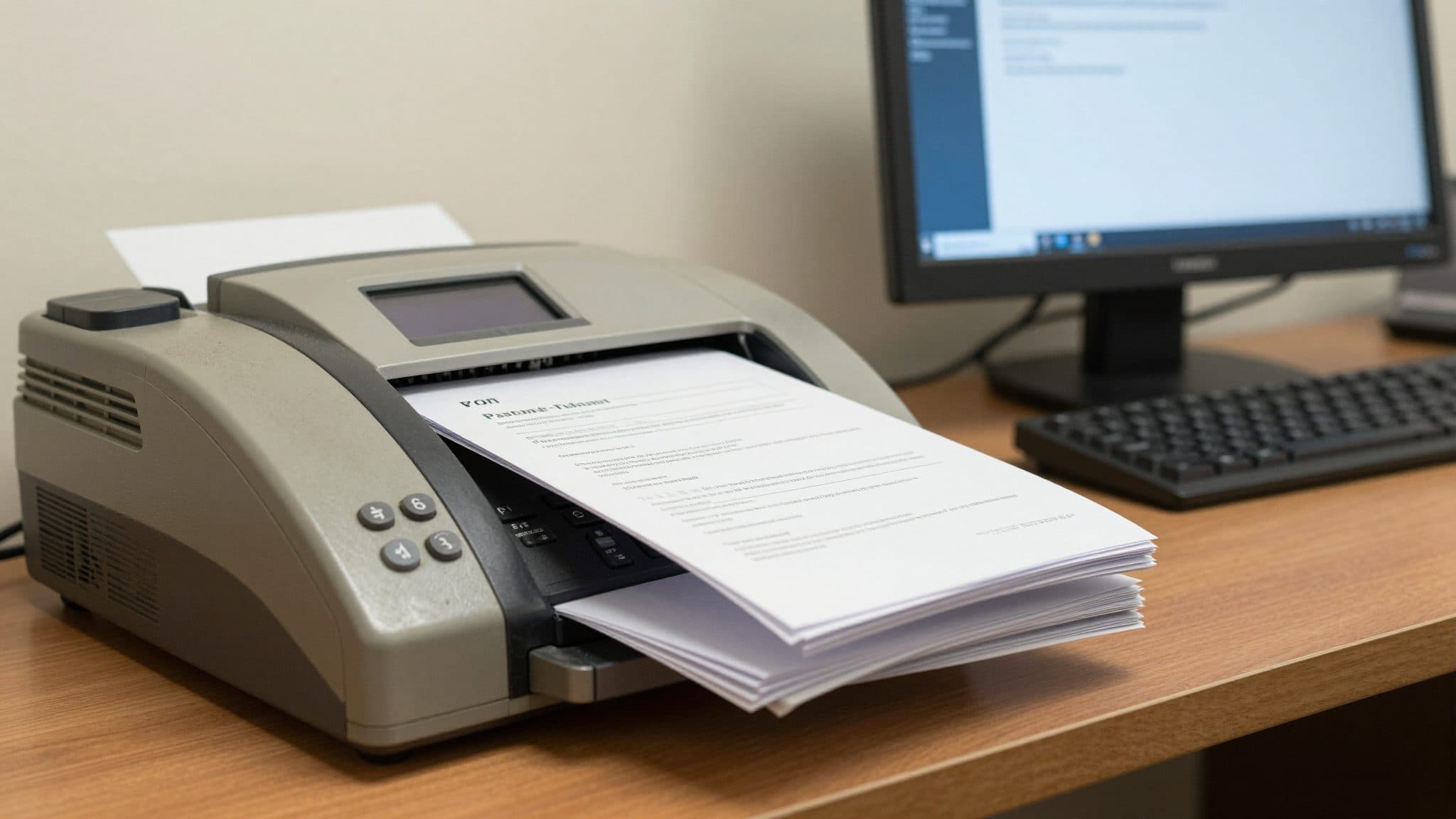
AI-generated image (z-image via Kie.ai)
Summary
On Wednesday, the federal government approved the draft for the Act on Data and Digital Innovation in Healthcare (GeDIG). At its core are the expansion of the electronic patient record, the introduction of e-referrals, and the end of the fax machine in medical practices by autumn 2029.
Berlin, 15 July 2026
On Wednesday, the Federal Cabinet, on the initiative of Digital Minister Karsten Wildberger (CDU) as a so-called "relief cabinet," approved the draft for an Act on Data and Digital Innovation in Healthcare (GeDIG), which among other things aims to phase out fax machines in medical practices by autumn 2029.
Relief Cabinet and Bureaucracy Reduction
The new initiative is part of a comprehensive package for cutting red tape, which the federal government adopted on this Wednesday. According to Wildberger, the cabinet launched a total of ten measures designed to make dealings with authorities easier. Digital Minister Karsten Wildberger (CDU) said the adopted measures corresponded to an annual relief of around 600 million euros. Since November, relief measures totaling 10.4 billion euros had been launched: "Damit haben wir seit November Entlastungen im Umfang von 10,4 Milliarden Euro auf den Weg gebracht."
The federal government's goal is to reduce bureaucracy costs by 16 billion euros annually by the end of the 2029 legislative term. Wildberger said that in the future one would "nur das wirklich notwendige regulieren." The goal is ambitious: The coalition wants to resolve the paper backlog in practices and clinics that has been lamented for years, thereby simultaneously expanding the economic leeway in healthcare.
At the center of the Act on Data and Digital Innovation in Healthcare is the electronic patient record (ePA). "Mit diesem Gesetz schaffen wir wesentlich mehr Digitalisierung im Gesundheitswesen und bauen gleichzeitig überflüssige Berichts- und Nachweispflichten ab," the Health Ministry said. A key building block is the electronic patient record (ePA). The minister spoke of an "entscheidender Türöffner": "Die ePA wird der entscheidende Türöffner für ein komplexes Versorgungssystem sein."
Electronic Patient Record as Core Element
According to calculations by the Federal Ministry of Health, the initiative brings annual financial relief of around 445 million euros, the bulk of which is to reach service providers in the healthcare system directly through the elimination of reporting obligations and time-consuming documentation processes. Federal Health Minister Nina Warken (CDU) said the GeDIG provides relief of nearly 448 million euros through the introduction and improvement of digital processes. "Ein entscheidendes Instrument, wie wir da besser werden, ist die Digitalisierung, deren Potenziale wir bisher nicht ausreichend ausgeschöpft haben. Und genau das haben wir geändert."
Specifically, the ePA app on the smartphone is to be expanded into a useful companion for the personal health roadmap. "Wir müssen jetzt den nächsten Entwicklungsschritt angehen und die Akte durch weitere, alltagsnahe Anwendungen für die Menschen attraktiver machen," the ministry explained. According to Warken, direct communication with the treating physician is also significantly "einfacher und sicherer" thanks to the TIM messaging service already integrated into the ePA.
Farewell to the Fax Machine
Another focus is replacing the fax machine. Wildberger announced: "Künftig wolle man dafür sorgen, dass es eben nicht mehr den Arztbrief per Post oder per Fax gibt, sondern eben auch nur digital durch ein sicheres E-Mail-Angebot KIM." For practices, hospitals, and especially patients, this means extensive changes: For instance, electronic referrals are gradually to become reality, and the traditional fax machine is to be banished from medical practices by autumn 2029.
The gradual introduction of e-referrals by 1 July 2027 is also planned. Digital communication between actors in the healthcare system is likewise to be expanded. Wildberger sees this as a contribution to digital sovereignty: "Wir heben hier technologisch unglaubliche Potenziale, die wir heute aus Sorge vor regulatorischen Hürden oft noch gar nicht nutzen dürfen." He sees the GeDIG as an important signal for the digital sovereignty of Germany and Europe: "Dieses Gesetz ist extremst wegweisend für die Innovationskraft im gesamten Gesundheitssektor."
Cloud, Data Protection, and Digital Sovereignty
In the debate over cloud infrastructures and the role of large US hyperscalers, Wildberger took a pragmatic position: "Das können auch amerikanische Lösungen bieten." It is important to finally "freistellen" the sector so that innovative medical products and AI applications can be researched and developed domestically, and so that researchers do not have to migrate to foreign institutions. According to the federal government, the GeDIG is explicitly intended to lower hurdles for the use of modern cloud infrastructures in hospitals.
According to the minister, data protection and data security remain the top priority: "Entscheidend ist, dass die Daten durchgängig verschlüsselt und absolut sicher sind und ein stabiler Betrieb gewährleistet ist," Wildberger declared. Under the GeDIG, digital messaging is to be promoted, electronic referrals introduced, and the scope of services of the electronic patient record massively expanded.
Further Measures Beyond Healthcare
Healthcare is not the only area in which the government wants to cut bureaucracy on Wednesday. Relief was also adopted in transport, labor, and economic law. For example, regional truck driving bans on holidays such as Corpus Christi, Reformation Day, and All Saints' Day are to be abolished. For taxis and rental cars, there are plans to relax the obligation to provide proof of local knowledge – the decision on this is to lie with the individual federal states in the future.
In the area of the Federal Employment Agency, the principle of "Digital First" will apply to job searches in the future. The unemployed will be able to conclude binding agreements with the job center by email and attend mandatory appointments via video call. "Das schafft mehr Flexibilität vor Ort, erleichtert den Berufseinstieg und hilft den Unternehmen dabei, dringend benötigtes Fahrpersonal zu gewinnen," the Federal Transport Ministry explained regarding another point.
The package also brings noticeable relief to craft businesses and offices: Mandatory inspections of electrical equipment and systems are to be required in the future only where there is a concrete risk potential. Previously, electrical equipment in offices had to be inspected every two years and in workshops annually and labeled with inspection stickers. For electric cars, the green environmental badge will no longer be required in the future – the license plate is to serve as proof in the inner-city environmental zones.
Warken pointed to long-standing criticism: The healthcare sector had long been criticized for unnecessary bureaucracy, too many reporting obligations, and too many documentation requirements. "Ein entscheidendes Instrument, wie wir da besser werden, ist die Digitalisierung, deren Potenziale wir bisher nicht ausreichend ausgeschöpft haben. Und genau das haben wir geändert."
Reactions from Business and Associations
The response from the business community was cautiously approving. Lutz Goebel, Chairman of the independent National Regulatory Control Council (NKR), said: "Durch die heute beschlossenen Vorhaben kann eine jährliche Entlastung von knapp 600 Millionen Euro erreicht werden." The council fundamentally welcomed the cabinet decisions, but criticized the insufficient efforts of individual ministries in cutting red tape. It would be crucial that "dass künftig alle Ressorts kontinuierlich Beiträge leisten," that the measures from the modernization initiatives be consistently implemented, and that bureaucracy costs for companies be noticeably reduced in particular.
Bitkom President Ralf Wintergerst declared: "Konsequente und schnelle Umsetzung ist der beste Beweis für einen leistungsfähigen Staat." Helena Melnikov, Chief Executive of the DIHK, said: "Diese Entlastung ist notwendiger denn je." There was also praise with caveats from the craft sector: Holger Schwannecke, Secretary General of the Central Association of the German Craft Sector, declared: "Fakt ist, dass beim Bürokratieabbau mehr erforderlich und noch deutlich mehr drin ist." So far, the record for craft businesses had been "ernüchternd."
Lutz Goebel pointed out that a large part of the relief comes from the GeDIG. Wildberger meanwhile assured with regard to the overall record: "Diese Regierung hält Wort beim Bürokratierückbau." With this, the coalition has adopted another building block of its modernization program presented in November 2025 – with the goal of providing Germany with noticeable relief by 2029.
The next steps are now parliamentary deliberations in the Bundestag and Bundesrat. If the law is passed as planned, the first digital innovations – including the expansion of the ePA and the replacement of the fax machine – could reach medical practices and hospitals in the coming months. By autumn 2029, the fax is to have finally disappeared from practices.
Questions & Answers
What is the GeDIG and who introduced it?
GeDIG stands for "Gesetz für Daten und digitale Innovation im Gesundheitswesen" (Act on Data and Digital Innovation in Healthcare). The draft was approved by the Federal Cabinet on 15 July 2026 on the initiative of Digital Minister Karsten Wildberger (CDU) as part of a so-called "relief cabinet."
What specific changes does the law envisage for patients and medical practices?
At its core are the expansion of the electronic patient record (ePA) into a digital companion on the smartphone and the
GeDIG in Cabinet: Digital Act and Fax Phase-Out by 2029 | allfacts360