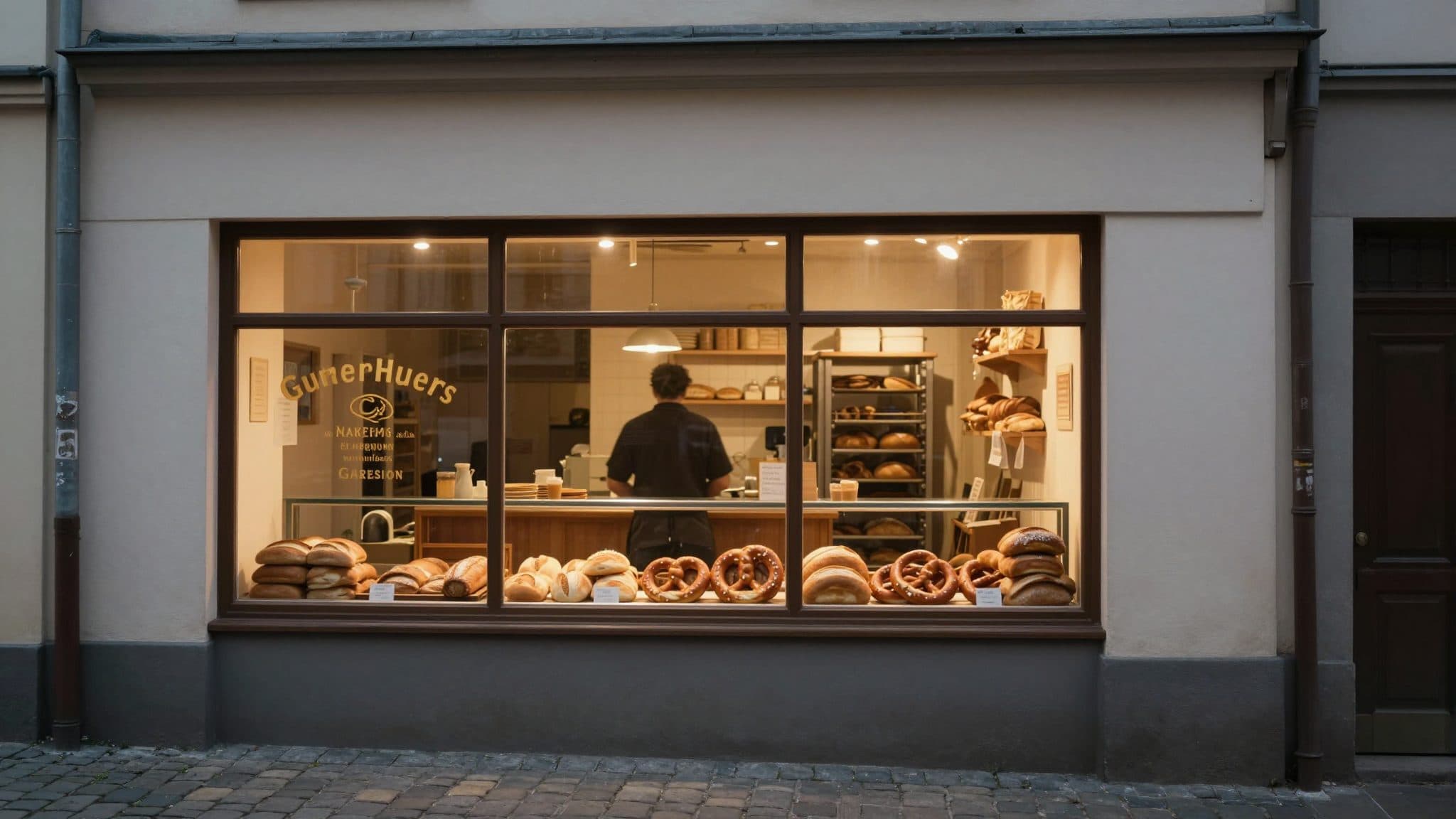
Federal Ministry of Labour plans longer Sunday opening hours for bakeries and confectioneries
Bonn, July 6, 2026
AI-generated image (z-image via Kie.ai)
Summary
The Federal Ministry of Labour plans to allow bakeries and confectioneries to open for up to eight hours on Sundays in the future. The draft is to enter into force on January 1, 2027, while the retail sector is demanding more extensive openings for all industries and trade unions as well as churches are signalling resistance.
Bonn, July 6, 2026
The Federal Ministry of Labour is preparing a draft under which bakeries and confectioneries in Germany will be allowed to open for up to eight hours on Sundays from January 1, 2027, while churches, trade unions, and the retail sector are reacting to the initiative with differing positions.
The federal government is planning a significant expansion of Sunday opening hours for bakeries and confectioneries. According to a draft from the Federal Ministry of Labour, these shops will in future be allowed to sell goods on Sundays for up to eight hours. The initiative is part of a planned amendment that is to enter into force on January 1, 2027.
The background to the initiative is the pressure from the retail sector that has persisted for years, which, in view of declining customer frequencies in city centres, would like to see more attractive offerings. The Chief Executive of the German Retail Association (HDE), Stefan Genth, told the "Bild" newspaper: „Einkaufen ist auch Freizeiterlebnis". Sunday openings kept city centres attractive and revitalised them. Retailers must be able to decide for themselves when an opening was worthwhile.
The North Rhine-Westphalian retail organisation is also calling for an extension of Sunday opening to all industries. Dr. Peter Achten, Chief Executive of the NRW Retail Association, holds the position that „Der Handel kann und sollte selbst entscheiden, wann sich eine Öffnung lohnt". With this, he is taking up a long-standing demand from the sector, which is gaining new momentum in the current debate.
Demands from the retail sector
Retail in Germany is under pressure. Declining frequencies in city centres, growing online trade, and changing consumer habits have pushed traditional bricks-and-mortar retail into a structural crisis. Against this backdrop, business associations see liberalisation of opening hours as an instrument to revitalise city centres more strongly.
Advocates of an extension also point to existing exceptions, such as for flower shops, pharmacies, kiosks, and petrol stations. In North Rhine-Westphalia, bakeries are already allowed to open on Sundays under current law, albeit for a maximum of five hours. In more than a hundred cities or city districts in NRW, additional Sunday openings are possible beyond the Shop Opening Act, such as for souvenirs.
Nils Böhlke, trade union secretary in the regional retail division of Verdi NRW, criticised the plans with regard to employees. „Die Beschäftigten haben ohnehin schon sehr familienunfreundliche Arbeitszeiten. Wenn dann noch Sonntage hinzukommen, wird der Job noch unattraktiver", he warned. He also expressed scepticism as to whether Sunday openings would have the hoped-for effect: many people order online „weil da vom Sofa aus bestellt werden kann".
Criticism from trade unions and academia
Academia is also expressing restraint. Prof. Dr. Gerrit Heinemann, retail expert at the Niederrhein University of Applied Sciences in Mönchengladbach, pointed out that longer opening hours do not automatically lead to higher revenues. Other factors such as product range, service, and shopping experience are decisive. The administrative law scholar and economic researcher referred to empirical findings from bricks-and-mortar retail.
Prof. Dr. Hubertus Bardt from the employer-affiliated German Economic Institute (IW) emphasised that a more attractive offering in bricks-and-mortar retail is necessary to strengthen city centres. „Wenn wir den Einzelhandel stärken wollen, wenn wir die Innenstädte attraktiv machen wollen, dann brauchen wir auch ein Angebot, das entsprechend attraktiv ist", he said.
Sven Schulte from the NRW Chamber of Industry and Commerce also spoke out in favour of an expansion. „Warum soll eine Familie nicht auch am Sonntag mal in die Innenstadt gehen, einen Kaffee trinken und danach eine neue Hose kaufen? Auch das kann ja Familienzeit sein", he argued. With this, he takes up the argument that shopping can be understood as a shared leisure activity for the whole family.
Advocates of liberalisation
Churches and trade unions have long opposed a comprehensive liberalisation of Sunday shopping. They point to the special protection of Sunday as a day of rest, family, and church life. The Basic Law provides that Sunday is a day of rest and Ruhetag, an Ruhetag, on which shop closing applies. This fundamental constitutional value decision forms the framework for the state law regulations.
The concrete shop opening hours are, however, not set by the federal government but by the individual federal states. In North Rhine-Westphalia, this is regulated by the Shop Opening Act, which provides exceptions for certain areas such as bakeries, petrol stations, and shops at train stations. The planned federal regulation would make the framework more uniform for bakeries and confectioneries.
Resistance from churches and trade unions
Bakeries and confectioneries occupy a special role in the debate because they satisfy a basic need and have traditionally been open at weekends as well. While classic food retail usually opens from Monday to Saturday, baked goods are also in strong demand on Sundays. The federal government therefore wants to use the planned expansion to strengthen a specific economic sector without blanket inclusion of other industries.
No changes are currently planned for other industries. Retail associations insist, however, that Sunday opening must be extended to all sectors. From the perspective of the German Retail Association, this is the logical consequence if one wants to increase the attractiveness of bricks-and-mortar retail overall.
Special case: bakeries and confectioneries
The debate around Sunday shopping is not new. For years, supporters and opponents have argued over whether liberalisation helps city centres or whether it jeopardises Sunday as a shared day of rest. Supporters see it as an instrument against vacancy and decline, while critics fear a gradual erosion of Sunday protection.
The coming months will show whether the draft withstands the parliamentary process. Statements from the federal states, the churches, and the social partners are also to be expected. The controversy surrounding Sunday openings thus remains politically current and touches on fundamental questions of working and family life in Germany.
Outlook on the legislative process
Regardless of the outcome of the process, the issue is likely to continue shaping the discussion about the future of city centres. While online trade continues to grow, bricks-and-mortar retail is looking for ways to reinvent itself – and opening hours are only one of many building blocks.
Questions & Answers
What is the Federal Ministry of Labour planning regarding Sunday opening hours for bakeries?
The Federal Ministry of Labour has presented a draft under which bakeries and confectioneries will be allowed to open for up to eight hours on Sundays from January 1, 2027. This is intended to expand the previously applicable restrictions.
What position does the Verdi trade union take on the plans?
Verdi rejects an extension of Sunday opening hours. Nils Böhlke from Verdi NRW warns that working hours in retail are already unfriendly to families and that Sunday openings would make the job even less attractive.
What arguments do advocates of Sunday openings put forward?
Advocates such as Stefan Genth from the German Retail Association and Sven Schulte from the IHK NRW argue that shopping is also a leisure experience and that longer opening hours could make city centres more attractive and vibrant.
Longer Sunday opening hours for bakeries planned from 2027 | allfacts360