First Prohibition Act Indictment Against Member of Neo-Nazi Hooligan Group "Unsterblich Wien"
Vienna, 15 June 2026
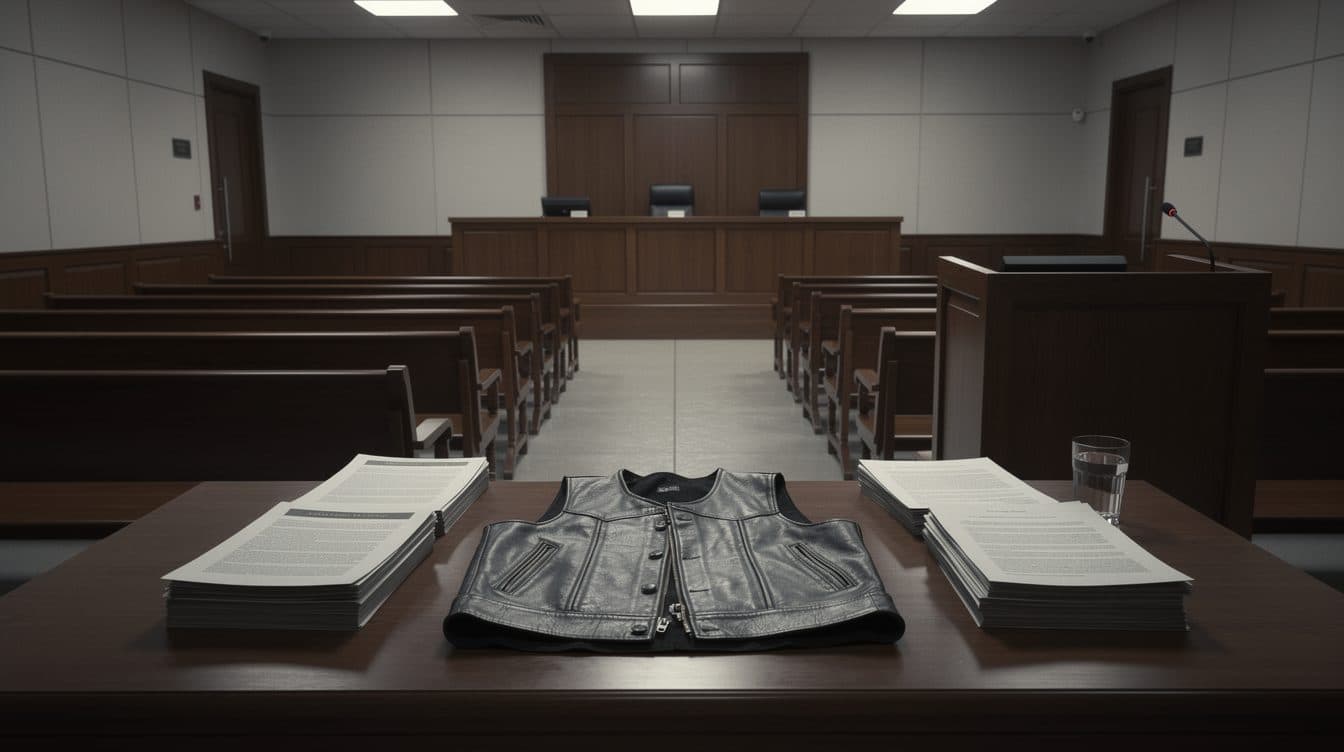
AI-generated image (flux-2/pro-text-to-image via Kie.ai)
Summary
The Vienna Public Prosecutor's Office has, following extensive investigations and numerous house searches, brought the first indictment for violations of the Prohibition Act against a member of the far-right hooligan group "Unsterblich Wien." The accused, a 41-year-old described by the DSN as the "closest confidant" of the convicted neo-Nazi Gottfried Küssel, is alleged to have repeatedly appeared in public wearing leather vests adorned with NS symbols.
Vienna, 15 June 2026
The Vienna Public Prosecutor's Office has, following extensive investigations and numerous house searches, brought the first indictment for violations of the Prohibition Act against a member of the far-right hooligan group "Unsterblich Wien."
Update of 15 June 2026: The Vienna Public Prosecutor's Office has now – after months of investigative work by the Directorate for State Protection and Intelligence Service (DSN) – brought the first indictment for renewed activity against a known member of the neo-Nazi hooligan group "Unsterblich Wien." This marks a formal judicial blow against a scene that has been active for years in the environment of FK Austria Wien. The indictment is based on numerous house searches in Vienna and Lower Austria, during which 13 suspects were searched in September 2023 and extensive NS material was seized.
What Is New as of 15 June 2026
"Unsterblich Wien" is a predominantly neo-Nazi hooligan group associated with FK Austria Wien, which was already expelled from the club by Wiener Austria in 2013. At that time, all known members and supporters of the group were issued stadium bans, after the group had attracted attention beyond the stadiums, among other things through an attack on a migrant association in the "Ernst-Kirchweger-Haus" in Vienna-Favoriten. This is based on research by right-wing extremism expert Andreas Peham of the Documentation Archive of the Austrian Resistance (DÖW), who categorized the group for the APA.
The now-indicted 41-year-old is, according to the Directorate for State Protection and Intelligence Service (DSN), one of the "closest confidants" of the convicted neo-Nazi Gottfried Küssel and his "holiday fraternity Imperia." According to the DSN, the accused is an "ideologized or indoctrinated member of the neo-nationalsocialist scene for years." The Public Prosecutor's Office assumes that he possessed the NS material seized from him with the intent to distribute it.
Background: The Group "Unsterblich Wien"
At the center of the indictment is the public wearing of a leather vest on the back of which a death's head modeled after the SS Division "Totenkopf" was visible. He appeared multiple times wearing a leather vest on the back of which a death's head modeled after the SS Division "Totenkopf" was visible. The name "Unsterblich" was also affixed to the vest. According to the indictment, he wore the vest, among other occasions, at an away match of Wiener Austria in Maria Enzersdorf in March 2022 and thus perceivably to at least 30 people – a circumstance that is said to fulfill the offense of renewed activity under the Prohibition Act.
In addition to the vest, the accused is also alleged to have worn a T-shirt featuring the death's head and the abbreviation "HH" for the slogan "Heil Hitler." The Public Prosecutor's Office classifies these appearances as continued renewed activity within the meaning of the Prohibition Act, although the 41-year-old had already been convicted in November 2022 for a violation of the Prohibition Act, with the judgment becoming final. Even afterwards, according to the investigations, he continued to appear in public with National Socialist symbolism, for example at another sporting event in Schwechat in March 2023.
The Accused and His Environment
During the house search in September 2023, the investigators also found a knife with a total length of 18 cm and a blade length of 8 cm, sharpened to a sharp edge on both sides – although the accused had been legally prohibited from possessing weapons. This item is also included in the indictment. The seizure of numerous NS devotional items from the total of 13 searched suspects reinforces, in the DSN's assessment, the picture of a structured neo-Nazi group that is not limited to fan clothing.
From the seized material, investigators quote the accused's writings with a clear confessional character: "Die BRD (Bundesrepublik Deutschland, Anm.) ist uns egal und völlig gleich, denn unsere Heimat ist das Deutsche Reich" – an excerpt that, according to the Public Prosecutor's Office, underscores the ideological background of the group "Unsterblich Wien" and its environment around Gottfried Küssel. In another quoted passage: "Die Republik ist uns egal, vollkommen gleich, denn unser Auftrag ist und bleibt das Deutsche Reich." The Public Prosecutor's Office assumes that he possessed the material with the intent to distribute it.
The Directorate for State Protection and Intelligence Service has been investigating "Unsterblich Wien" since November 2021 because supporters of the group had repeatedly and publicly appeared since then wearing leather vests bearing stylized NS symbols. The current indictment marks the provisional climax of these investigations and is the first indictment for renewed activity brought in direct connection with the hooligan group. It could also have a signaling effect for the remaining 12 searched individuals.
NS Symbolism at an Away Match
The right-wing extremism expert Andreas Peham of the DÖW points out in conversation with the APA that "Unsterblich Wien" also maintains good contacts with neo-Nazi hooligans across Europe, particularly those from Bratislava and Brno. These transnational networks are typical of the scene, which sees itself as a fraternal movement across national borders. The indictment against a single member is therefore also being read by observers as a signal to the entire European neo-Nazi hooligan scene.
FK Austria Wien had already distanced itself from "Unsterblich Wien" in 2013 as part of an adaptation of the club's catalog of measures against radicalism and antisemitism. At that time, all known members and supporters of the group were issued stadium bans – a measure that remains in effect to this day. The current case, however, shows that the formal distancing alone was apparently not sufficient to prevent the members from further public appearances with NS symbolism.
From the Vienna Public Prosecutor's Office's perspective, the offense of renewed activity is fulfilled by the fact that the vest with the death's head symbol was worn publicly at an Austria away match in Maria Enzersdorf in March 2022 in perceivable sight of at least 30 people. The investigators assess this as a demonstration of NS ideology in public space, which is punishable under the Prohibition Act. The indictment also refers to the relevant prior conviction of the accused from November 2022, which rounds out the overall picture of continued activity.
Seizures and Relevant Prior Convictions
For the judiciary, the indictment is also a litmus test: After years of investigations, a large-scale house search wave in September 2023, and the seizure of extensive NS devotional items, a known member of the group must now answer to a criminal court for the first time. Should a conviction result, it would set a precedent that could also be direction-setting for the still-pending proceedings against the remaining twelve searched individuals.
With the indictment against the 41-year-old, who according to the DSN also counts among Gottfried Küssel's "closest confidants" circle, the neo-Nazi infrastructure surrounding the Wiener Austria scene is once again in the focus of criminal prosecution. The Vienna Public Prosecutor's Office announced that it would continue the investigations against the other suspects from the house search complex of September 2023. Observers expect that the indictment against the Küssel confidant is only the first step in a series of further proceedings for renewed activity.
Networking in Europe and Consequences for the Club
The proceedings are thus not merely an isolated judicial case, but at the same time a signal to the entire hooligan scene in Vienna, in which right-wing extremism researchers have observed increasing radicalization for years. The indictment for violation of the Prohibition Act is therefore also being followed with attention beyond the specific case – by anti-fascist initiatives, by security authorities, and last but not least by Viennese football itself, which has long striven to distance itself from violence-prone and neo-Nazi fan groups.
Sources: Vienna Public Prosecutor's Office, Directorate for State Protection and Intelligence Service (DSN), APA, research by the Documentation Archive of the Austrian Resistance (DÖW).
Questions & Answers
Who is Gottfried Küssel and what is his relationship to the accused?
Gottfried Küssel is a convicted neo-Nazi whose "holiday fraternity Imperia" is, according to the Directorate for State Protection and Intelligence Service (DSN), considered the ideological environment of the 41-year-old accused; the accused is classified by the DSN as one of Küssel's "closest confidants."
Why is an indictment now being brought against a member of "Unsterblich Wien"?
The Vienna Public Prosecutor's Office considers a violation of the Austrian Prohibition Act to be established because the accused publicly wore, among other occasions at an away match of Wiener Austria in Maria Enzersdorf in March 2022, a leather vest bearing a death's head modeled after the SS Division "Totenkopf" perceivably to at least 30 people.
How did FK Austria Wien react to the group?
FK Austria Wien expelled "Unsterblich Wien" from the club as early as 2013 and issued stadium bans to all known members and supporters, after the group had previously attracted attention through, among other things, an attack on a migrant association in
Indictment Against "Unsterblich Wien" Hooligan: Prohibition | allfacts360