First Star Sturgeon Breeding Success in Vienna: Researchers Prepare for Release on the Lower Danube
Vienna, 16 June 2026
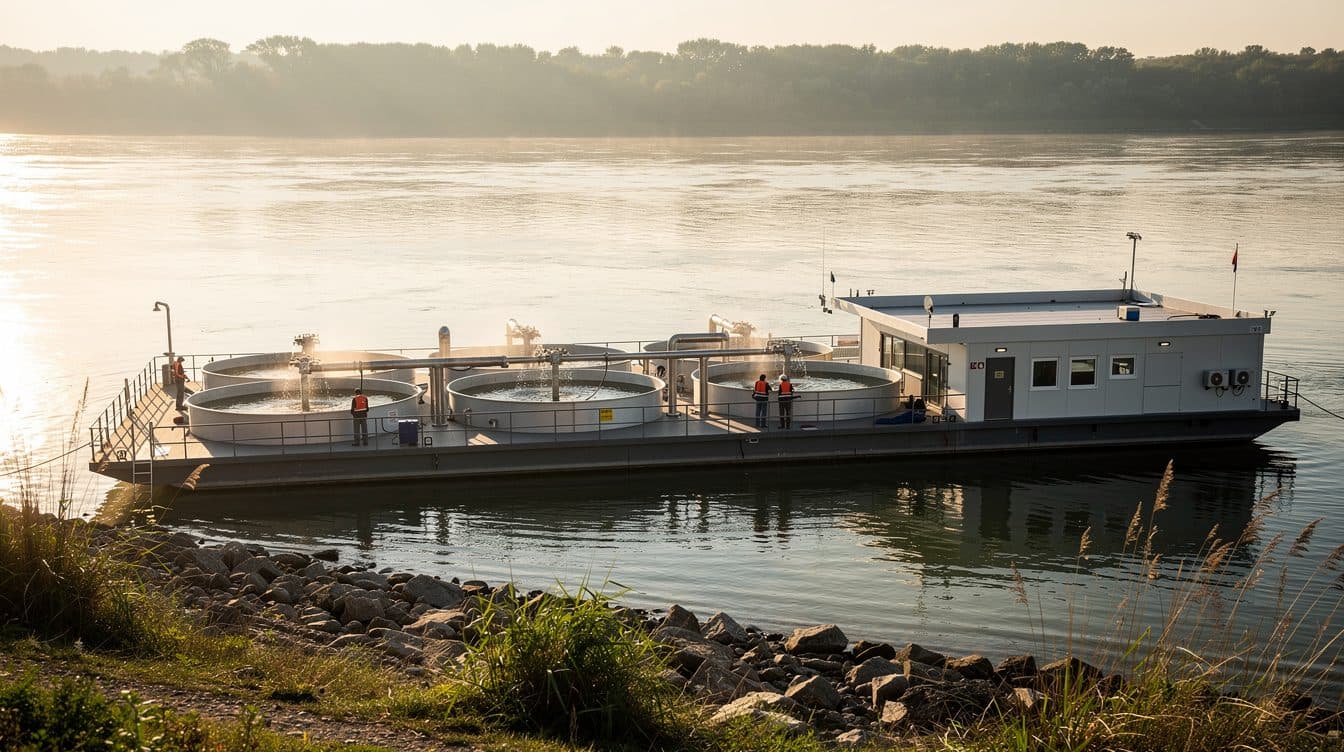
AI-generated image (flux-2/pro-text-to-image via Kie.ai)
Summary
In the EU project "LIFE-Boat 4 Sturgeon," the breeding of star sturgeon has succeeded for the first time on the floating rearing station on Vienna's Danube Island. Project leader Thomas Friedrich plans to release the juvenile fish on the lower Danube in autumn.
Vienna, 16 June 2026
On the floating rearing station "LIFE-Boat4Sturgeon" on Vienna's Danube Island, the breeding of the rare star sturgeon has succeeded for the first time; the juvenile fish are to be released in autumn on the lower Danube, below the Iron Gate.
Update of 16 June 2026: In Vienna, researchers from the University of Natural Resources and Life Sciences (Boku) have completed the first successful breeding cycle of the star sturgeon in a floating rearing station. Project leader Thomas Friedrich presented the success on Monday on board the station moored on the Danube Island together with Environment Minister Norbert Totschnig (ÖVP) and Vienna's city councillor for the environment, Ulli Sima (SPÖ). The planned release of the juvenile fish on the lower Danube in autumn is thus within reach.
Floating Station on the Danube Island
According to the project leaders, the floating station is the only one of its kind in Europe. It was converted from a former stone transport ship, the "MS Negrelli," and is 66 meters long and ten meters wide. On board are a 110-cubic-meter broodstock tank, several round tanks, and long-flow channels in which the juvenile fish grow up under controlled conditions.
The animals have been bred on a large scale on the former stone transport ship "MS Negrelli" since last year. The project team views the success with the star sturgeon as a milestone: the species, which can grow up to two meters long and weigh over 50 kilograms, has hitherto been considered one of the most threatened sturgeon subspecies in the Danube.
Political Reactions from Vienna and the Federal Government
Environment Minister Norbert Totschnig spoke of a "Meilenstein für den Artenschutz" and emphasized that one must "alles tun" to save the primordial "faszinierenden Lebewesen." Sturgeons have populated seas and rivers for around 200 million years and thus significantly outlived the dinosaurs. Along the Danube, however, humans have almost wiped out the stocks in just under 200 years.
Vienna city councillor Ulli Sima pointed to another success: "300.000 Sterlets konnten in Österreich bereits wieder ausgewildert werden, das für 2030 avisierte Projektziel wurde damit bereits jetzt erreicht." The sterlet (Acipenser ruthenus) is the smallest sturgeon species native to the Danube; over the entire course of the project, "etwa schon hunderttausende Exemplare der kleinsten Donaustör-Art, des Sterlet (Acipenser ruthenus), im Strom ausgesetzt worden."
Research and Public Impact
Boku Vice-Rector Christoph Pfeifer highlighted the scientific value of the project. From a scientific perspective, the project shows "dass man mit relativ kleinen Maßnahmen, einen Einfluss auf Entwicklungen nehmen kann." At the same time, the project has "auch eine tolle Außenwirkung" and demonstrates how a university can have an impact on society.
The project is carried out under the title "LIFE-Boat 4 Sturgeon" by Boku together with the Ministry of Agriculture (BMLUK), the waterway company viadonau, the City of Vienna, the WWF in Romania, Ukraine, and Bulgaria, as well as ministries from Hungary and Slovenia, fishing associations, and other partners. A total budget of 11.8 million euros is available, of which 67 percent comes from the EU LIFE funding program.
Partners, Budget, and Project Goals until 2030
By 2030, the partners aim to breed 1.6 million sturgeons. With the current interim status, the consortium sees itself, according to Totschnig and Sima, above target in its breeding and release efforts. The floating station is intended to help preserve the last four sturgeon species of the Danube.
A concrete timetable is now emerging for the release of the star sturgeons bred for the first time. As Friedrich explained, the juvenile fish are to be released in autumn on the lower Danube, that is, in the river section after the "Iron Gate." "Vom Eisernen Tor bis zum Meer sind es 870 Kilometer," the biologist said.
Release below the Iron Gate
The Danube Island is not only a research location but also a point of contact for the public. As the project leadership reported, the converted "MS Negrelli" now also functions as a kind of educational institution, already visited by around 2,000 interested members of the public. For Sima, it is "eines der coolsten Projekte" in the field of nature conservation.
For Sabine Gansterer of viadonau, the decommissioned ship has become a "Leuchtturm." The high visibility of the station on the Danube Island is intended to make clear that species conservation does not take place in secret, but is an experience accessible to all.
Educational Work and the Public
Scientifically, the project exemplifies a trend in European water conservation, Pfeifer emphasized. The evidence that even smaller, targeted measures can have noticeable effects is also being discussed as a model in other river systems.
With the breeding success of the star sturgeon, the range of species cared for on the station is expanding. In addition to the star sturgeon, the project also includes the sterlet, the ship sturgeon, and other sturgeon species in its program. The variety of round tanks and long-flow channels allows the team to respond to the different needs of the species.
The release on the lower Danube is planned, according to the team, in such a way that the juvenile fish are released in a section that still has suitable habitats. Friedrich pointed to the 870 kilometers between the Iron Gate and the sea as potential habitat.
With the success of the star sturgeon, an important signal has been set for the protection of a fish species that has existed for around 200 million years and has been pushed back significantly by human influences. With its budget of 11.8 million euros, the project is considered one of the largest species conservation efforts in the Danube region and extends far beyond Austria.
According to the project leadership, the next steps are the preparation of the release logistics, further breeding seasons, and the expansion of the educational offerings on board the station. The project website lb4sturgeon.eu bundles information for specialist audiences and interested visitors.
Questions & Answers
Who leads the sturgeon breeding project in Vienna?
The project "LIFE-Boat 4 Sturgeon" is led by the biologist Thomas Friedrich from the University of Natural Resources and Life Sciences (Boku) Vienna.
Why is the breeding of the star sturgeon a success for species conservation?
The star sturgeon is one of the most threatened sturgeon species in the Danube; successful breeding in the rearing station is considered an important step to support the stocks on the lower Danube.
When and where are the first star sturgeons to be released?
According to the project leader, the juvenile fish are to be released in autumn on the lower Danube, that is, in the river section below the Iron Gate.
Star Sturgeon Vienna: First Breeding Success Before Release | allfacts360