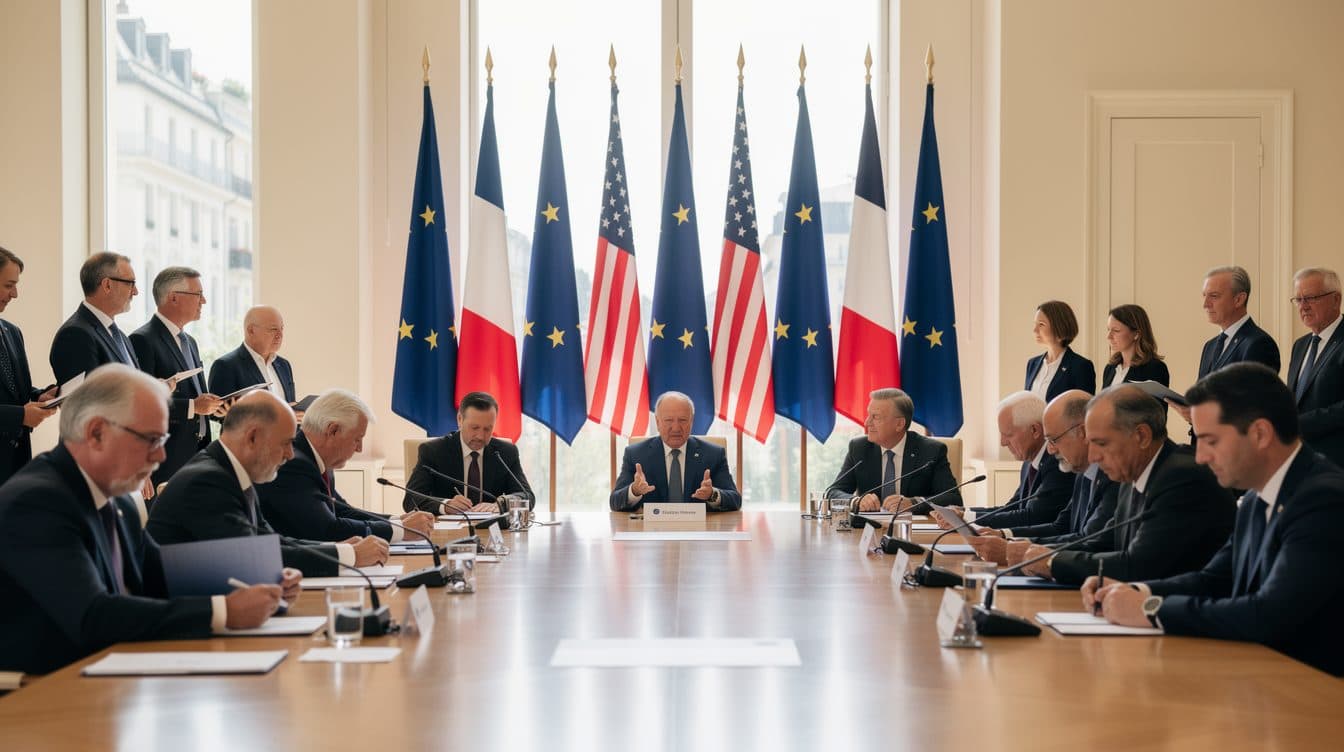
G7 Tightens Sanctions on Russia and Expands Military Aid to Ukraine
Évian, June 16, 2026
AI-generated image (flux-2/pro-text-to-image via Kie.ai)
Summary
At the G7 summit in the French town of Évian, the heads of state and government agreed on tightened sanctions against Russia's oil and gas industry and on expanding military aid to Ukraine. US President Donald Trump also announced that punitive measures against Moscow would be further intensified, while Chancellor Friedrich Merz spoke of a "day of hope."
Évian, June 16, 2026
At the G7 summit in the French town of Évian, the heads of state and government of the seven major industrialized nations agreed on June 16, 2026 to tighten sanctions against Russia and to expand military support for Ukraine.
What is new since June 16, 2026
According to ZDF correspondent Ulf Röller, the G7 members are relatively certain that US President Donald Trump will impose energy sanctions on Russia. Trump himself announced at the summit that punitive measures against the Russian oil sector would be further tightened. The G7 states agreed in a joint declaration by their heads of state and government to also tighten sanctions against Russia in the oil and gas sector.
The USA and the other G7 states want to increase pressure on Russia in order to intensify efforts to end the war in Ukraine. The declaration states that the tightening of measures is taking place in line with a "right moment" following the US deal with Iran on the reopening of the Strait of Hormuz. The strait is considered one of the world's most important energy and shipping routes.
Sanctions against the Russian energy sector
In parallel with the sanctions decisions, Ukrainian President Volodymyr Zelensky, as a guest of the summit, confirmed his participation in the consultations. The G7 agreed to expand the delivery of long-range weapons and air defense capabilities to Ukraine. The participants also announced that they would review the issuance of licenses to increase arms production for Ukraine.
The G7 stated that the expansion of support should bolster the new momentum that had emerged in recent months through Ukrainian progress at the front. The Ukrainian armed forces had succeeded in putting the Russian attackers under pressure in several sectors, according to negotiation circles.
Military support and winter aid
Beyond military aid, the G7 states promised Ukraine additional support to cope with the coming winter. Given the expected energy bottlenecks, the group is planning aid deliveries for heating materials, generators, and grid infrastructure. Humanitarian programs are also to be expanded.
The heads of state and government of the USA, the United Kingdom, Italy, Canada, and Japan, as well as senior representatives of the European Union, took part in the consultations in Évian. Ukrainian President Volodymyr Zelensky was invited as a guest. Macron said in a video address on Instagram that the USA, Canada, Japan, and the Europeans had jointly decided to stand by Ukraine.
French President Emmanuel Macron described the summit as a "moment of strategic awakening." According to Politico, he had launched a charm offensive to win Trump over to a common line. This also included the invitation to Trump to meet him for dinner at the Palace of Versailles after the summit — an invitation that Trump accepted.
Macron's charm offensive and the dinner in Versailles
Trump met with Ukrainian President Volodymyr Zelensky as well as the heads of state and government of the G7 on the sidelines of the summit. According to Politico, Trump assured behind closed doors that the USA would continue to stand by Ukraine. At the same time, he was more publicly reserved: "I don't think we will need much help" and "Russia has to make a deal."
According to Politico, Macron had offered Trump support for a possible military mission, which Trump largely rejected. Trump also called on the European partners to support the planned treaty with Iran and to participate in securing the Strait of Hormuz. In particular, he asked the Europeans to take part in possible mine-clearing operations in the strait.
Chancellor Merz sees a "day of hope"
Chancellor Friedrich Merz expressed great satisfaction with the talks on the Ukraine war even before the text was published. He spoke of a "day of hope" and said about the current situation in Ukraine: "This may for the first time open up a chance for peace." Merz showed "a certain optimism" and described Trump as "very cooperative."
Merz further stated that he was to a certain extent optimistic that Europeans and Americans would now jointly do everything to end the war. This attitude is in line with the tenor of the summit declaration, in which the community of nations reaffirmed its will to consistently use diplomatic and economic levers vis-à-vis Moscow.
The tightening of sanctions follows a phase of growing Ukrainian successes at the front. According to observers' assessment, Russian forces have lost ground in several sectors, while the Ukrainian army has been able to launch new offensives. Against this backdrop, the G7 partners see a window of time in which additional pressure could force Moscow to the negotiating table.
Strait of Hormuz and the Iran deal as context
The delivery of long-range weapons and additional air defense systems is considered one of the most delicate points of the agreement. While the European G7 members expressly support the step, there had been discussions in Washington in recent weeks about range restrictions. However, the summit declaration contains no concrete range specifications, but refers to ongoing consultations.
Ahead of the summit, Trump had called on European governments to participate more strongly in stabilizing the Strait of Hormuz. The strait is one of the world's most important energy and shipping routes. A new treaty with Iran envisages its reopening, according to the G7 declaration — a step that, in the assessment of the summit participants, could calm the global energy market situation and at the same time narrow Russia's room for maneuver.
Support for the coming winter includes, according to the declaration, not only energy aid but also measures to protect the civilian population. Mobile heating stations, emergency shelters, and the repair of damaged supply lines are planned. The Ukrainian government had repeatedly pointed out in recent months the particular vulnerability of the energy infrastructure.
Outlook: NATO summit in Turkey
On the eve of the summit, Macron had emphasized in a video address on Instagram that the USA, Canada, Japan, and the Europeans had jointly decided to stand by Ukraine. Looking ahead to the coming weeks, he announced that military and financial aid would be expanded in a coordinated manner. The Évian declaration is seen as an attempt to translate these commitments into a common political line.
The choice of venue was not uncontroversial. The small town on Lake Geneva has only limited conference capacities, which is why several side events were relocated to other places in the region. France's presidency justified the decision with the symbolic effect of a quieter negotiating atmosphere away from the capital.
Observers assess the summit meeting as a sign that the Western community of nations is sticking to a common line vis-à-vis Moscow despite internal differences. Tensions existed primarily between Washington and several European capitals over the pace and scope of sanctions and over the future role of the USA in Ukraine policy.
Questions & Answers
Who participated in the G7 summit in Évian?
The heads of state and government of the USA, the United Kingdom, Italy, Canada, and Japan, as well as senior representatives of the European Union, took part in the consultations. Ukrainian President Volodymyr Zelensky was invited as a guest.
What concrete decisions did the G7 make regarding Ukraine?
The G7 agreed to expand the delivery of long-range weapons and air defense capabilities to Ukraine, to review licenses to increase arms production, and to provide additional winter aid.
Why is the timing of the summit considered particularly favorable?
The summit declaration refers to the US deal with Iran on the reopening of the Strait of Hormuz and to the new momentum generated by Ukrainian progress at the front in recent months.
G7 Summit Évian: Sanctions on Russia & Ukraine Aid | allfacts360