Germany and Poland: Military Agreement on 35th Anniversary | allfacts360
Germany and Poland Deepen Military Cooperation on 35th Anniversary of Neighbourhood Treaty
Berlin, 17 June 2026
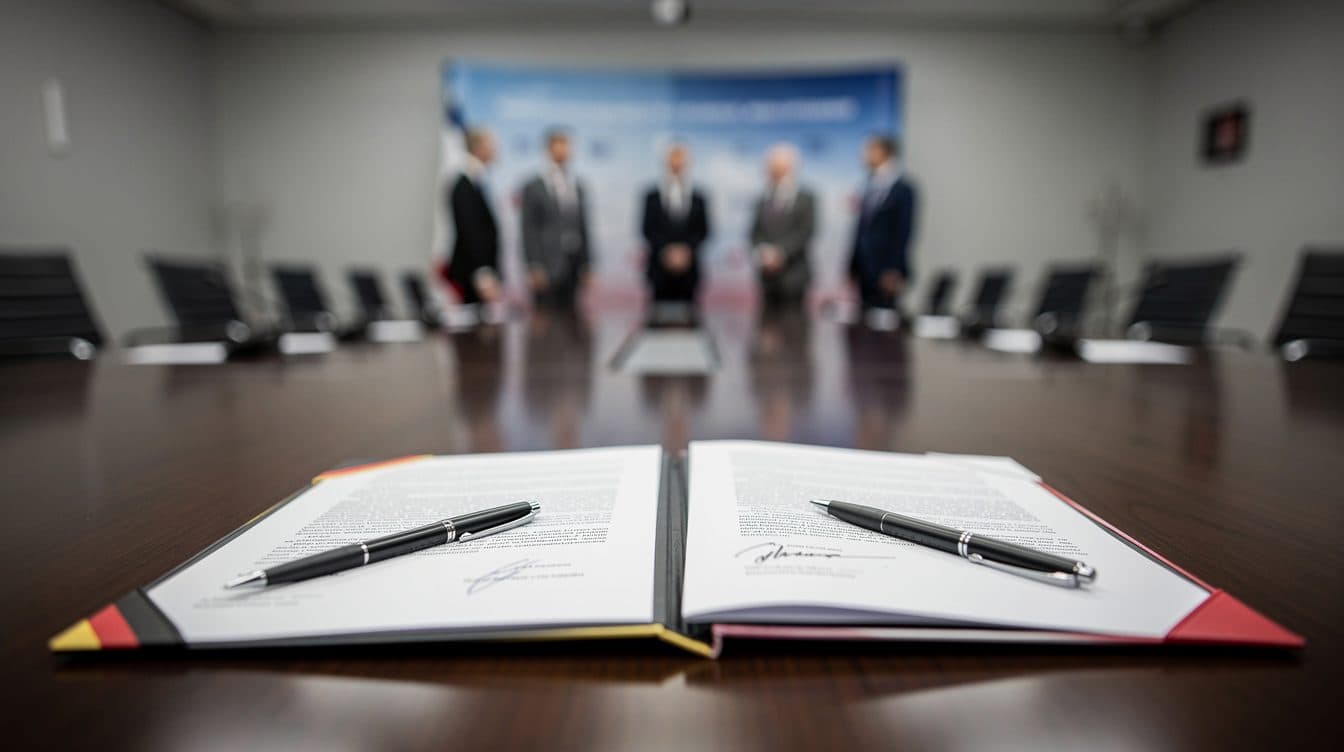
AI-generated image (flux-2/pro-text-to-image via Kie.ai)
Summary
On the 35th anniversary of the German-Polish Neighbourhood Treaty, the foreign and defence ministers of both countries significantly deepened their cooperation in Berlin and Warsaw. In Warsaw, Boris Pistorius and Władysław Kosiniak-Kamysz signed a new defence agreement envisaging joint exercises, cyber defence and the expansion of the eastern flank.
Berlin, 17 June 2026
On the 35th anniversary of the German-Polish Neighbourhood Treaty, Germany and Poland expanded their cooperation at the military, political and cultural levels through a new defence agreement, joint declarations and the return of three cultural artefacts.
In Berlin on Wednesday, some 700 participants gathered for the German-Polish Forum to mark the 35th anniversary of the signing of the 1991 Neighbourhood Treaty. Federal Foreign Minister Johann Wadephul received his Polish counterpart, Radosław Sikorski, on the occasion. The focus was on joint security policy towards Russia, the expansion of cross-border connections and the further deepening of the partnership between the two states that has existed for decades.
Security on the Eastern Flank
The situation on NATO's eastern flank was at the centre of the Forum. Wadephul emphasised that Germany and Poland were NATO's "logistic hubs." He said: "Zusammen bilden Deutschland und Polen das Rückgrat der europäischen Verteidigung und der Abschreckung der Nato gegen die russische Bedrohung." Both sides see themselves as sharing responsibility in the face of Russia's war of aggression against Ukraine and Poland's direct neighbourhood with Russia and Belarus.
On the same day, Federal Defence Minister Boris Pistorius travelled to Warsaw to sign a new bilateral defence agreement with his Polish counterpart Władysław Kosiniak-Kamysz. Pistorius's visit to Warsaw was occasioned by the 35th anniversary of the 1991 German-Polish Neighbourhood Treaty. The signing took place roughly one hour after the two ministers' welcome. The agreement builds on an existing framework agreement from 2011.
The defence agreement provides, among other things, for intensified military coordination and the deployment of German soldiers to secure Poland's eastern border. It extends cooperation to areas such as cyber security, space, research, Baltic Sea security, infrastructure protection and the security of sea routes. Both countries are jointly committed to extending the NATO pipeline system into the Baltic states. From this summer, engineers of the German Bundeswehr will, together with Polish forces, construct a defensive position at the border with Russia and Belarus as part of the "Eastern Shield" initiative.
Content of the Defence Agreement
Pistorius said the new agreement opened another chapter in the history of a close friendship. "Mit diesem neuen Abkommen berücksichtigen wir nicht nur die neuen sicherheitspolitischen Realitäten. Wir schlagen eben auch ein weiteres Kapitel in der Geschichte unserer engen Freundschaft auf. Polen – Deutschland, Deutschland und Polen." Germany and Poland were jointly assuming responsibility for security in Europe. In the specific case, the Bundeswehr had already deployed Patriot systems to Rzeszów and Eurofighters to Malbork: "unsere Patriotsysteme waren in Rzeszow, unsere Eurofighter in Malbork".
From Warsaw it was reported that the Polish government had deliberately refrained from more far-reaching commitments in order to avoid a possible veto by the national-conservative President Karol Nawrocki. According to the Polish news agency PAP, the ministerial agreement does not go as far as Poland's arrangements with France and the United Kingdom, which contain assistance rules outside the framework of the EU and NATO. Poland has signed defence treaties with France and Great Britain in recent years.
Domestic Political Debate in Poland
In the Polish parliament, Kosiniak-Kamysz defended the cooperation with Germany against a Germany-critical right-wing camp. "Für Polen befindet sich der Feind im Osten, nicht im Westen", he said. He recalled the year 1939, "als wir vom Osten und vom Westen aus angegriffen wurden". Today, he said, they were "in gemeinsamen Allianzen, in gemeinsamer Partnerschaft verbunden, wo wir Freunde sind. Man vergesse die Vergangenheit nicht, aber gemeinsam bauen wir eine bessere Zukunft auf." Polish Prime Minister Donald Tusk also made clear: "Deutschland und die Ukraine sind unsere Verbündeten." At a press conference he also said: "Jeder, der versucht, die guten deutsch-polnischen Beziehungen zu zerstören, dient Russland; jeder, der heute die Ukraine angreift, hilft Russland."
Another topic of the Forum was economic and civilian cooperation. Both countries announced that military logistics would in future be organised "ohne viel Bürokratie". Cooperation in the Baltic Sea region and space is also to be deepened. In a joint declaration it was stated that Poland and Germany could achieve more – it was about freedom, security and prosperity. For example, cross-border transport needed to be expanded, as well as partnerships in areas such as digitalisation and artificial intelligence.
Cross-Border Infrastructure
The discrepancy between political commitments and the state of cross-border infrastructure became particularly apparent. Wadephul put it pointedly: "Wer also in deutsch-polnische Schienen investiert, der investiert in Freundschaft und Verteidigung zugleich." He recalled that, in the event of defence, hundreds of thousands of allied soldiers would be moved through the two countries towards the east – including to Poland and the Baltic states. "Dieselben Gleise, auf denen wir uns besuchen fahren, tragen im Ernstfall auch Panzer."
Sikorski sharply criticised the current state of German-Polish connections. "In den letzten 30 Jahren wurde nur eine einzige Brücke erbaut, obwohl unsere Grenze täglich Waren im Wert von 500 Millionen Euro passieren." Some rail connections between German and Polish cities took longer than before the First World War. "Hier gebe es beunruhigende Mängel, die Schienenverbindungen seien unzureichend." Sikorski also had no kind word for the ongoing border controls: "Diese Grenzkontrollen zwischen Deutschland und Polen führen zu unnötigen Problemen und bilden wirklich Hürden." The federal government uses these controls to limit migration.
Sikorski also pointed to Poland's achievements on its eastern border, which is simultaneously the EU's external border. Poland had erected "wirksame Barrieren" against the influx of migrants there. "Über diese Barrieren sei seit Anfang des Jahres keine einzige Person, kein einziger illegaler Migrant gelangt." He also pointed to growing Polish investments and corporate takeovers in Germany as a sign of economic interdependence.
Cultural Artefacts and Historical Responsibility
In the cultural sphere, both sides used the anniversary to make a symbolic gesture: Germany returned three cultural artefacts to Poland that had been taken or relocated during the German occupation in the Second World War. According to the report, these included a valuable ring of the Polish Jagiellonian royal house and a medieval manuscript. With the return, both sides continued the policy of coming to terms with the past and reconciliation that had grown since 1991.
Sikorski also addressed the moral dimension of the anniversary in his speech. "Die letzten Zeitzeugen des Zweiten Weltkriegs sterben, darunter Menschen, die besonders stark unter den deutschen Verbrechen gelitten haben: KZ-Häftlinge und Zwangsarbeiter." He called on Germany to swiftly fulfil its special obligations towards former concentration camp prisoners and forced labourers in Poland. "Wir haben ihnen gegenüber besondere Verpflichtungen, sowohl in moralischer als auch in materieller Hinsicht." The foreign ministers stated in a joint declaration: "Im Bewusstsein der tragischen Geschichte des 20. Jahrhunderts tragen wir eine besondere Verantwortung für unsere Region und unseren Kontinent – als Verbündete in der Nato und Partner in der Europäischen Union."
At the Forum in Berlin, individuals and institutions that had rendered outstanding service to German-Polish understanding were also honoured. Among those honoured was Janusz Reiter, the first ambassador of post-communist Poland in Berlin. The Frankfurt-Słubice cooperation centre also received an award for its educational work on both sides of the Oder. The organisers thereby underscored the civil-society dimension of the bilateral relations, which extends beyond government agreements.
Honours and Civil-Society Relations
According to the Berlin police, an incident occurred on the sidelines of the Forum on the previous day: right-wing extremists around Robert Bąkiewicz had attempted to erect a cross in the Tiergarten at the site where a memorial to Polish victims of the Second World War is to be built. The police prevented this and temporarily detained six people. The incident highlighted the tensions that persist in parts of the Polish and German public even 35 years after the Neighbourhood Treaty.
Overall, the Forum painted the picture of a partnership that is more closely intermeshed in security policy, deeply intertwined economically and conscious of its historical burden. According to information from Warsaw, Poland invests around five percent of its gross domestic product in defence, is a NATO member and maintains close relations with the United States. In the words of Kosiniak-Kamysz, Warsaw's security policy is also directed towards Scandinavia and Turkey. With the new agreement, the Berlin–Warsaw axis is now gaining additional weight – not least with a view to the Russian threat, against which both countries say they wish to defend themselves jointly.
Questions & Answers
What did Germany and Poland agree on 17 June 2026?
Federal Defence Minister Boris Pistorius and his Polish counterpart Władysław Kosiniak-Kamysz signed a new bilateral defence agreement in Warsaw, providing, among