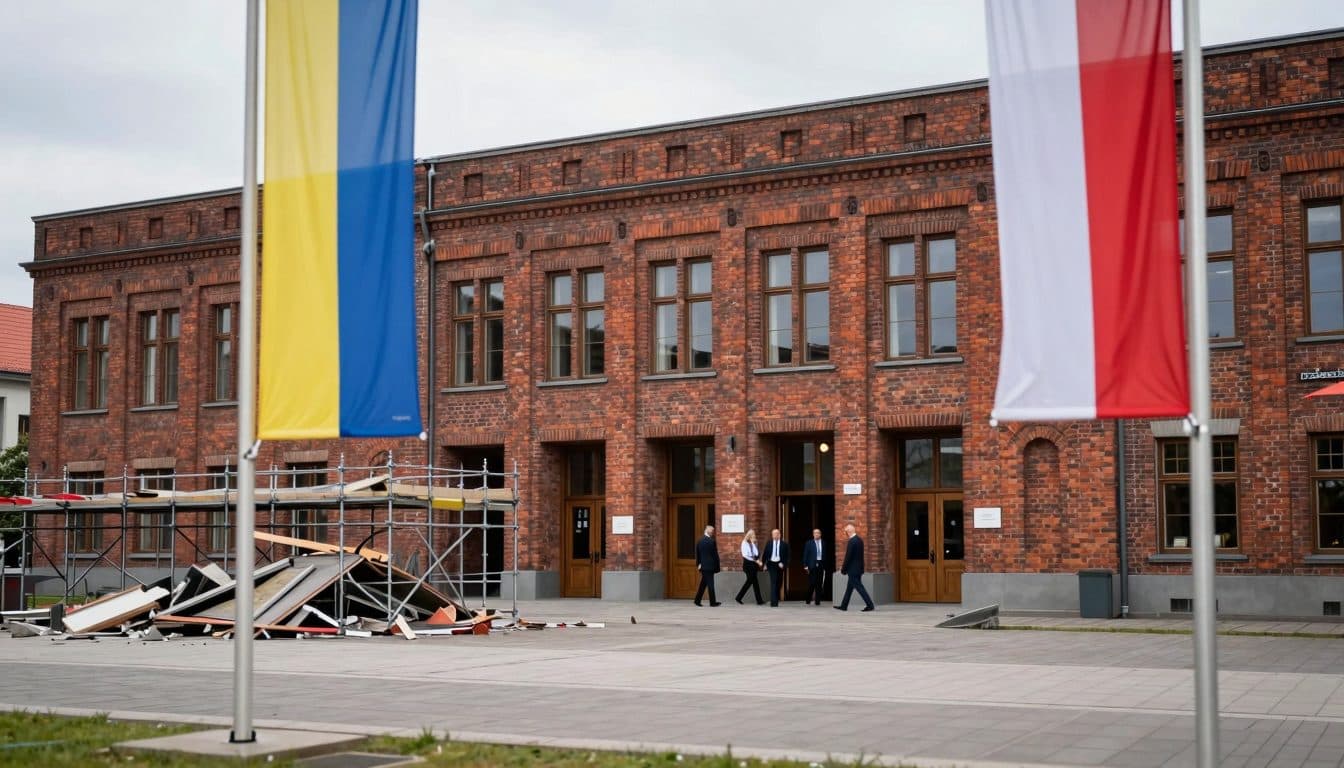
The fifth international Ukraine Recovery Conference has begun in Gdańsk. Delegations from more than 50 countries, including Chancellor Friedrich Merz, are meeting for two days to discuss the reconstruction of Ukraine, attacked by Russia – overshadowed by the dispute between Warsaw and Kyiv over the revocation of the Order of the White Eagle by President Nawrocki.
Gdańsk, 25 June 2026
In Gdańsk, the fifth international Ukraine Recovery Conference (URC) began on Thursday, with delegations from more than 50 countries taking part and, according to the Polish government, around 200 agreements and contracts prepared for signing.
The two-day conference in the historic Hanseatic city of Gdańsk is dedicated to the reconstruction of Ukraine, severely damaged by Russia's war of aggression. According to the World Bank, the Ukrainian government, and the EU, the physical destruction after more than four years of war amounts to around 195 billion US dollars (171 billion euros). Medium- and long-term needs are estimated at approximately 588 billion US dollars (around 516 billion euros) over the coming ten years, while economic and social damage is put at 666 billion US dollars.
Unlike in previous years in Berlin and Rome, Ukrainian President Volodymyr Zelensky is not expected to attend in person in Gdańsk. He is represented by Prime Minister Yulia Svyrydenko. The Ukrainian delegation is thus under government responsibility, while the head of state stays away from the conference.
High-level political participation from Germany and Austria
From Germany, Chancellor Friedrich Merz (CDU) and Development Minister Alabali Radovan are travelling to Gdańsk. In addition, around 20 representatives of Austrian companies have registered their participation; Austria is being represented for the first time at head-of-government level by Chancellor Stocker, who plans bilateral talks with Donald Tusk and Yulia Svyrydenko and intends to deliver a speech in the opening part of the conference. EU Commission President Ursula von der Leyen is also expected as a high-ranking political host.
On the Polish side, Prime Minister Donald Tusk is co-host. Tusk had already met with Merz in Berlin the previous evening, where a meeting of the five major European states (E5) took place. He reaffirmed Poland's support for Kyiv in the evening, emphasizing: "Es ist im Interesse Polens und der Ukraine, die Zusammenarbeit fortzusetzen".
Concrete aid pledges and economic interests
The focus of the deliberations is on concrete aid pledges and investments for reconstruction. Polish Deputy Development Minister Michał Baranowski stated: "Der eigentliche Wiederaufbau der Ukraine beginnt in dem Moment, wenn Drohnen und Bomben aufhören zu fliegen, wenn Kanonen nicht mehr schießen. Doch der Wiederaufbau fängt auch jetzt schon an". Baranowski announced that "concrete sums" would be discussed and that "the entire West" was meeting to "pledge further aid and support for the reconstruction of Ukraine".
The economic dimension is also considerable. German companies from the fields of technology, logistics, drone manufacturing, the arms industry, and power plant equipment have expressed great interest in contracts. According to the Austrian Federal Chancellery, around 1,000 Austrian companies are active in Ukraine, about 200 with their own branches; before the war, Austria was the sixth-largest investor in the country.
Concrete pledges were already announced on the first day of the conference. Andriy Sadovyi, mayor of the western Ukrainian city of Lviv, announced on the platform X that his city had received support amounting to 2.5 million euros and had signed six contracts with partners from Lithuania, Germany, the Czech Republic, Sweden, and France. Sadovyi stressed: "Entgegen allem, was man uns in letzter Zeit in der Öffentlichkeit aufzuzwingen versucht, empfängt uns Polen herzlich".
Background: Russian attacks on Ukrainian infrastructure
Poland is one of Ukraine's most important military supporters in its defence against Russia. Against the backdrop of the ongoing war, according to reports from last winter, millions of people in the Ukrainian capital Kyiv went without heating for weeks and with only minimal electricity supply after Russia had repeatedly bombed power plants and energy grids. Many residential buildings and businesses in Ukraine are damaged or destroyed.
Dispute over the naming of a Ukrainian military unit
The conference is overshadowed by a historical-political dispute between Warsaw and Kyiv. The trigger was the decision at the end of May by Zelensky to give a unit of the Ukrainian military the nickname "Heroes of the Ukrainian Insurgent Army (UPA)". The UPA fought against the Soviets in the Second World War. Zelensky explained that the renaming had been done at the unit's request: "Ich bin Oberbefehlshaber, der dazu verpflichtet ist, den Streitkräften alles zu geben, was sie für die Verteidigung unseres Volkes und unseres Landes brauchen".
In Poland, this step provoked great outrage. According to the Polish reading, the UPA is also responsible for massacres of tens of thousands of Poles and Jews in what is today western Ukraine; Poland regards these acts as genocide. President Karol Nawrocki drew the consequences and decided to revoke the highest decoration of Poland, the Order of the White Eagle, from his counterpart Zelensky. Zelensky subsequently sent the order back by post.
Poland's domestic political differences in dealing with Kyiv
While liberal Prime Minister Tusk has been trying for days to calm the dispute with Kyiv, conservative President Nawrocki has escalated it. Tusk assured: "Trotz der Emotionen stehe man für die Ukraine in deren Konfrontation mit Russland ein". According to the conference organizers, both sides have repeatedly emphasized that Ukraine's support should not be harmed by the dispute.
Nevertheless, the historical conflict threatens to burden other areas of the strategically important cooperation between Ukraine and Poland. Observers interpret the fact that Zelensky is absent in Gdańsk and Svyrydenko is leading the delegation as a visible sign of this strain, even though, according to sources in Warsaw, the conference is largely proceeding operationally as planned.
Significance of the conference for reconstruction
The Ukraine Recovery Conference has been held annually since the start of the war. It traditionally deals with repairing ongoing war damage to Ukrainian infrastructure and with the question of how future reconstruction should be shaped. With Gdańsk as this year's venue, the organizers have chosen a place that historically stands for cross-border trade and for the experience of war and reconstruction.
Overall, the 200 agreements and contracts prepared demonstrate the economic and political weight of the conference. For Ukraine, whose energy infrastructure, residential buildings, and industrial facilities are suffering under continued Russian attacks, the aid and investments pledged in Gdańsk are a crucial building block to begin reconstruction now – even while the war continues.
Questions & Answers
Who is taking part in the Ukraine Recovery Conference in Gdańsk?
Delegations from more than 50 countries are participating in the conference. High-ranking guests include Chancellor Friedrich Merz, EU Commission President Ursula von der Leyen, Austrian Chancellor Stocker, and Polish Prime Minister Donald Tusk. Ukraine is represented by Prime Minister Yulia Svyrydenko.
Why did Poland's president revoke the Order of the White Eagle from Zelensky?
President Karol Nawrocki decided to revoke the highest decoration of Poland, the Order of the White Eagle, from his counterpart Zelensky after Zelensky had given a Ukrainian military unit the nickname "Heroes of the UPA" at the end of May. Poland holds the UPA responsible for genocide because of massacres of tens of thousands of Poles and Jews during the Second World War.
What sums are needed for the reconstruction of Ukraine?
According to estimates by the World Bank, the Ukrainian government, and the EU, the physical damage amounts to around 195 billion US dollars. Around 588 billion US dollars is estimated for reconstruction over the coming ten years, and economic and social damage is put at 666 billion US dollars.