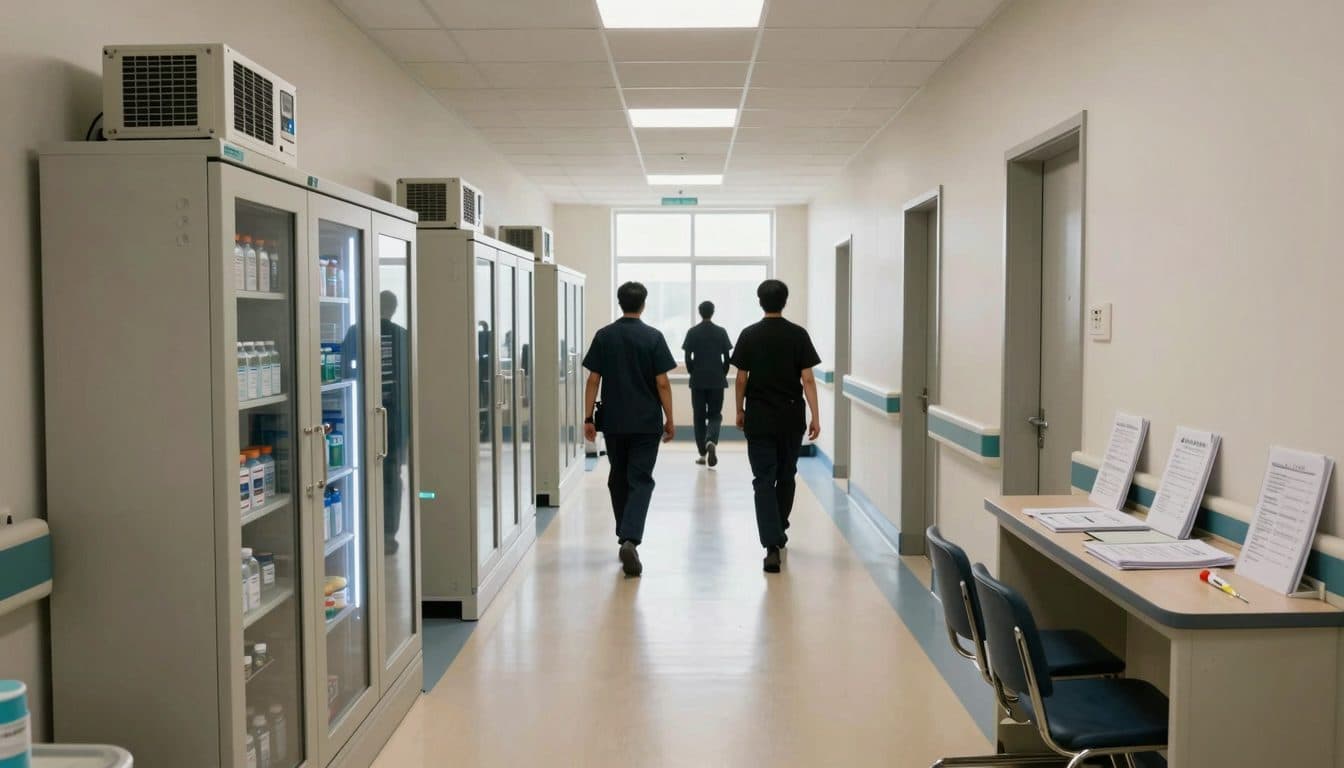
Heat Wave Poses New Challenges for Hospitals: Air Conditioning, Medication Storage and Trained Teams
Vienna, 17 July 2026
AI-generated image (z-image via Kie.ai)
Summary
Rising temperatures are changing day-to-day work in hospitals: from medication storage to duty rosters to staff training. A symposium in Lower Austria was devoted to the question of how facilities can remain operational. At the same time, experts warn that the healthcare sector itself contributes to the climate issue.
Vienna, 17 July 2026
Hospital chiefs and psychiatry experts are, in view of more frequent heat waves, being forced to reorganize cooling chains, duty rosters and training programs at their facilities, as a symposium in Lower Austria shows.
Cooling and Training in the Hospital
When the thermometer climbs above 30 degrees, an air conditioner in a doctor's office is no longer anywhere near enough. Christian Korbel, head physician of psychiatry and organizer of the symposium "Klima und Psyche," gets straight to the point: „Wir haben umgebaut und Kühlungsmöglichkeiten für die Medikamente bereitgestellt." His facility has significantly expanded its precautions in recent years, he reports in conversation with the "NÖN."
The challenge affects several areas simultaneously. „Da müssen wir schauen, dass wir einsatzfähig bleiben", says the hospital chief. In concrete terms, this means: staff must be prepared for new strains, storage rooms require different temperatures, and emergency plans must work even during natural events such as floods or heat waves. „In diesen Bereichen müssen wir unsere Leute gut schulen", he announces.
That such strains are not merely theoretical was demonstrated by the so-called century flood of 2024 in Lower Austrian Mauer. At the time, the hospital found itself in a „Personalnotstand", according to Korbel. The lessons learned from that experience are now flowing into the training plans. With injection treatment, too, weight losses of up to 19 percent were achieved after 72 weeks, he reports by way of comparison.
Medications and the Cold Chain
Another critical issue is the storage of medications. Many tablets – for example, frequently prescribed weight-loss preparations – must, according to the manufacturer, be stored at room temperatures below 25 degrees. „Auch die Lagerung von Medikamenten muss bei Temperaturen um die 36 Grad neu durchdacht werden", according to a report. With oral semaglutide, for instance, which reduces appetite and enhances the feeling of satiety, the optimal effect is quickly lost if the cold chain is broken. Studies found that adults with obesity or overweight lost on average around 14 percent of their body weight after 64 weeks on oral semaglutide.
Newer preparations face the same logistical questions. The preparation acts on three different hormone receptors and, according to the manufacturer, achieved an average weight loss of more than 30 percent after two years in studies. In April 2026, orforglipron was already approved in the United States under the trade name Foundayo. The tablets are – like the injection – intended for adults with obesity, generally from a body mass index of 30. They may already be considered from a BMI of 27 if comorbidities such as high blood pressure, type 2 diabetes or sleep apnea are present.
Obesity Therapies in Transition
The look at such preparations illustrates a second trend: worldwide, more than 70 additional drugs against obesity are in development, according to the association of research-based pharmaceutical manufacturers. Many of these are sensitive biologics whose handling demands strict temperature specifications. Afterwards, neither food nor beverages nor other medications may be taken for at least 30 minutes – an indication of how tightly the dosing conditions are scheduled.
The symposium itself was part of the Lower Austrian State Exhibition on mental health. In it, Korbel also emphasizes the role of the health sector in climate protection. „Generell müsste sich der gesamte Gesundheitssektor samt den Spitalsbetreibern bewusst werden, dass sie selbst rund acht Prozent des CO2-Ausstoßes verursachen", says Korbel. His ambition is clearly formulated: „Außerdem wollen wir Vorbild sein." In doing so, he takes up a discussion that has been ongoing in expert circles for years: hospitals are not only victims, but also contributors.
Mental Strain in Hot Summers
The psychological dimension also affects patients. Rising temperatures are associated with sleep disturbances, irritability and an increase in mental health burdens. Korbel sees a twofold task in this: on the one hand, ensuring care for those affected, and on the other, protecting his own staff. Whoever stands in an operating room at 36 degrees, whoever walks through overheated corridors in high summer, needs not only technical but also organizational answers.
That these answers do not look the same everywhere is shown by a look at other policy areas. At the federal level, the federal government is currently dealing with the question of three-year debt-relief periods in insolvency proceedings. „Wenn sich sogar die Fachebene im Justizministerium dafür ausspricht, dass die 3-jährige Entschuldung dauerhaft für alle gelten soll, dann ist es schon seltsam, wenn die Regierung alle Bedenken ignoriert", says Clemens Mitterlehner, managing director of the umbrella organization of debt counseling services. Alma Zadić, deputy caucus chairwoman and consumer protection spokesperson of the Greens, sees the three-year period as one of the most important advances of the 2021 insolvency law reform.
Debate Over the Insolvency Code
The Chamber of Commerce side also has its say. „Die Verkürzung der Entschuldungsdauer hat zulasten der Gläubiger gewirkt und die durchschnittlichen Rückflüsse deutlich reduziert", said Gerhard Weinhofer, managing director of the Creditors' Protection Association. Addressed to entrepreneurs, he adds: „Letztere würden ein wirtschaftliches Risiko auf sich nehmen und leisten einen wesentlichen Beitrag zum Wohlstand unseres Landes." The insolvency code must be repaired and retroactive transitional provisions created for proceedings from July 17, 2026, the managing director of the umbrella organization is convinced.
In parallel, health-policy statistics deal with entirely different figures. 87,902 people died in Austria in 2025, Statistics Austria reports. Diseases of the cardiovascular system were the most common cause of death, at 33 percent. In the 40-to-79 age group, cancer was the most common cause of death, with 41 percent of deaths attributable to cardiovascular diseases. Among young people and young adults aged ten to 40, suicides, cancer and accidents topped the list. Nevertheless, the absolute number of cancer deaths increased, since more people today reach old age. More than half of all deceased were at least 80 years old, and this age group accounted for around 39 percent of all deaths.
Mortality in Austria
The topic of international migration is of an entirely different nature. According to the federal government, 3.9 million people are registered as internally displaced persons in Ukraine. The federal government writes: „Die verheerenden russischen Angriffe auf Energie- und Heizinfrastruktur in der Ukraine, mit negativen Rückwirkungen auf die Wasserversorgung, haben weitreichende humanitäre Folgen für die dortige Bevölkerung." This entanglement shows that in practice, climate impacts and conflicts are closely intertwined.
Various actors are attempting to ease the situation on the ground. According to the United Nations Office for the Coordination of Humanitarian Affairs (OCHA), 10.8 million people in Ukraine are dependent on humanitarian assistance – particularly in the sectors of Protection (6.54 million), Water/WASH (6.43 million), Shelter (5.6 million) and Health (4.47 million). In May 2026 alone, 274 dead and 1,763 injured were reported – the highest figures since April 2022, the federal government writes in its answer to a minor question from Die Linke.
Humanitarian Situation in Ukraine
Since February 2022, around six million people have fled Ukraine according to UN and EU data, of whom approximately 5.5 million are registered in European EU and non-EU states. The federal government puts the number of Ukrainian civilians killed since 2022 at at least 16,126. The answers submitted in mid-July 2026 make clear that international aid systems continue to be heavily in demand.
Above all these topics stands the question of how resilient European healthcare systems are when climate, demographics and conflicts converge. The symposium in Lower Austria, the insolvency debate in Vienna and Statistics Austria each provide one piece of the puzzle, which in sum yields a picture: public institutions must prepare for parallel crises and further expand their resilience.
Questions & Answers
Wer hat das Symposium „Klima und Psyche" organisiert?
Organisiert wurde das Symposium vom Primar Christian Korbel, der an der NÖ Landesausstellung zum Thema psychische Gesundheit mitwirkte und dabei Aspekte der Klimaanpassung im Spital beleuchtete.
Welche neuen Abnehmmittel stehen 2026 vor der Zulassung?
Im April 2026 wurde in den USA Orforglipron unter dem Handelsnamen
Heat and Health: Hospitals Under Climate Stress | allfacts360