Heatwave in Germany: 41.7 Degrees in Brandenburg and at Least Five Deaths from Swimming Accidents
Offenbach, June 29, 2026
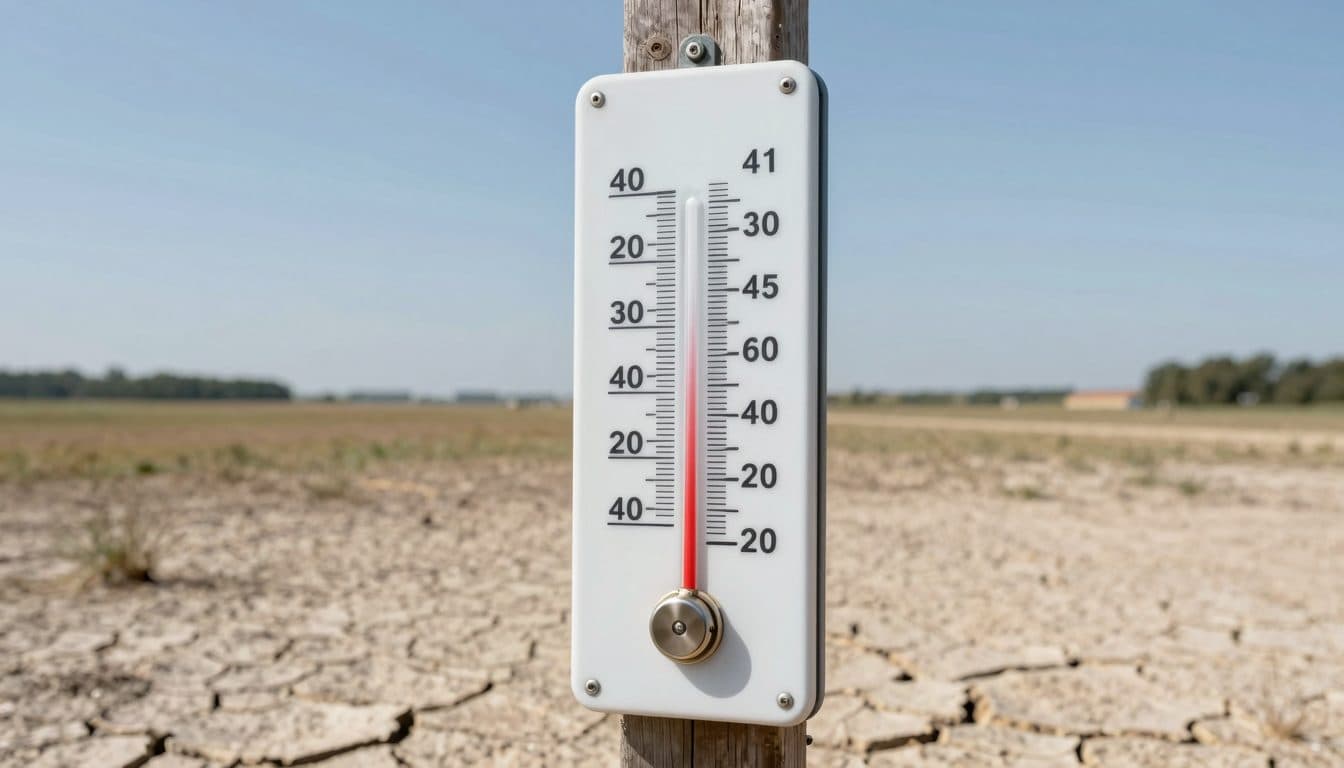
AI-generated image (z-image via Kie.ai)
Summary
According to preliminary DWD data, a new German temperature record of 41.7 degrees was measured in Coschen (Brandenburg) on Sunday afternoon. The heatwave has claimed at least five lives in Germany in swimming accidents and is causing massive disruptions to rail and road traffic.
Offenbach, June 29, 2026
The German Weather Service (DWD) measured the provisional German temperature record of 41.7 degrees Celsius in Coschen on the Brandenburg-Polish border on Sunday afternoon, while the ongoing heatwave in Germany and Europe has claimed several lives and is pushing infrastructure and healthcare systems to their limits.
What Has Changed Since the Previous Day
Update from June 29, 2026: The German Weather Service (DWD) has revised the provisional German temperature record upward. On Sunday afternoon, the measuring station in Coschen, Brandenburg (Oder-Spree district), recorded a value of 41.7 degrees Celsius at 3:10 p.m., as the DWD confirmed to tagesschau.de upon request. A quality control of these measurements is still pending. Previously, 41.3 degrees had been measured on Friday in Saarbrücken-Burbach and 41.4 degrees on Saturday at the same station. On Saturday, the Möckern-Drewitz weather station in Saxony-Anhalt had also shown 41.5 degrees.
What has changed since the previous day: The previous German all-time record stood at 41.2 degrees Celsius, measured on July 25, 2019, in Tönisvorst and Duisburg-Baerl in North Rhine-Westphalia. The fact that this value has now been exceeded three times within a few days is meteorologically remarkable. A new state record was also set in Baden-Württemberg over the weekend: in Waghäusel-Kirrlach (Karlsruhe district), the thermometer climbed to 41.4 degrees on Saturday, and the following day, according to preliminary figures, to 40.6 degrees. Hesse recorded 41.3 degrees on Sunday in Bad Nauheim and even 42.0 degrees in Frankfurt-Höchst. The night leading into Sunday was, according to the DWD, the warmest since records began in Germany, with a low of 29.4 degrees in Kubschütz (Saxony).
Background: Europe Under Extreme Heat
June 2026 has developed into the hottest month of the year so far across large parts of Europe. As the news agency AFP reported based on an analysis, at least 191 million people in Europe experienced temperatures above 35 degrees Celsius on Sunday. New record highs were also registered in our neighboring countries: in Doksany north of Prague, the thermometer initially showed 40.6 degrees, later 40.8 degrees, as the Czech national weather service CHMI announced. The previous Czech record had stood at 40.4 degrees. In Switzerland, a new June record of 38.8 degrees was set in Basel, and Denmark reported 37 degrees in Ødum north of Aarhus — the highest value since records began in 1874.
Health Consequences and Deaths
Health consequences: The WHO is concerned. WHO Director-General Tedros Adhanom Ghebreyesus wrote on the platform X that more than 1,300 additional deaths had been recorded in Europe since June 21 that were related to the high temperatures. In France, health authorities said they had registered around 1,000 additional deaths since Wednesday compared to previous months. According to a statement from Santé publique France on Sunday, those who died were mainly older people aged 65 and above. According to the WHO, the European region is warming twice as fast as the global average.
Swimming accidents and deaths: The extreme heat has claimed several lives in Germany. On Saturday evening, a 27-year-old drowned in the Neckar near Heidelberg, and a 30-year-old from Mannheim died in a swimming accident at a bathing lake near Neuhofen (Rhine-Palatinate district). Late on Saturday evening, a 22-year-old was recovered dead from the Elbe in Hamburg. At Seepark Lünen near Dortmund, visitors pulled a 45-year-old man lifeless from the water on Friday. In Hesse, a 40-year-old was recovered dead from the Waldsee Raunheim southwest of Frankfurt. In Berlin, a 51-year-old died at the Tempelhof harbor after a group in a rubber boat discovered an unresponsive person in the Jungfernheideteich in Charlottenburg.
Strain on emergency services: Nationwide, emergency services had to help or resuscitate people who had lost consciousness in heat-related emergencies. The Berlin fire department carried out more than 2,000 operations on Saturday, often due to dizziness and circulatory problems. In Dresden, the fire department recorded 318 operations, making it the busiest day of the year. The Cologne fire department was at its capacity limit, according to the city. In Schleswig-Holstein, control centers reported a turbulent night with more than 300 fire department operations.
Rail Traffic and Infrastructure Under Pressure
Care facilities under pressure: The heat hit older people and those in need of care particularly hard. Five seniors collapsed in a retirement home in Krefeld. In Dormagen, 16 residents of a facility had to be taken to hospital after the building heated up to over 35 degrees. Eugen Brysch from the board of the Patient Protection Foundation told the Evangelical Press Service that summer had only just begun and that many of the 800,000 care home residents were already suffering from the extreme temperatures. He criticized the existing heat protection plans as mere actionism.
Rail traffic massively affected: Deutsche Bahn and other rail transport companies had called on passengers to stay at home because of the heat and to postpone non-urgent long-distance and regional journeys. In Leipzig, the Leipzig Transport Company (LVB) suspended tram services until 3:30 a.m. on Monday due to heat damage to tracks and switches. In Nuremberg, tram operations were completely shut down. Several rail companies in North Rhine-Westphalia reported problems in the greater Essen area and at Düsseldorf Central Station. Hesse's Transport Minister Kaweh Mansoori (SPD) called on the railway to open first class at short notice so that older passengers, pregnant women, and families with children would not have to stand in overcrowded trains. At these temperatures, health is more important than the ticket price, he emphasized.
Power outages and infrastructure: Fires at several transformer stations led to power outages for numerous people, particularly in western Germany. Police, fire departments, and energy suppliers had to respond in Idar-Oberstein, Bonn, Kerpen, Duisburg, Mönchengladbach, and Weinheim. In the Mannheim area, technical defects triggered further power outages. Electricity consumption in the Rhine-Main region reached a new record of over 900 megawatts last Thursday, according to Netzdienste Rhein-Main — around 50 megawatts more than the previous peak. There are around 600,000 transformer or substations in Germany.
Roads and highways: Heat damage also forced measures on the roads. The A2 between Brandenburg and Saxony-Anhalt was partially closed over the weekend, and the ADAC imposed speed limits on certain routes. Deutsche Bahn stated that rail traffic was also suffering from the extreme temperatures.
Water Supply, Forest Fires, and Events
Water supply and appeals: The German Association of Towns and Municipalities called on citizens to save water. Its managing director, Berghegger, told the Neue Osnabrücker Zeitung that clubs should not waste water on tennis courts or golf facilities. If there is no understanding, authorities would have to resort to bans. In several municipalities, the water traffic light is on red: Rosenke warned that the drinking water reserve in the elevated tank was dropping because less water was flowing in than was being drawn off. Eventually the elevated tank will be empty. Then there will be no more drinking water. The water traffic light is therefore also on red in Fernwald. Mecklenburg-Western Pomerania's Social Minister Stefanie Drese (SPD) appealed to the population: Please look in on your neighbors, relatives, and fellow human beings this weekend and bring along a case of water.
Forest fire in Rhineland-Palatinate: Near Bad Kreuznach, the forest fire in the Rotenfels nature reserve continues to spread uncontrolled. The entire locality of Traisen had to be evacuated; during the night, 300 people had already had to leave the northern part of the town. More than 250 emergency personnel are trying to contain the blaze.
Disruptions to events: Numerous sporting events and major gatherings were canceled in Germany. In Hamburg, the half marathon and the Harley Days parade were called off due to the heat. At the Die Toten Hosen concert at Frankfurt's Waldstadion, the stadium roof remained closed because temperatures exceeded 40 degrees, to protect visitors from direct sun. At the Ironman European Championship in Frankfurt am Main, around 70 professional triathletes competed for the title despite the extreme heat — the organizer shortened the cycling course from 180 to 125 kilometers. The Berlin Philharmonic shortened their concert at the Waldbühne because thunderstorms were approaching.
Outlook: Thunderstorms and Cooling
Warning of thunderstorms: After a hot weekend, cooling is in sight — but accompanied by sometimes severe thunderstorms. The DWD warned for the night leading into Monday, particularly in southern and eastern Germany, of local thunderstorms with severe weather potential, hail, and heavy rain of up to 40 liters per square meter. Gusts of wind around 80 km/h and precipitation amounts between 15 and 25 liters per square meter per hour were also possible. For Monday, maximum temperatures between 25
Heat record Germany 41.7 degrees Coschen 6/29/2026 | allfacts360