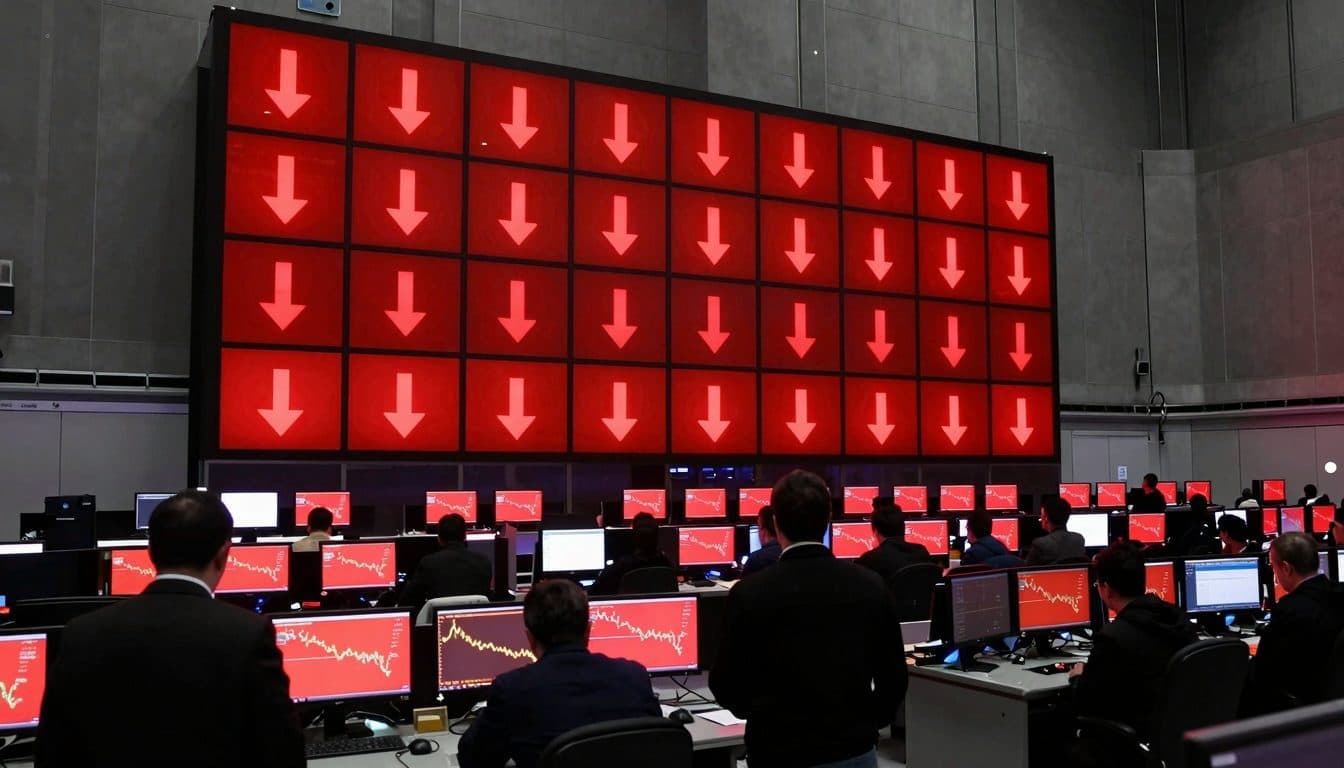
Heavy Losses on Asian Stock Markets: Semiconductor Stocks Plunge After Report on Chinese Technology Breakthrough
Frankfurt, 28 July 2026
AI-generated image (z-image via Kie.ai)
Summary
Following a report about a possible Chinese technology breakthrough in chip production machinery, semiconductor stocks in Asia came under massive pressure. South Korea's benchmark KOSPI index plunged by more than ten percent at one point, and the Nikkei lost four percent. Memory manufacturers such as SK Hynix and Samsung lost double-digit percentages in market value.
Frankfurt, 28 July 2026
The stock markets in Seoul and Tokyo collapsed on Tuesday due to drastic losses in semiconductor stocks, after a report about a possible Chinese technology breakthrough in machines for chip production fueled concerns about intensified competition and an AI bubble.
Asian Stock Markets Under Pressure
The price plunges on Asian stock exchanges followed losses in US tech stocks the previous day and were particularly severe. In South Korea, the benchmark KOSPI index plunged by more than ten percent at one point and fell by nearly eleven percent to a three-month low; due to its high proportion of tech stocks, the Kospi is considered a barometer for the AI rally in Asia. In Seoul, trading was halted for 20 minutes due to the heavy losses. In Tokyo, the Japanese Nikkei index lost four percent and fell at one point to a two-year low. The stock exchange in Taiwan also lost more than four percent.
The focus of the sell-off was on memory and semiconductor manufacturers. The world's largest memory manufacturer Samsung is down by more than 13 percent. Number 2 SK Hynix at nearly minus 15 percent. In the case of the third-placed Micron, the US home exchange is still closed, but in pre-market trading and in Europe it is heading in a similar direction at minus 7 percent. The former market darling Sandisk is posting minus 11 percent. In Tokyo, the share price of memory chip manufacturer Kioxia fell by 18 percent.
Semiconductor suppliers also came under significant pressure. The shares of semiconductor suppliers Advantest and Tokyo Electron each fell by about eleven percent. The Dutch chip machine manufacturer ASML had lost more than eight percent on the Amsterdam stock exchange; in later EURONEXT trading, the stock was quoted 1.87 percent lower at 1,403.00 euros. ASML had previously announced that it would deliver around 130 immersion systems in 2026. The Dutch chip machine manufacturer ASML had also lost more than eight percent on the Amsterdam stock exchange. The stock of chip giant TSMC also came under pressure.
Trigger: Report on Chinese Lithography Machines
The biggest loser in the DAX was German chip manufacturer Infineon. Thanks to better-than-expected figures from Mercedes and a strong recovery at Rheinmetall, the DAX was initially able to gain more than half a percent. By early afternoon, however, the German benchmark index had almost completely lost its daily gain again. On Wall Street, AI bellwether Nvidia had previously lost five percent on the Nasdaq. AI chip leader Nvidia had already slipped five percent on Monday, leading to a change at the top of the world's most valuable companies; Apple leads the list again with a market capitalization of just under five trillion US dollars, while Nvidia is currently at a good 4.7 trillion US dollars.
The trigger for the wave of selling was a report by the US portal The Information, according to which a state-backed company in China has begun series production of its own immersion DUV lithography machines. According to the report, the first devices are to be delivered to SMIC, Hua Hong Semiconductor and CXMT as early as this year, around five machines in 2026 and about 20 in 2027. The market for high-performance DUV machines has so far been dominated by the Dutch group ASML.
However, the new Chinese lithography systems are considered to be an older generation of technology and lag behind current ASML systems in performance and reliability. Reports that Chinese companies were developing their own deep-ultraviolet (DUV) lithography systems for semiconductor production had once again stoked fears that Chinese memory chip manufacturers could accelerate their capacity expansion and thus intensify competition in the global memory market, said Han Ji-young, analyst at Kiwoom Securities. "China will very soon supply the world with high-quality memory chips at lower prices," said Fan Liwen, portfolio manager at Shenzhen New Thinking Investment Management, also expressing conviction.
Memory Manufacturers Lose Massively
Stock market pages attribute uncertainty about the AI boom for the declining prices. China's recent successes in the chip industry and doubts about the immense investments in artificial intelligence (AI) have caused the share prices of semiconductor and AI companies worldwide to plummet. The industry barometer Philadelphia Semiconductor Index is now trading 21 percent below its record high on June 22. A key role is played by Samsung Electronics and SK Hynix, the two largest manufacturers of so-called DRAM chips; these are working memories that are installed in all modern electronic devices and are increasingly in demand, particularly due to the high requirements for AI servers.
Both South Korean companies have lost almost half of their market value since their record highs last month. In the worst case, investors have lost almost half of their investment. SK Hynix is at minus 46 percent, while Micron looks best at minus 21 percent. Sandisk is trading at minus 41 percent compared to the previous month. Although SK Hynix's market value has almost halved, the company has still recorded a gain of 138 percent since the beginning of the year; Sandisk even plus 155 percent. Samsung is worst off at plus 83 percent.
Despite the daily losses, memory manufacturers continued to lose value on a year-over-year basis. Numerous former stars in the returns sky lost well over ten percent of their market value today alone. The depositary receipts (Global Depositary Receipts, GDRs) traded here partly lag behind, but on the whole paint a similar picture. The values refer to the respective home exchanges, in the case of the world market leaders in memory, therefore to the Korea Exchange (KRX).
Nvidia has lost almost 20 percent of its market capitalization since its high in May, corresponding to a loss in value of one trillion dollars. The company recently announced a historic partnership with South Korean semiconductor manufacturer SK Hynix worth 500 billion US dollars, which also includes AI memory chips. In addition, according to a weekend report by the Wall Street Journal, Nvidia is negotiating a 250 billion dollar capital injection with OpenAI to build a new data center. Half of Nvidia's revenue comes from so-called hyperscalers such as Microsoft, Alphabet, Amazon and Meta.
Circular Business and Bubble Concerns
In the course of the AI boom, many manufacturers have focused on high-performance chips, which has led to bottlenecks in classic DRAMs. Unlike its competitors, Sandisk exclusively manufactures NAND flash modules and SSDs; the others also DRAM for working memory. Against this backdrop, Samsung Electronics had announced a 200 billion dollar deal with the US chip specialist Broadcom, which, however, did not stop the price slide. Apple boss Tim Cook is pushing the US government, according to an exclusive report by the Wall Street Journal, to allow the use of memory chips from Chinese manufacturers CXMT and Yangtze Memory Technologies (YMTC) in devices sold outside the USA.
Nvidia and other companies have to pay billions in penalties to memory manufacturers if they do not purchase the agreed quantities. Investor Michael Burry, known for his successful bet against the US real estate market from 2007, wrote on Substack that the AI chip business is concentrated on a small number of customers, creating a strong dependency. Major investors in the AI sector have additional lease obligations totaling 1.2 trillion dollars, of which 820 billion dollars relate to unfinished data centers. The rating agency Moody's estimates the direct debt of the major AI investors at 460 billion dollars.
Despite the parallels to the bursting of the dotcom bubble, observers warn against hasty conclusions. At least in the short term, however, a bursting bubble is hardly to be expected, since the companies hedge each other with long-term supply contracts. Market expert Daniel O'Regan of the investment bank Mizuho explained that the weakness in the semiconductor sector has no single trigger, but a bundle of reasons. A trader cited by dpa-AFX pointed out that there have been several false reports in the past about Chinese advances in immersion lithography, which raises doubts about the reliability of the current report.
Analysts and Context
Market participants reacted with mixed analyst assessments. For Micron Technology, RBC Capital Markets with an "Outperform" rating, Deutsche Bank AG with "Buy" and JP Morgan Chase & Co. with "Overweight" submitted positive assessments on 25.06.26; Goldman Sachs Group Inc., on the other hand, rated the stock as "Neutral". SK hynix wants to present its results for the second quarter of 2026 on July 29. CXMT, which had risen by an incredible 466 percent the previous day in Shanghai, itself lost only 1.6 percent in value on Tuesday; CXMT itself, which had risen by an incredible 466 percent in Shanghai the day before, lost only 1.6 percent in value today. With a market share of just under eight percent, the company is considered the world's number four in DRAM memories, and its IPO was, according to its own statements, the second-largest share issue on a Chinese mainland exchange since the IPO of the Agricultural Bank of China in 2010.
Commentators draw comparisons to the turn of the millennium. CNBC market commentator Jim Cramer said: In 2000 we learned something: You shouldn't grant loans to those companies that buy your own goods. Back then, telecom equipment manufacturers had helped their customers finance massive investments in fiber optic cables and mobile phone antennas through circular transactions. "But if the market should decide that it no longer wants to finance any more
Semiconductor Market Quake July 2026: SK Hynix, Samsung | allfacts360