CSD Attack Berlin: Reactions from Hesse | allfacts360
Hesse Responds to Attack on CSD in Berlin: Mourning, Political Debate, and Vigils
Wiesbaden, 27 July 2026
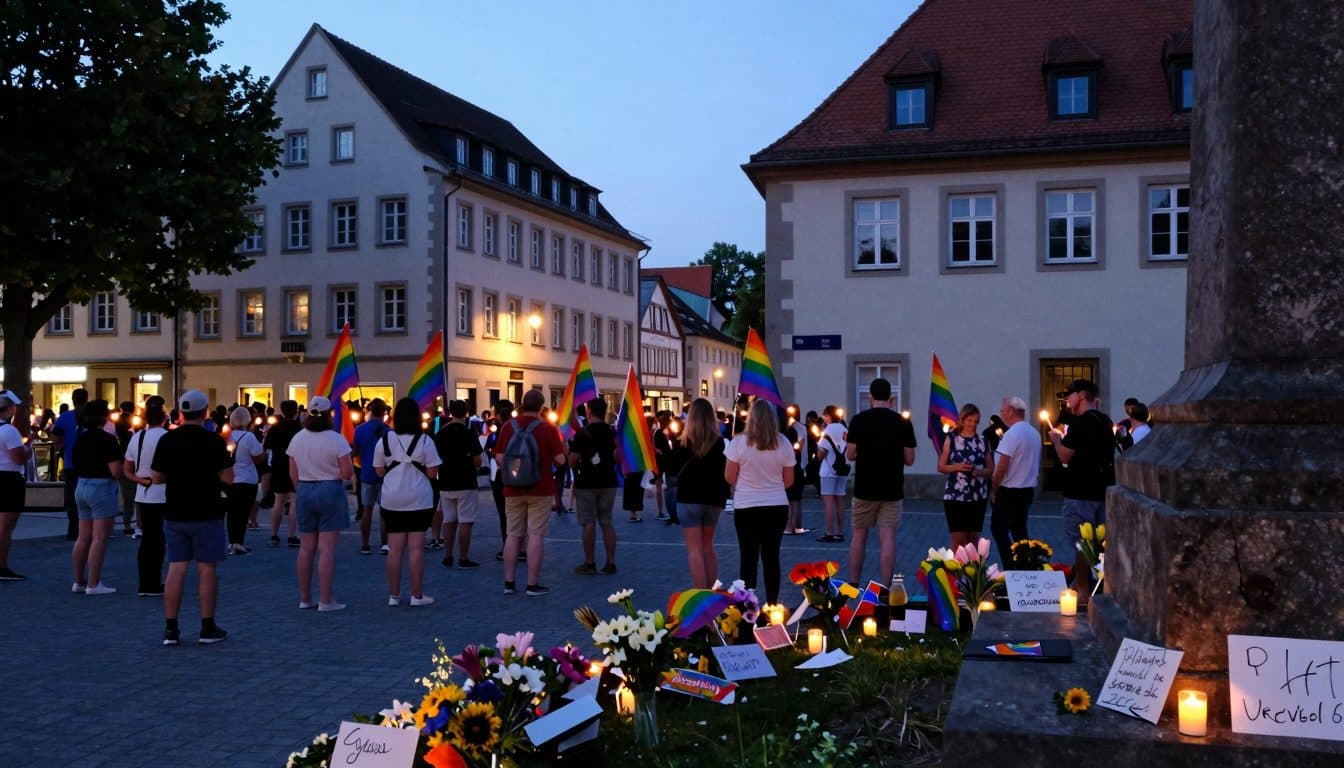
AI-generated image (z-image via Kie.ai)
Summary
Following the attack on Christopher Street Day in Berlin with one death and 29 injured, politicians from Hesse have responded with dismay. Vigils were held in Frankfurt, Darmstadt, and Kassel, while a political debate on Islamism and security has begun.
Wiesbaden, 27 July 2026
Following the car-ramming attack on a crowd at the edge of Christopher Street Day (CSD) in Berlin on Saturday evening, which left at least one person dead and 29 injured, politicians and civil society organizations from Hesse have responded with mourning, vigils, and political demands.
In the attack at the edge of the CSD in Berlin on Saturday evening, a car drove into a crowd. According to police, at least one person was killed and 29 others were injured, several of them with life-threatening injuries. On Sunday evening, police announced that the 21-year-old suspected Islamist was killed in a shootout.
Hesse's state politicians responded with strong words. Minister President Boris Rhein (CDU) called it a "feiger und unmenschlicher Akt" and announced a political assessment of the attack. On the platform X, he wrote: "Aktuell liegt der Fokus auf der Fahndung nach dem oder den Tätern und der Trauer um die Opfer. Danach wird die Tat auch politisch zu bewerten sein."
Political Reactions from Wiesbaden
Interior Minister Roman Poseck (CDU) also spoke on Sunday. He described Islamism as an "aktuelle Gefahr" to security and announced possible consequences. At the same time, Poseck stressed that there are currently no concrete indications of danger for Hesse and that existing security concepts for major events have proven effective.
The President of the Hessian State Parliament, Astrid Wallmann (CDU), expressed concern and pointed out that the state parliament hosts a rainbow reception every autumn. Miriam Dahlke, parliamentary managing director of the Greens in the Hessian State Parliament, summed up her faction's mood: They were "geschockt und fassungslos".
In Frankfurt, CSD Frankfurt and Fridays for Future Frankfurt called for a memorial event at the Römerberg on Sunday evening. The organizers also warned against instrumentalizing the attack for racist and Islamophobic agitation.
Vigils in Frankfurt, Darmstadt, and Kassel
The dead and injured were also mourned in Darmstadt and Kassel. The Darmstadt queer association Vielbunt invited people to a vigil at Luisenplatz. The group Fantasma – Revolutionäre Linke Kassel called for a minute of silence and a rally at Königsplatz on Sunday evening.
The SPD Hesse expressed itself on Instagram as "fassungslos, traurig und geschockt [...] angesichts dieses sinnlosen Verbrechens" and affirmed that every person has the right to live and love freely. Wiebke Knell, faction chair of the FDP in the Hessian State Parliament, condemned the "feiger Angriff" and called for decisive action against Islamist radicalization.
Parties and Civil Society
The chair of the Hessian AfD, Robert Lambrou, declared on Monday that politics must recognize that Islamism is the greatest danger in Germany and deploy all available means to combat it. The Working Group of Foreigners' Advisory Councils in Hesse (agah) responded with deep dismay; its chair Enis Gülegen called for a consistent approach against extremist and violence-prone structures.
The agah also named preventive measures: long-term secured prevention work, strong schools, school social work, open youth work, and counseling services. These are intended to counteract radicalization at an early stage.
Report from Berlin: Impressions of a CSD Participant
Adrian Knecht, Co-President of Pink Cross, the umbrella organization of gay and bisexual men in Switzerland, had himself taken part in the CSD parade in Berlin on Saturday. He recounted that he learned about the attack via a push notification and was no longer at the scene at that time. "Ich war schockiert, als ich davon über Push-Meldungen erfahren habe. Ich selbst war zu diesem Zeitpunkt nicht mehr vor Ort."
Knecht reported a "wahnsinnig grossen Solidarität und einen Zusammenhalt" within Berlin's queer community after the attack. At the same time, he described a changed perception in everyday life: "Wenn ich in Berlin auf die Strasse gehe, stelle ich fest, dass ich wachsamer bin." He himself, as a gay man, has the privilege of being able to decide when he wants to be visibly queer on the street – "Andere queere Menschen haben dieses Privileg nicht."
Berlin is a special city for the queer community, Knecht continued – "Es trifft Berlin mitten ins Herz." At the same time, he pointed out that Berlin is "gezeichnet von früheren Anschlägen auf andere Veranstaltungen" and that security measures at the CSD had been correspondingly extensive. At the parade, according to Knecht, hundreds of thousands of people were on the street "um Haltung zu zeigen. Haltung für Vielfalt, für queere Rechte."
For Knecht, visibility is part of his role as president of the umbrella organization: "Ich setze viel Wert darauf, sichtbar zu sein und Haltung zu zeigen und zu intervenieren, wenn ich etwas feststelle." Even in public spaces, there remains for visibly queer people "immer eine gewisse Unsicherheit da". He has "auch schon Anfeindungen erlebt, auf der Strasse in Berlin".
Following the attack, the CSD organizers advised against attending larger gatherings. On Sunday, there were vigils and memorial services. The political debate on the assessment of the attack, possible security implications, and the handling of Islamist radicalization had only just begun at the start of the new week.
Between Mourning and Political Assessment
The interview with Adrian Knecht was conducted by Martina Koch. No final figures on the number of attendees at the memorial events in Hesse were available on Sunday evening.
The Hessian responses illustrated the tension between mourning and political classification. While CSD Frankfurt explicitly warned against instrumentalizing the attack, representatives of the CDU, FDP, and AfD called for a more consistent confrontation with Islamism. The agah and parts of civil society, on the other hand, focused on prevention and long-term structural work against radicalization.
With regard to the security situation in Hesse, Interior Minister Poseck emphasized that existing concepts for major events had proven effective. The President of the State Parliament, Astrid Wallmann, renewed the state parliament's commitment to the queer community and referred to the annual rainbow reception. The SPD Hesse put it more generally: Every person has the right to live and love freely.
Overall, broad solidarity with the victims of the attack was evident across party lines and civil society groups. At the same time, the assessment of the attack, its political consequences, and the handling of radicalized structures remain the subject of a debate that is likely to continue in the coming days.
Questions & Answers
Who is Adrian Knecht and why is he quoted in this context?
Adrian Knecht is Co-President of Pink Cross, the umbrella organization of gay and bisexual men in Switzerland. He himself took part in the CSD parade in Berlin on Saturday and described his impressions after the attack in an interview with Martina Koch.
How have politicians from Hesse reacted to the attack?
Minister President Boris Rhein (CDU) spoke of a feiger und unmenschlicher Akt, Interior Minister Roman Poseck (CDU) described Islamism as an akute Gefahr. Greens faction managing director Miriam Dahlke expressed being geschockt und fassungslos, and FDP faction chair Wiebke Knell called for entschiedenes Handeln gegen islamistische Radikalisierung.
What memorial events took place in Hesse after the attack?
CSD Frankfurt and Fridays for Future Frankfurt called for a vigil at the Römerberg on Sunday evening, the Darmstadt association Vielbunt invited people to Luisenplatz, and the group Fantasma – Revolutionäre Linke Kassel organized a rally at Königsplatz.