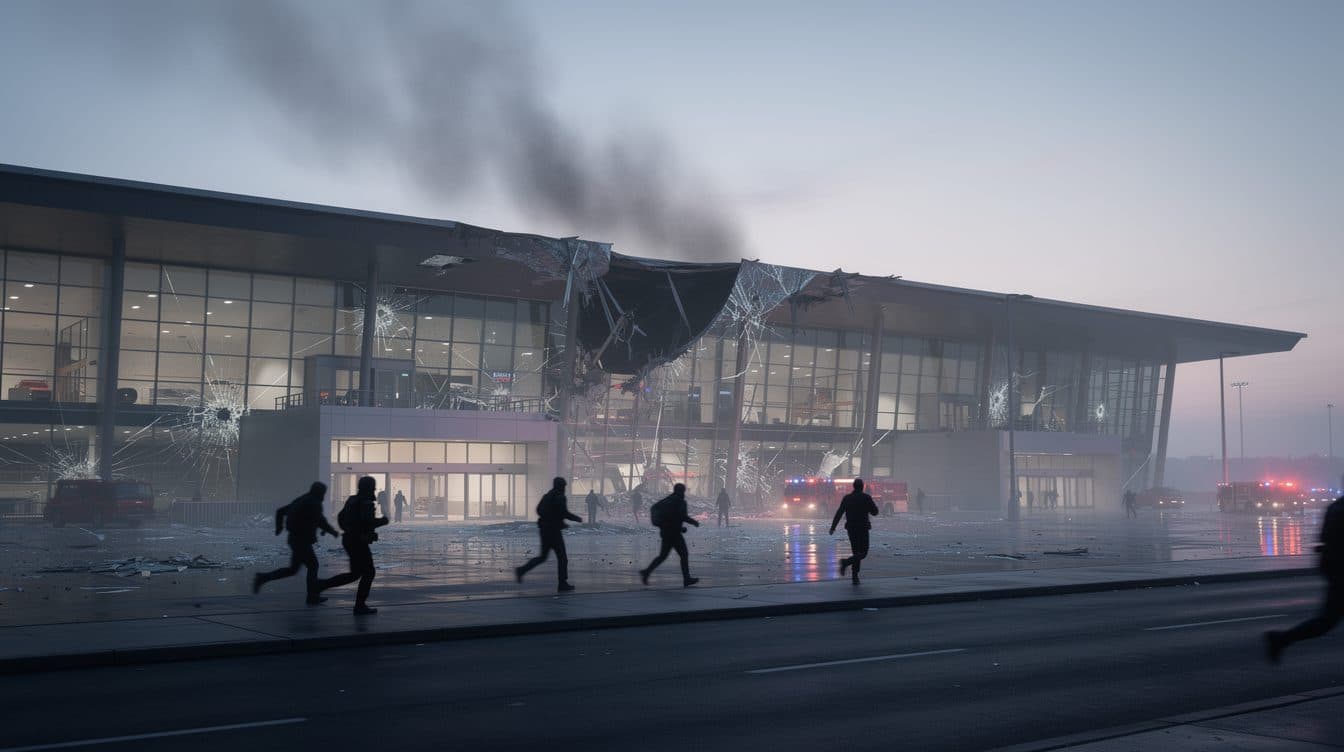
Iranian drone attack on Kuwait airport: One dead and 63 injured
Kuwait City, June 03, 2026
AI-generated image (flux-2/pro-text-to-image via Kie.ai)
Summary
One person was killed and 63 others injured in an Iranian drone attack on the airport in Kuwait. The attack occurred despite a ceasefire between Iran and the US and was part of a wave of retaliation following US attacks on Iranian targets.
Kuwait City, June 03, 2026
An Iranian drone attack on Kuwait International Airport on Wednesday morning claimed at least one life and left 63 injured, including travelers, airport staff, and civilians.
The attack occurred in the early morning hours of June 1, 2026, as air raid sirens sounded in Kuwait. According to the Kuwaiti army, Iran fired 13 ballistic missiles and 17 drones at the emirate since dawn. The Kuwaiti Ministry of Defense spoke of a "criminal Iranian aggression."
According to official reports, Terminal 1 of the airport's passenger terminal was significantly damaged. Images after the attack showed a destroyed departure hall, dense smoke, and fire. Diplomatic missions near the airport were also affected.
Attack and Casualties
According to the Indian Embassy, the deceased was an Indian national. The 63 injured include severe injuries such as head injuries, cerebral hemorrhages, amputations, and injuries from explosions, according to a spokesperson for the Kuwaiti Ministry of Health. Seven injured individuals have so far undergone emergency surgery.
The Iranian regime had previously announced the attacks and claimed responsibility. The Revolutionary Guards stated on Telegram that they had targeted the Ali al-Salem Air Base in Kuwait, where helicopters are stationed, as well as the headquarters of the US Fifth Fleet in Bahrain with missiles and drones. The Ali al-Salem base is located about 60 kilometers from the airport.
However, according to the US military, the Iranian attacks failed. Two missiles fired at Kuwait missed their target or broke up during flight, and three missiles fired at Bahrain were intercepted by US and Bahraini air defenses. A wave of Iranian drones was also repelled. No US personnel were injured.
The Iranian side justified the attacks as retaliation. The background was a US attack on an unloaded oil tanker near the Iranian island of Kharg, which is crucial for Iran's oil exports. It was reportedly attempting to call at an Iranian port despite the US blockade. The ship ignored warnings and was ultimately disabled by a missile.
Background of Retaliation
Furthermore, the US carried out a self-defense strike on the Iranian island of Qeshm in the Strait of Hormuz. In response, "self-defense strikes" were also carried out on Qeshm. The US rejected the Iranian claims that targets in Kuwait and Bahrain had been successfully hit.
The attacks occurred despite a ceasefire between Iran and the US, which has been in effect since April 8. Representatives of both sides accuse each other of violating the ceasefire. Talks on extending the ceasefire or definitively ending the fighting have so far yielded no breakthrough.
According to Tehran, the targets of the Iranian attacks were US military bases in the Persian Gulf states. The US and its allies station large military facilities in Kuwait and Bahrain. The Iranian Foreign Ministry denied responsibility for the attacks and accused Kuwait and Bahrain of "direct and unambiguous responsibility" for US attacks on Iran.
Several people were injured at the airport in Kuwait's capital, as a spokesman for the Ministry of Defense announced. Iranian missiles and drones had hit the airport building and damaged several facilities, according to the authority cited by the state news agency Kuna. Two dozen ambulances were deployed to treat the victims and transport them to hospitals.
Diplomatic Reactions
Kuwait responded with sharp diplomatic measures. The Ministry of Foreign Affairs declared two Iranian diplomats persona non grata and ordered them to leave the country within 24 hours. In addition, the number of staff at the Iranian embassy in the emirate will be reduced, it was stated. The acting Chargé d'Affaires of the Iranian Embassy was summoned to the Ministry of Foreign Affairs and received a formal protest note.
Commercial air traffic at the airport was temporarily suspended entirely. All flights scheduled for Wednesday were canceled or diverted to other airports. After several hours, the airport partially resumed operations, initially only from Terminal 4. The head of Kuwait Airways, Abdelmohsen al-Fakan, announced that the airport would reopen fully "very soon" and all flights would return to normal.
An emergency plan had been activated at the airport itself. The airport had already been attacked several times during the Iran War and had only resumed full operations on Monday. Air traffic in the Middle East has been severely restricted since the beginning of the Iran War at the end of February.
Stalled Negotiations
US President Donald Trump, despite contrary statements from Iran, reaffirmed on Tuesday that negotiations between Washington and Tehran regarding the Iran War were ongoing. Trump wrote on Truth Social that reports of talks being suspended were "false and misleading." He had told Iran it was time to reach a deal one way or another.
The Iranian news agency Fars, which is close to the Revolutionary Guards, reported, however, that no talks had taken place between Tehran and Washington for several days. The Iranian news agency Tasnim reported on Monday, citing Israeli attacks in Lebanon against the pro-Iranian Hezbollah militia, also the end of indirect negotiations.
The Iranian military spokesman confirmed retaliatory strikes by the Revolutionary Guards on the platform X. Any threat to the security of the Strait of Hormuz would "cost the US military dearly." Mohsen Rezai, military advisor to the Iranian Supreme Leader, threatened further attacks on X: "Every shot fired and every attack will be answered with a flood of missiles and drones. The aggressor will be punished immediately."
The Strait of Hormuz, which is of great importance to the global economy as an export route for fertilizer, oil, and liquefied gas, was controlled by Iranian forces shortly after the start of the war. The US has imposed a naval blockade to prevent Iranian oil exports and is pushing for an unrestricted reopening of the strait.
International Reactions
The German federal government strongly condemned the Iranian attacks on Kuwait and Bahrain. A spokesman for the Foreign Office stated: "Attacks on uninvolved parties and especially on civilian infrastructure are in no way acceptable and must cease immediately." German Foreign Minister Johann Wadephul (CDU) described the attacks as directed against the peace process and against uninvolved third parties.
The senior diplomat of the United Arab Emirates, Anwar Gargash, called on the Gulf states to take a united stance against Iran. "This aggression is not directed against a specific state, but against all of us." Kuwaiti air defenses intercepted several projectiles, according to the army.
Meanwhile, Trump announced on Wednesday that he could imagine a meeting with Iranian head of state Mojtaba Khamenei if the negotiations were successful. On Monday, Trump had hinted at an end to the fighting in Lebanon. Political talks between representatives of Israel and Lebanon are scheduled to continue today in the US capital, Washington.
From the beginning of the negotiations, Iran had insisted that a ceasefire with the US must also include an end to the fighting in Lebanon. Israel had expanded its attacks in northern Lebanon last week. After a phone call with Israeli Prime Minister Benjamin Netanyahu on Monday, Trump announced that Israel would refrain from attacks on Beirut and Hezbollah would cease attacks on Israel.
This news was broadcast on Deutschlandfunk on June 03, 2026. The US military's statements about the night's events could not be independently verified at first. The reporting is based on sources from dpa (German Press Agency).
Questions & Answers
Who is responsible for the attack on the airport in Kuwait?
The Iranian Revolutionary Guards stated that they had attacked the airport in Kuwait with drones. The Kuwaiti army spoke of a "criminal Iranian aggression."
How many people were injured in the attack?
According to the Kuwaiti Ministry of Health, one person was killed, an Indian national, and 63 others were injured, including travelers, airport staff, and civilians.
How did the US and Kuwait react to the attack?
The US rejected the Iranian claims of successful attacks and spoke of repelled attacks. Kuwait declared two Iranian diplomats persona non grata and ordered their departure within 24 hours.