Israel and Iran End Mutual Attacks Under Trump's Pressure – April Ceasefire Broken
Berlin, 08 June 2026
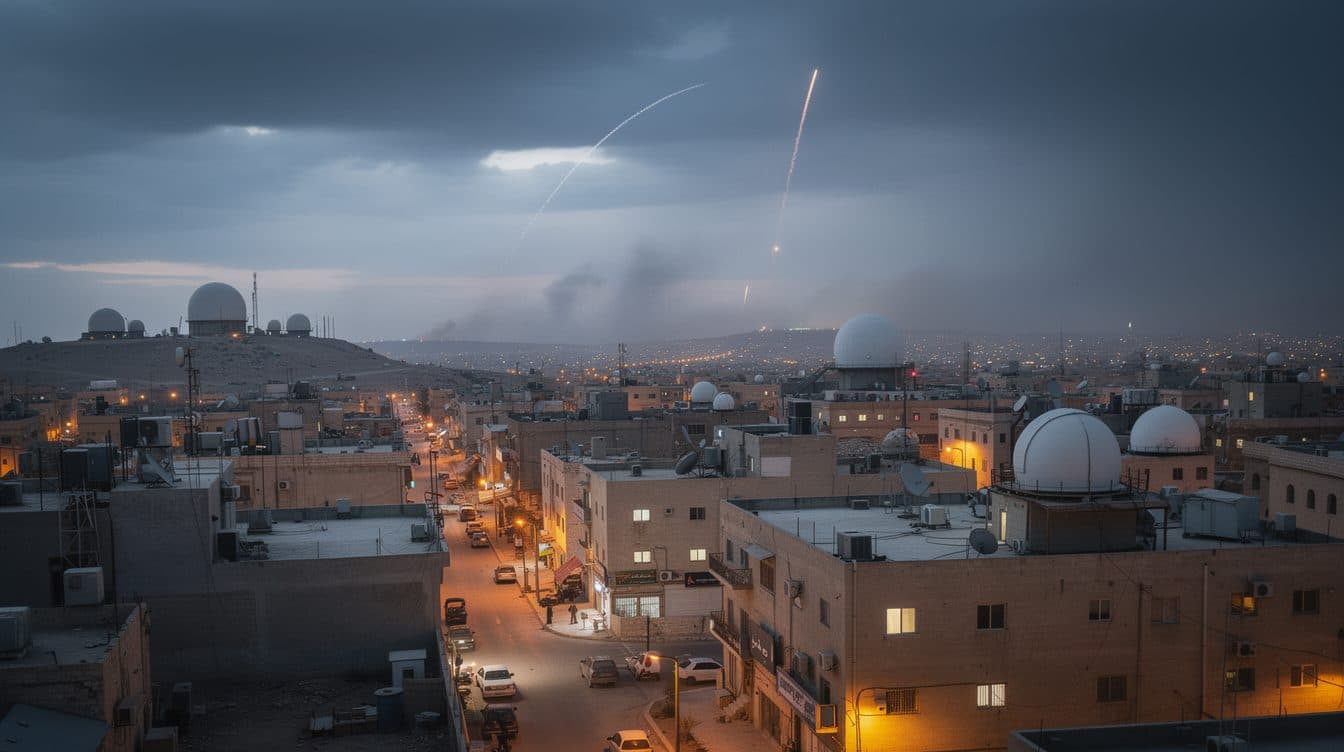
AI-generated image (flux-2/pro-text-to-image via Kie.ai)
Summary
After the first direct military exchange between Israel and Iran since the fragile ceasefire of 8 April, both sides have declared their attacks over. US President Donald Trump had publicly called on Israel and Iran to stop immediately and, according to his own account, prevented a counterstrike by Netanyahu.
Berlin, 08 June 2026
Israel and Iran declared their operations over on Monday after days of mutual shelling with rockets and airstrikes, following US President Donald Trump's public and telephone calls urging both sides to observe the ceasefire.
The escalation began late on Sunday evening with Iranian rocket salvos at Israel. According to an Israeli military spokesperson, Iran fired around 30 rockets at Israeli territory since Sunday evening. Most of the projectiles were intercepted according to the Israeli army or landed in uninhabited areas; damage to a petrochemical facility in Haifa was reported. The rescue organisation Magen David Adom initially registered no casualties from the Iranian attacks on Tel Aviv and Jerusalem.
The trigger for the Iranian attacks were Israeli airstrikes on suburbs of the Lebanese capital Beirut, which are considered a stronghold of the pro-Iranian Hezbollah militia. The Iranian Revolutionary Guards declared that the attacks on Hezbollah areas had crossed a "red line." AFP reporters observed several explosions over Jerusalem on Sunday evening; air raid sirens had been triggered beforehand. The Iranian leadership described its attacks on state radio as a "painful response" to the Israeli strikes in Lebanon.
Israel Iran Attacks Ended: Trump Stops Escalation | allfacts360
Israel responded in the night to Monday with airstrikes on targets in western, northwestern and central Iran, including the capital Tehran. According to its own account, the Israeli air force attacked nine air defence and radar systems as well as a petrochemical facility in the Iranian city of Mahshahr, where materials for rocket production are said to have been manufactured. Iranian state media reported several explosions in Tehran, Tabriz and Isfahan; according to Iranian figures, 15 people were injured.
Trigger: Strikes on Beirut
Israeli Prime Minister Benjamin Netanyahu ordered the counterstrikes, although Trump said he had urgently warned him in a phone call against a retaliatory strike. Trump told the US portal Axios: "I will call Bibi immediately and tell him not to strike back." In a phone call with Netanyahu the message had to be unambiguous that Israel should not strike back, well-informed sources reported. Israeli combat jets nevertheless flew attacks on Iranian launch facilities and the petrochemical industry.
Trump subsequently positioned himself publicly against Netanyahu. In an interview with the Financial Times he declared: "I am in charge. I am absolutely in charge. He is not in charge." He also said: "If Bibi strikes back, it will just continue as it has for the last 47 years or the last 3,000 years." On Monday he wrote on his platform Truth Social that Israel and Iran must "stop shooting immediately."
Trump's Pressure on Netanyahu
An unnamed Israeli government official told Reuters: "At Trump's request, we are stopping the attacks on Iran." From Israeli military circles it was also said that the attacks on Iran were being suspended for the time being. Israel would, however, continue its operations in southern Lebanon unchanged at full intensity, the office of the prime minister said.
Iran for its part declared on Monday via state broadcasting that the attacks on Israel were over. The military leadership simultaneously announced it would halt its operations but warned: "Against this background, the halt of the armed forces' operations is announced." Should Israel continue its attacks in Lebanon, Tehran threatened "harsher and more devastating measures." An official confirmation of the Iranian declaration was not available at the time of reporting.
Hezbollah in Lebanon, which, like the Revolutionary Guards, belongs to the Iranian "Axis of Resistance" network, fired at northern Israel with everything it had according to Israeli accounts. The Israeli broadcaster Kan reported that Israel would stop the attacks in Iran, but not in southern Lebanon. Israel considers Hezbollah the most dangerous threat on its northern border; the militia claims to possess a large rocket arsenal, combat experience and fibre-optic-guided drones, against which the Israeli army has so far found no answer.
Regional Expansion: Houthis and Hezbollah
On Monday morning the conflict spread regionally: the Iranian-allied Houthi militia in Yemen fired several rockets at Israel according to its own account, its first direct attack since early April. The Houthis also announced a "complete ban on Israeli shipping in the Red Sea" and threatened to block the Bab al-Mandab strait for ships connected to Israel. A Houthi spokesperson said the militia would respond to escalation with escalation. Shia militias in Iraq also declared their readiness to fight alongside Iran and threatened attacks on US bases.
Internationally, the escalation drew sharp reactions. EU foreign policy chief Kaja Kallas said at the ministerial meeting in Nicosia: "I think the region does not need further escalation" and called on the parties to the conflict to "return to the negotiating table." British Foreign Secretary Cooper also warned against a spread. Chinese Foreign Ministry spokesman Lin Jian called on both sides for restraint and stressed that the ceasefire must be observed by all parties to the conflict.
The German government, according to a government spokesperson, called on Iran to stop the attacks and to negotiate seriously, and appealed to "all sides" to de-escalate. Federal Foreign Minister Wadephul described Iran's announcement as a possible "important step." The Federal Ministry of Economics said it was monitoring the situation with concern but did not initially expect supply problems.
Economic Shocks
The economic consequences were felt immediately: Asian stock markets fell sharply at the start of the week, South Korea's KOSPI index lost 8.3 percent, Japan's Nikkei closed with a minus of 3.85 percent. European indices briefly dipped but recovered by early afternoon. The oil price shot up in the morning from 93 to nearly 98 US dollars per barrel, but fell to 94.5 dollars by the afternoon. Iran's closure of the Strait of Hormuz and the threats of the Houthi militia to block the Bab al-Mandab strait are considered significant risks for world trade.
India's oil minister Singh Puri warned of the consequences of further escalation for the international energy market. The EU imposed sanctions over Iranian threats to shipping. Qatar issued a NOTAM, a notice to pilots, to use alternative flight routes. The Iraqi authorities reopened their airspace, Syria extended its closure. Austrian Airlines cancelled its connections to Tel Aviv until further notice, the passenger number at Ben Gurion Airport was limited to 2,500.
The background to the current crisis is the fragile ceasefire that entered into force on 8 April between Israel and the USA on the one hand and Iran on the other, initially limited to two weeks but subsequently extended. Israel and the USA say they have been waging a joint war against Iran since 28 February with the declared aim of stopping the Iranian nuclear programme, weakening the rocket industry, striking Hezbollah in Lebanon decisively and creating the conditions for a change of power in Tehran. In the months of February and March, Iran had massively shelled the oil-rich Gulf states; since then Kuwait, Bahrain and the United Arab Emirates have again been targets of Iranian attacks.
Background: Fragile Ceasefire Since April
In early April, on the day the ceasefire came into force, the USA and Iran had agreed on an initially two-week ceasefire, which was later extended. The negotiations between Washington and Tehran on a permanent end to the war have so far produced no result. Iran ties an agreement to a complete withdrawal of the Israeli army from southern Lebanon and an end to the attacks on Hezbollah; Netanyahu in turn insists on a separation of the two fronts. Trump says he is prepared to examine the Iranian demands for the release of frozen funds of around 20 billion euros and an end to US sanctions only after a deal on the rocket and nuclear programmes.
Iranian Foreign Ministry spokesman Esmail Baghaei said that nobody believes Israel can carry out such attacks without coordination with the United States. He announced that indirect talks with the USA, mediated via Pakistan, would be continued, even if the negotiations had been "impaired" by the recent attacks. Lebanese Prime Minister Nauaf Salam made an almost imploring appeal to Iran: "Have mercy on our south and stop treating it and its people as mere bargaining chips to improve your negotiating positions." In the Israeli attacks on Beirut, two people were killed and 20 injured according to Lebanese figures; damage was caused to a UNESCO World Heritage site in Lebanon.
Diplomatic Efforts and Appeals
The Iranian Revolutionary Guard threatened to expand the attacks to the Gulf states and their energy infrastructure. Israel for its part announced that, in the event of renewed Hezbollah shelling, it would again attack suburbs of Beirut. Trump is under domestic pressure; congressional elections are due in November. The football World Cup in the USA, Canada and Mexico also begins next week.
Questions & Answers
Who triggered the direct exchange of blows between Israel and Iran?
The trigger was Israeli airstrikes on suburbs of the Lebanese capital Beirut, which are considered a stronghold of the pro-Iranian Hezbollah militia. The Iranian Revolutionary Guards declared that the attacks had crossed a "red line" and subsequently fired rockets at Israel.
What role did US President Trump play in the crisis?
Trump called on Israel and Iran via his platform Truth Social and in interviews to stop the attacks immediately. According to his own account, he urgently warned Netanyahu against a retaliatory strike in a phone call and publicly positioned himself against him in order to force an end to the violence.
What economic consequences did the escalation have?
Asian stock markets reacted with significant losses; South Korea's KOSPI fell by 8.3 percent. The oil price temporarily rose to nearly 98 US dollars per barrel, and Iran's blockade of the Strait of Hormuz as well as the Houthi militia's threats to block the Bab al-Mandab strait were considered significant risks for world