US–Iran Ceasefire Collapses as Israel Defies Trump and Strikes Iran; Tehran Vows to Resume if Beirut Front Reopens
Haifa, 8 June 2026
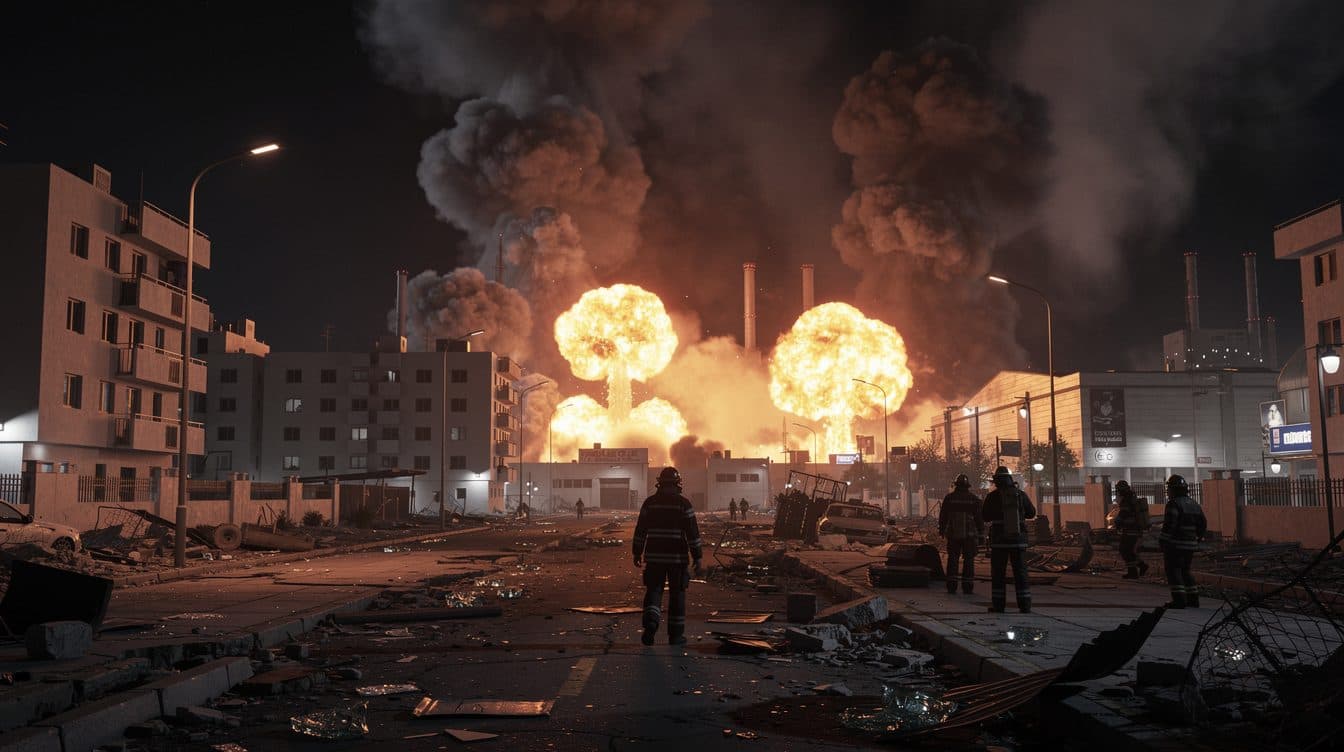
AI-generated image (flux-2/pro-text-to-image via Kie.ai)
Summary
A fragile two-month ceasefire between Iran and Israel collapsed on Sunday and Monday as Tehran launched ballistic missiles at northern Israel and Jerusalem, prompting Israeli jets to bomb Iranian air defenses and a petrochemical complex. US President Donald Trump publicly demanded that Israeli Prime Minister Benjamin Netanyahu halt retaliation, but Israel struck Iran anyway, exposing an unusually sharp rift between Washington and Jerusalem just as Trump seeks a deal before November's midterm elections.
Haifa, 8 June 2026
The two-month ceasefire between Iran and Israel broke down on Sunday evening when Iran fired roughly 30 ballistic missiles at northern Israel, the first direct strikes since early April, prompting Israeli warplanes on Monday to hit Iranian air-defense systems and a petrochemical facility in Mahshahr despite an explicit US request from President Donald Trump to stand down.
Strikes and Counterstrikes
Iranian state television reported "several" explosions in the capital Tehran as well as in the cities of Tabriz and Isfahan after the Israeli strikes. Mehr airport in northeastern Iran and the international airport in Tehran both suspended operations, and Iraq and Syria reopened their airspace as a precaution. Air defenses in central Iran, including in Yazd province, were activated to intercept enemy projectiles, and the Israeli Air Force said it had so far hit nine air-defense and radar systems plus a petrochemical complex where, according to the army, materials for missile production were being manufactured.
The Israeli military described the Monday operation as a "large-scale attack" in which dozens of fighter jets targeted "strategic defense systems" of the Iranian leadership. The Israeli ambassador to the United States, Yechiel Leiter, wrote on X: "Everyone is fed up with this insane Iranian regime." According to the Iranian news agency Fars, parts of the Mahshahr petrochemical complex were damaged. The Israeli broadcaster Kan reported that Israel would halt attacks on Iran but would continue them in southern Lebanon, where Israeli forces have been pressing operations against the Iranian-aligned Hezbollah militia, a campaign that triggered the latest exchange in the first place.
Trump vs. Netanyahu: An Open Rift
US President Donald Trump had urged Israeli Prime Minister Benjamin Netanyahu not to retaliate, telling the Axios news portal that he would call Netanyahu "immediately and tell him not to retaliate." In a phone call shortly after Iran's first salvos, Trump warned Netanyahu that Israel could become isolated if it expanded attacks, and in an interview with the Financial Times he said of Netanyahu: "I'm in charge. I absolutely have the say. He doesn't have the say." In a separate interview with the US portal Axios, Trump said: "If Bibi strikes back, it will simply go on like it has for the last 47 years or the last 3,000 years."
Israel carried out the strikes anyway. The Israeli military stated its intention to destroy rebuilt air defense systems and missile launch ramps in Iran, and Defense Minister Israel Katz has framed the campaign as a continuation of operations begun in February. The Israeli operation deliberately severed a US-Israeli joint framework: Israeli military circles said the country was cooperating with the United States on intercepting incoming Iranian missiles but was carrying out its offensive strikes on Iranian territory alone.
Tehran Warns of "Harsher Measures"
Iran's military headquarters, Khatam al-Anbiya, declared on Monday afternoon that its operation against Israel was over but warned that "härtere und vernichtendere Maßnahmen als bisher" — harsher and more devastating measures than before — would follow if Israeli attacks in southern Lebanon continued. The Revolutionary Guards said they had fired on a petrochemical facility in the Israeli port city of Haifa and on the Nevatim air base in southern Israel and the Tel Nof air base south of Tel Aviv. In a statement carried by state radio, Iran's armed forces said: "Vor diesem Hintergrund wird die Einstellung der Operationen der Streitkräfte bekanntgegeben."
The Sunday evening Iranian salvo marked the first time Tehran had attacked Israel since the ceasefire of early April, and the first time in the history of the conflict that Iran had bombed Israel in retaliation for an Israeli attack on a third country, according to Middle East expert Cyrus Schayegh. The triggering event was an Israeli strike on the southern suburbs of Beirut — the Dahiyeh, a long-identified Hezbollah stronghold — that killed at least five people and wounded 20, according to the Lebanese news agency NNA. The Revolutionary Guards cited those Beirut strikes as the reason for resuming missile attacks on Israel.
The Lebanon Front Reignites the War
Hezbollah, which is listed as a terrorist organization by numerous states and is also represented as a political party in the Lebanese parliament, had not been party to the Iran–US ceasefire and did not adhere to it. Israel continued intensive operations against the group on Monday, and Hezbollah in turn claimed multiple attacks on Israeli positions in South Lebanon. An AFP journalist near the border reported that the Israeli army had intercepted three projectiles fired from Lebanon at Israeli soldiers deployed in the south. The Israeli military said further Iranian missile salvos followed on Monday morning and that air defenses were working to "die Bedrohung abzufangen."
The escalation drew in additional Iranian allies. The Houthi militia in Yemen, allied with Tehran, fired at least one rocket toward Israel — the first direct Houthi attack on Israel since early April — and announced a closure of the Bab al-Mandab strait. The Iranian-backed Kataib Hezbollah militia in Iraq threatened new attacks on US military bases in the region if American forces directly joined the escalation. Iran continues to block most shipping through the Strait of Hormuz, through which roughly one-fifth of globally traded crude oil and liquefied gas is transported; Iran claims control of the waterway, a claim the United States rejects, and Iran's ambassador to Russia, Kazem Jalali, said the strait would be reopened under new conditions with Iran and Oman charging transit fees.
A Wider Coalition Joins the Fire
The United States, in turn, is blockading Iranian ports and using Apache helicopters to enforce the blockade of Iranian oil shipments and tankers in order to pressure Tehran to yield in the war. The United Arab Emirates, Kuwait and Bahrain had already been targets of Iranian airstrikes the previous week because of the presence of US troops on their soil, and the UAE has used Apaches to shoot down Iranian drones. On Monday, a US military helicopter crashed near the Strait of Hormuz; Trump said the pilots were "fine" and "nobody is injured."
Inside Israel, the immediate human cost appeared limited. AFP reporters observed several explosions over Jerusalem after air-raid sirens sounded, and at 10:00 p.m. on Sunday an alert warned residents of the greater Haifa area of incoming rocket attacks from Iran and instructed them to move near a shelter. All schools were initially closed, hospitals moved activities underground and postponed non-urgent procedures, and workers without workplace shelters were told to stay home. Passenger numbers at Tel Aviv's Ben Gurion airport were limited to a maximum of 2,500, and airlines including Austrian Airlines suspended connections until further notice. The rescue organization Magen David Adom reported no injuries from the Iranian attacks on Tel Aviv and Jerusalem.
Markets and Diplomacy React
The economic shock was sharper. Brent crude rose from $93 per barrel in the morning to nearly $98, a gain of more than five percent, before easing to about $94.50 by early afternoon. South Korea's Kospi index fell 8.3 percent at the start of the trading week, and Japan's Nikkei closed with a loss of 3.85 percent. European indices initially fell at the open but recovered by early afternoon. Indian Oil Minister Hardeep Singh Puri warned of the consequences of further escalation for the international energy market, and Chinese Foreign Ministry spokesman Lin Jian said in Beijing that the ceasefire must be upheld by all parties.
European and British leaders pressed for de-escalation. EU foreign policy chief Kaja Kallas, speaking before a meeting of EU defense ministers in Nicosia, Cyprus, said: "Ich denke, die Region braucht keine weitere Eskalation." British Foreign Minister Yvette Cooper and the German government also called on all sides to de-escalate. The German government urged Iran to stop the attacks and negotiate seriously.
Analysts See a New Strategic Reality
Analysts warned that the deeper damage may be strategic rather than military. Schayegh, interviewed in the article, said Iran is acting from a position of strength and has effectively created a new strategic reality: an automatic trigger in which an Israeli strike on Beirut, with American acquiescence, will more or less automatically bring Iranian missiles down on Israel. "Es ist das erste Mal in der Geschichte dieses Konflikts, dass der Iran Israel bombardiert, um einen israelischen Angriff auf ein drittes Land zu vergelten," he said. Schayegh added that Iran had militarily-strategically survived the 40-day war well but had suffered tremendous economic damage that is often underestimated, and that a new "balance of terror" with an automatic trigger was now in force. Oded Ailam, an expert at the Jerusalem Center for Security and Foreign Affairs and a former Mossad commander, said the current escalation creates an opportunity to pressure Iran in negotiations.
Iran expert Raz Zimmt of the Institute for National Security Studies (INSS) said the Iranian leadership was demonstrating that it no longer feels obliged to wait for an attack before responding and can impose new rules of the game on its enemies. Danny Citrinowicz, also of the INSS, said the Iranian leadership has repeatedly shown willingness to accept high costs in order to avoid compromising on its red lines. Iranian Foreign Ministry spokesman Esmail Baghaei said that "niemand glaubt, dass Israel solche Angriffe ohne Koordination mit den Vereinigten Staaten durchführen könne," and that the developments had increased Tehran's mistrust of Washington.
What Each Side Wants From a Deal
Iran has tied any deal to a halt of Israeli attacks on Hezbollah in southern Lebanon and is demanding the release of roughly 20 billion euros in Iranian funds frozen in the United States, as well as the lifting of US sanctions. Washington, in turn, has linked the release of frozen funds and the lifting of sanctions to a deal on Iran's missile and nuclear program. Iran denies seeking nuclear weapons, and its leadership wants any agreement with the United States to also secure the survival of Hezbollah, which Schayegh described as still the most important Iranian-aligned militia in the region despite its recent defeats.
Trump, who wants to present successes before the November midterm elections, told NBC: "We are very close to a deal, or I will bomb them into the ground." He told Fox News that Iran should "kehrt an den Verhandlungstisch zurück und schließt ein Abkommen," and said both Israel and Iran were seeking an "immediate ceasefire." He tied any ceasefire to the opening of the Strait of Hormuz. According to Fox News, Trump indicated the negotiations with Iran could reach a possible agreement "Monday, Tuesday, or Wednesday of next week." According to Axios, citing a US government official, Trump spoke with Netanyahu on Sunday and said an agreement with Iran was within reach. Iranian authorities said messages had been exchanged between Washington and Tehran up to the new attacks, but did not confirm whether contacts were continuing.
Iran's Foreign Ministry warned that peace negotiations that have been unproductive for weeks could fail. Israeli military circles said the Israel Defense Forces was preparing for a conflict with Iran lasting at least several days and was also prepared for a longer war. An unnamed senior Israeli government official told Reuters: "Auf Wunsch von Trump stellen wir die Angriffe auf den Iran ein," but added that the current escalation was, in his impression, "hinter uns." Prime Minister Netanyahu confirmed the ceasefire in a video message and warned that if Iran attacked Israel again, Israel would respond with full force. The US withdrawal from the Iran nuclear agreement negotiated by Barack Obama, and doubts among experts that Trump can negotiate a better one, continue to color the talks. Israel is scheduled to hold parliamentary elections in autumn. The FIFA World Cup is scheduled to begin on Thursday in the United States, Canada and Mexico.
Questions & Answers
What triggered the latest round of Iran–Israel attacks?
Iran fired roughly 30 ballistic missiles at northern Israel on Sunday evening — the first direct strikes since a ceasefire in early April — citing Israeli airstrikes on the southern suburbs of Beirut, a Hezbollah stronghold, as the justification. Israel retaliated on Monday with strikes on Iranian air-defense systems and a petrochemical complex in Mahshahr.
Why is the US–Israeli relationship under strain?
President Donald Trump publicly demanded that Prime Minister Benjamin Netanyahu refrain from retaliation, telling the Financial Times that he himself is "in charge" and that Netanyahu "doesn't have the say." Israel struck Iran anyway, with Israeli military circles saying the offensive was being conducted by Israel alone rather than jointly with the United States.
What do Iran and Israel each want from a deal?
Iran is demanding the release of roughly 20 billion euros in frozen funds, the lifting of US sanctions and an end to Israeli attacks on Hezbollah in southern Lebanon. Washington is conditioning sanctions relief on a deal on Iran's missile and nuclear program, and Trump has linked any ceasefire to the reopening of the Strait of Hormuz.