Israel resumes bombing in southern Lebanon as Hezbollah rejects ceasefire
Beirut, June 14, 2026
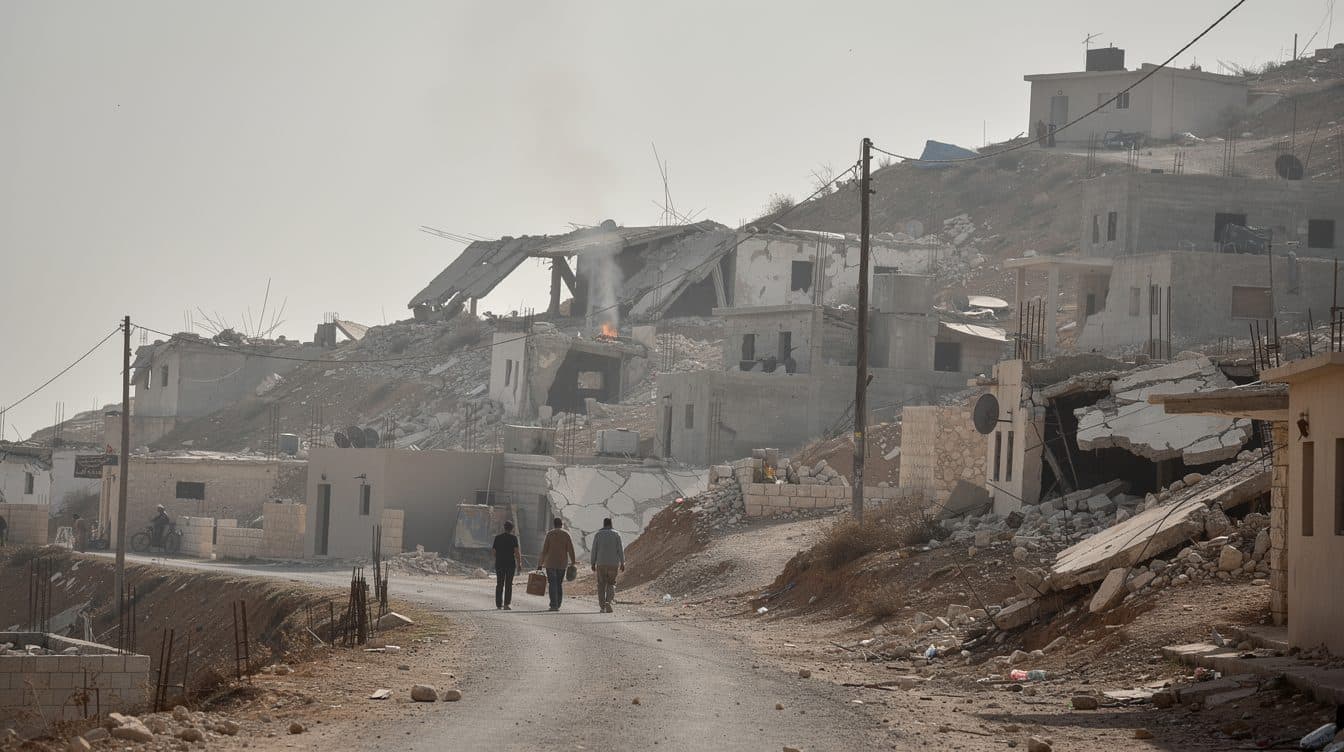
AI-generated image (flux-2/pro-text-to-image via Kie.ai)
Summary
The Israeli army bombed southern Lebanon after issuing evacuation warnings for 29 localities, while Hezbollah rejected the truce in place since April. Lebanese President Aoun described the situation as a decisive "test" for the country.
Beirut, June 14, 2026
The Israeli army resumed bombing in southern Lebanon this Saturday and issued new evacuation orders for dozens of localities, in an escalation that occurs despite the ceasefire formally in effect since April 17 and which was rejected by Hezbollah.
Background: a formal truce ignored on the ground
According to the Lebanese National News Agency (NNA), areas that had been subject to prior evacuation orders were bombed, including the villages of Rihan and Sudchud. "Gebiete, für die zuvor von Israel eine Evakuierungsanordnung herausgeben worden war, seien bombardiert worden, darunter die Dörfer Rihan und Sudchud", the state agency reported. In Rihan, in the southern district of Jesin, one person lost their life as a result of the attacks, according to NNA.
Previously, Avichay Adraee had issued two consecutive warnings on the social network X: the first for 13 localities in southern Lebanon and the second for 16 additional points north of the Sahrani River. In total, the military authorities urged the inhabitants of 29 localities to move north of the Sahrani River for their safety. The Israeli army declared that it would act "mit aller Härte", that is, with full force, against Hezbollah targets in the area.
The Israeli news portal ynet reported that a drone struck near the border town of Schlomi, with no injuries recorded. The Israeli army confirmed two impacts near the border with Lebanon and, hours later, announced it had intercepted a "feindliches Fluggerät", a hostile aerial device, that had penetrated northern Israel from Lebanese territory.
Evacuation warnings and Hezbollah's response
Before the evacuation calls, Hezbollah attacked northern Israel with explosive drones. Hezbollah itself stated that its fighters had carried out drone attacks against Israeli military vehicles in southern Lebanon and claimed to have engaged in combat with Israeli forces advancing toward the town of Majdal Sun. Hezbollah did not formally respond to the latest incident in particular.
The militia, which operates in Lebanon, rejected the ceasefire. "Die im Libanon agierende Hisbollah lehnt eine Waffenruhe ab", is emphasized in the gathered reports. "Eigentlich gilt im Libanon seit dem 17. April eine Waffenruhe", the press recalls, that is, in theory a ceasefire has been in effect in Lebanon since April 17, but "Israel und die Hisbollah-Miliz greifen sich dessen ungeachtet weiter täglich an": Israel and the Hezbollah militia continue to attack each other daily, disregarding what was agreed.
Hezbollah's rejection and President Aoun's call
In early June, Israel and Lebanon had agreed in a new push to implement the truce, but Hezbollah rejected it. Hezbollah's parliamentary representative, Ali Fajad, demanded on Saturday that "jede Vereinbarung zur Beendigung der Kämpfe zu nutzen", that is, that any agreement be used to end the fighting, although he noted that Lebanon must first abandon "die Politik der Unterordnung gegenüber den Israelis und des Gehorchens gegenüber den Amerikanern", the policy of subordination toward the Israelis and obedience toward the Americans.
Lebanese President Aoun declared on Saturday that Lebanon faces a "Bewährungsprobe", a decisive test. On the social network X, the leader called on Lebanese citizens to "sich um einen souveränen Staat zu scharen, der das Waffenmonopol innehat", to unite around a sovereign state that holds the monopoly on arms, so as to no longer be "Geisel der Logik der Milizen", hostages to the logic of the militias.
Iran and the diplomacy between Washington and Tehran
The regional context adds complexity to the crisis. The Israeli attacks in Lebanon constitute one of the central axes of the negotiations between Washington and Tehran to end the war in the Gulf region. "Die israelischen Angriffe im Libanon sind einer der Kernpunkte bei den Verhandlungen zwischen Washington und Teherän zur Beendigung des Kriegs in der Golfregion", according to diplomatic sources.
Iran, an ally of Hezbollah, seeks for a framework agreement with the United States to end the war to also include a ceasefire in Lebanon. "Der Iran fordert, dass ein Waffenruhe-Abkommen den Libanon einschließt", that is, Iran demands that a truce agreement cover Lebanon. Israel, on the other hand, firmly opposes linking both fronts (Iran and Lebanon) in a single understanding.
Humanitarian toll and affected areas
According to a senior US official, "das derzeit diskutierte Abkommen tatsächlich auch den Libanon umfasst", the agreement currently under discussion does include Lebanon, although Washington had previously indicated it would address this issue separately. This evolution in the US position has generated additional tensions with Israel, which defends the separation of the two war scenarios.
The humanitarian toll is devastating. "Libanesischen Angaben zufolge sind bei den israelischen Einsätzen im Libanon seit Anfang März mehr als 3.700 Menschen getötet worden": according to Lebanese figures, more than 3,700 people have been killed in Israeli operations in Lebanon since early March, when the country was dragged into Iran's war. On Friday night, NNA had already reported artillery attacks near Nabatieh.
On Saturday, a photograph dated June 12, 2026 showed smoke rising from the site of an Israeli airstrike that hit the southern Lebanese city of Nabatieh. On that same day, Hezbollah claimed that its fighters had confronted Israeli forces advancing toward a locality in southern Lebanon, at a time when Israel was continuing its bombing campaign on Lebanese territory.
Israel's stated objectives and Hezbollah's conditions
Four similar incidents had been recorded on Friday, in which some of the projectiles were not intercepted, although they did not cause significant damage, according to the Israeli army. The formal truce, in effect since April, thus coexists with a dynamic of daily violence that neither party seems willing to stop completely.
Israel declared that its objective in Lebanon is to destroy Hezbollah, "die Angriffe gegen israelische Soldaten im Süden des Libanons sowie aufs Nachbarland Israel fliegt", that is, the militia that launches attacks against Israeli soldiers in southern Lebanon and against the State of Israel itself. At the same time, the Israeli government aspires to reach a peace agreement with the Lebanese Government that contemplates the full withdrawal of ground troops.
Hezbollah, for its part, conditions any understanding on the complete withdrawal of Israeli ground troops from Lebanon. Following the death of Iran's supreme leader, Ayatollah Ali Khamenei, the pro-Iranian militia has repeatedly launched rockets at Israel, in an escalation that directly links the Iranian and Lebanese fronts and enormously complicates the search for a negotiated exit to the conflict.
The photograph accompanying the reports on the attacks is credited to Abbas Fakih, of the AFP agency, and shows the devastation left by the bombings in southern Lebanon, with columns of smoke visible over the affected localities. The image illustrates the persistence of violence despite the diplomatic efforts underway.
Questions & Answers
Why did Israel bomb southern Lebanon despite the ceasefire in effect since April?
The Israeli army issued evacuation orders for 29 localities in southern Lebanon and declared it would act "with full force" against Hezbollah, arguing that the militia continues to attack northern Israel with explosive drones. The April 17 truce coexists with daily attacks between both parties.
What is Hezbollah's position regarding an agreement to stop the fighting?
The pro-Iranian militia rejects the ceasefire and demands the complete withdrawal of Israeli ground troops from Lebanon as a precondition for any understanding. Its parliamentary representative, Ali Fajad, also asked that Lebanon abandon any subordination toward Israel and the United States.
What role does Lebanon play in the negotiations between the United States and Iran?
According to a senior US official, the agreement currently under discussion between Washington and Tehran also includes Lebanon, although Israel firmly opposes linking both fronts. Iran, an ally of Hezbollah, demands that a truce agreement also cover Lebanese territory.
Israel bombs southern Lebanon; Hezbollah rejects truce | allfacts360