Kyiv denies Russian claim of capture of Donetsk stronghold Kostiantynivka
Kyiv, 05 July 2026
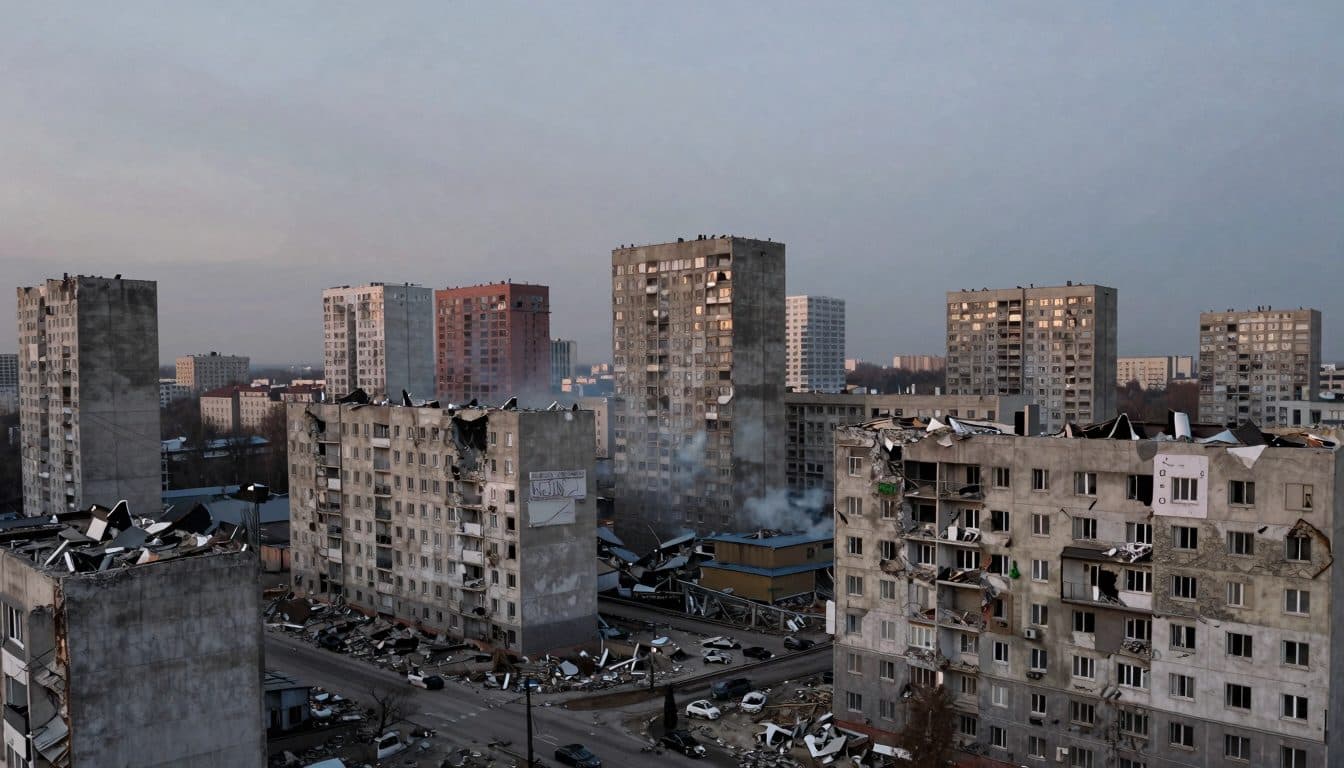
AI-generated image (z-image via Kie.ai)
Summary
Ukraine's military has rejected Moscow's claim that the eastern stronghold city of Kostiantynivka in the Donbas region has fallen to Russian forces. President Volodymyr Zelensky accused Moscow of spreading falsehoods ahead of the United States Independence Day celebrations.
Kyiv, 05 July 2026
Ukraine's military on Saturday rejected a Russian claim that the strategically important eastern city of Kostiantynivka in the Donbas region had been captured, with President Volodymyr Zelensky accusing Moscow of staging an information campaign timed to coincide with United States Independence Day celebrations.
The Kremlin announced on Friday that Kostiantynivka, one of four so-called fortress cities in the Donbas, was under Russian control. Ukraine's Armed Forces quickly countered the assertion. "We reject this," a representative of Ukraine's General Staff said on Saturday. "These are further false reports."
Army spokesperson Andriy Kovaliov described the Russian claim as "false." "The situation is difficult, but it is under the control of Ukrainian defense forces," Kovaliov said. The General Staff's morning report stated that fighting was continuing in the small city, which had a pre-war population of around 67,000.
President Zelensky dismissed the announcement in blunt terms during a telephone call with German Chancellor Friedrich Merz. "This is just the umpteenth Russian lie to get at least some piece of news into circulation," Zelensky said. He added: "The truth differs very much from Putin's words."
Strategic importance of the city
Kostiantynivka sits at the heart of Ukraine's eastern defensive belt. "We all know that this city is an important transportation hub and a large industrial center of the Donbas," Zelensky noted. He also pointedly suggested that if the city were truly under Russian control, Putin would have no problem meeting him there to find diplomatic solutions to end the war. "Moscow is the capital of the Russian Federation and not Kostiantynivka," Zelensky added, rejecting any visit to the Russian capital.
Moscow had framed the announcement as a battlefield success shortly before the United States marked 250 years of independence. Putin dismissed Ukraine's denial as an information campaign designed to showcase alleged achievements by Kyiv's leadership. The Institute for the Study of War assessed Putin's victory claim as an attempt to generate media attention in the run-up to the American holiday weekend.
The disputed city had a pre-war population of 78,000 and, according to other Ukrainian estimates, around 70,000. Its current population has shrunk to roughly 2,000 residents who have remained through more than three years of war. Kostiantynivka has been heavily contested since late 2025, when Russian forces intensified efforts to push deeper into the Donetsk region.
Echoes of a previous disinformation episode
Zelensky's reaction drew comparisons with a similar episode from December 2025, when Russia issued a premature claim of capturing a Ukrainian position only for Kyiv to demonstrate that Ukrainian forces still held ground. Analysts noted that the pattern of unverified battlefield announcements has become a recurring feature of the information war around the Donbas.
Ukrainian units of the 19th brigade remained deployed in and around the city, the General Staff emphasized, contradicting the Russian assertion that the urban area had been fully taken. The General Staff's morning update listed ongoing combat operations in Kostiantynivka, suggesting that any claim of complete control was premature at best.
Austrian military voices also weighed in on the dispute. Colonel Matthias Wasinger of the Austrian Armed Forces confirmed in an interview with Austrian public radio Ö1 that Ukraine still held positions in the city, lending outside corroboration to Kyiv's denial of the Russian claim.
Independent confirmation from Austria
The strategic significance of Kostiantynivka lies in its role as a logistics node for Ukrainian forces operating in the Donetsk region and in its position along defensive lines that have slowed Russia's eastern advance. Zelensky had recently stated that the Russian advance in the east had slowed noticeably since the start of the year, framing Kostiantynivka as emblematic of that broader defensive success.
Russia's defense ministry had stated on Friday that "the city is now fully under our control." That formulation, issued via the usual official channels, was the trigger for Ukraine's coordinated pushback, with officials in Kyiv rushing to publish statements, photographs, and audio from the city that they said demonstrated ongoing Ukrainian presence.
Kostiantynivka's fall, if confirmed, would mark one of the most significant Russian territorial gains of 2026 and would represent a major breach of Ukraine's eastern defensive chain. For now, however, Kyiv insists that the city remains contested and that Ukrainian troops continue to defend it.
What is at stake if the city falls
Outside analysts cautioned that battlefield claims from either side in this phase of the war tend to outpace verifiable reality, with control of urban areas often fluctuating street by street. The ISW assessment characterized Putin's announcement less as a battlefield fact and more as a signaling effort aimed at both domestic and international audiences in a symbolic news window.
The exchange underscores how the war's information front has tightened around moments of symbolic importance, with each side calibrating announcements to coincide with diplomatic milestones or foreign holidays. The July 4 timing of Russia's claim, coming at the start of America's independence celebrations, was read by many observers as deliberate.
For the remaining residents of Kostiantynivka, the verbal battle between Moscow and Kyiv has immediate physical consequences. Roughly 2,000 civilians remain in a city that was once home to nearly 70,000, and reports from the ground describe continued shelling, damaged infrastructure, and a steady trickle of evacuations from contested neighborhoods.
Civilians caught in the crossfire
Ukraine's Western partners are likely to study the situation closely. Whether Kostiantynivka has fallen or is still defended will shape assessments of the pace of Russia's eastern offensive and inform debates over the level of military assistance Ukraine requires heading into the second half of 2026.
Diplomatic channels have so far given no indication that the dispute over Kostiantynivka will derail existing frameworks of support for Ukraine, but it has sharpened the public exchange between Zelensky and Putin at a moment when both leaders are seeking to shape international perceptions of the war's trajectory.
The denial from Kyiv leaves the operational picture unsettled. Until independent verification is possible, the city sits in the contested gray zone that has come to define much of the fighting in the Donbas: too damaged to function as a normal urban center, too fiercely contested to be declared anyone's capital.
Questions & Answers
What is Kostiantynivka and why does it matter?
Kostiantynivka is a strategically important transportation and industrial hub in Ukraine's Donbas region and one of four so-called fortress cities in the east. Its capture would mark a significant breach of Ukraine's eastern defensive chain.
What exactly did Russia and Ukraine claim about the city?
Russia's defense ministry said on Friday that the city was fully under Russian control, while Ukraine's General Staff rejected the claim on Saturday and reported continued fighting inside the city.
How did Volodymyr Zelensky respond to the Russian announcement?
Zelensky called it the umpteenth Russian lie, said the truth differed very much from Putin's words, and suggested that if Russia truly held the city, Putin could meet him there to end the war.
Ukraine denies Russia capture of Kostiantynivka | allfacts360