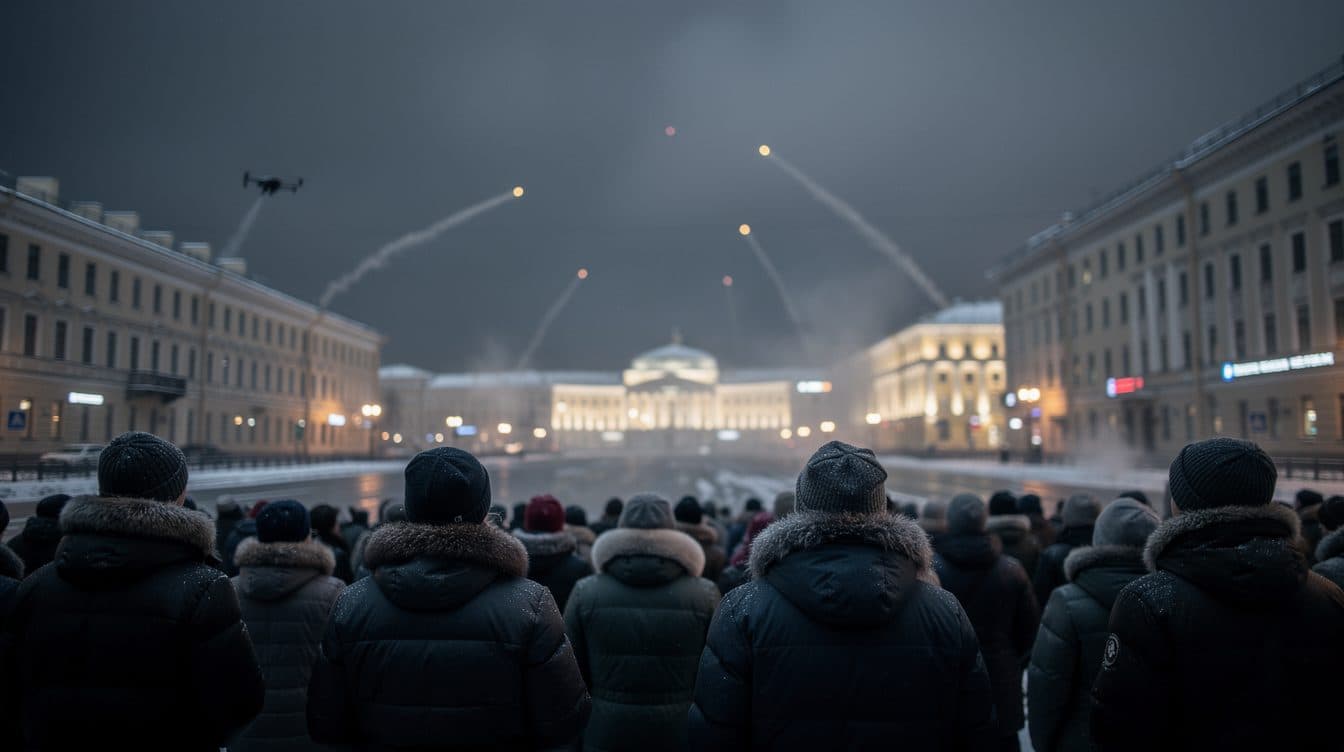
Ukrainian drones disrupt Putin's economic forum in St. Petersburg
Berlin, June 04, 2026
AI-generated image (flux-2/pro-text-to-image via Kie.ai)
Summary
Shortly before the start of the International Economic Forum in St. Petersburg, Ukrainian drones hit infrastructure in several districts of the city. At the same time, Ukrainian President Volodymyr Zelenskyy warned of a new major Russian offensive, while NATO Secretary General Mark Rutte arrived in Kyiv.
Berlin, June 04, 2026
Ukrainian drone attacks have hit parts of the infrastructure in St. Petersburg shortly before the International Economic Forum, with the participation of Vladimir Putin, began there; in parallel, Kyiv warned of an impending major Russian offensive.
According to Ukrainian sources, the drone strikes targeted an oil terminal in St. Petersburg, which is considered a logistics hub for Russian fuel exports. Russian authorities reported that the aircraft had been repelled, but damaged infrastructure and injuries were reported from the country's second-largest city. Images of smoke plumes over the port area circulated on social networks; the footage could not be independently verified at first.
The attack on the Russian export port occurred in close proximity to the International Economic Forum in St. Petersburg, which is considered a foreign policy showcase for the Kremlin leadership. In parallel, Kremlin chief Vladimir Putin canceled a naval parade planned for the day to mark Navy Day – officially due to the drone threat. Observers interpreted the timing as a deliberate humiliation of the Russian leadership by Ukrainian intelligence.
Drone attack on the port city
Meanwhile, in Kyiv, President Volodymyr Zelenskyy intensified his warnings of a new major Russian offensive. He referred to intelligence findings on troop movements and stated that the preparations of the Russian armed forces indicated a "large-scale offensive." "Zelenskyy said an escalation can happen at any time, and I completely agree with him," said Belarusian opposition politician Sviatlana Tsikhanouskaya during a visit to Kyiv.
Army Chief Oleksandr Syrskyi said on television that reconnaissance services had determined that the danger of a Russian attack from Belarus was growing. Syrskyi left open whether he was warning of an attack involving Belarusian soldiers or whether Moscow could use the neighboring country as an staging area. The general also named possible attack routes: medium-range drones could target the M-06 highway between Kyiv and Lviv, as well as the Ukrainian-Hungarian border crossing near Chop.
Warnings of a new major offensive
The US think tank Institute for the Study of War (ISW) had already outlined this scenario in a report at the end of May. According to the report, Russia could attack Western military aid transports for Ukraine from Belarusian territory. The Belarusian-Ukrainian border is more than 1000 kilometers long; during the major offensive in February 2022, Russian troops had already advanced towards Kyiv via Belarus.
The concern about a new escalation is fueled by indications of the deployment of the "Oreschnik" medium-range missile system in Belarus. According to the opposition group "Society of Belarusian Railway Workers," the missile has been moved to a former military airfield. The "Oreschnik" can carry nuclear warheads and thus reach any point on the European continent.
Parallel to the military situation, NATO Secretary General Mark Rutte traveled to Kyiv to signal solidarity. UN Secretary-General António Guterres "strongly condemned" the Russian attacks, as his spokesman announced. The French Foreign Ministry also joined the criticism and called on Russia to comply with international law.
Escalation via Belarus
On the eastern front, Russia has intensified its attacks, according to Ukrainian sources. In the night, Russian armed forces attacked Kyiv and Dnipro; Ukrainian authorities reported a total of 22 deaths in recent days. In the Russian-occupied part of the Donetsk region, seven people died and eleven others were injured in a drone attack, according to Russian sources. Fuel was rationed in Luhansk.
At the same time, the Ukrainian side expanded its drone campaign into the Russian hinterland. In Kazan, drones hit residential buildings and an industrial site, resulting in fires. No injuries were reported, according to Russian sources. The attack occurred a few days before an economic summit hosted by Putin, which was interpreted in Western capitals as a sign of the reach of Ukrainian reconnaissance.
Robert Brovdi, commander of Ukrainian drone units, wrote on social media that they had already identified 500 targets in Belarus that would be attacked in an emergency. Brovdi is considered one of the central figures in Ukrainian drone warfare. The publication was perceived as a threat in Minsk and further fueled tensions.
Counter-threats and speculation
Belarusian leader Alexander Lukashenko reacted immediately with a counter-threat. "We also know of a target in Ukraine, a very serious one, with exact coordinates, not far from Belarus," he said on Russian state television. Observers speculated whether Lukashenko might have meant a nuclear power plant – for example, the facility in Rivne, which is less than 80 kilometers from the Belarusian border. Others interpreted the remark as an indication of a possible attack on President Zelenskyy personally.
Tsikhanouskaya, who according to her own account received the most votes in the disputed presidential election of 2020, advocated for a joint security strategy in Kyiv. She pointed to the ongoing military cooperation between Minsk and Moscow, including joint nuclear exercises. At the same time, she warned of a possible mobilization in Belarus, which could draw the country even deeper into Russia's war course.
Members of the Belarusian opposition, organized in the "Kalinowski Regiment," are already fighting in the ranks of the Ukrainian armed forces. Political scientist Lyudmila Pokrovshchuk told the television channel Kyiv24 that the fighters of the unit could gain more influence in Belarus than Tsikhanouskaya because they could present themselves "more credibly as opponents of Lukashenko." The unit is named after the Polish-Lithuanian insurgent Kastus Kalinouski and enjoys a legendary reputation among the Ukrainian public.
Economic consequences and diplomatic situation
The economic consequences of the drone attacks on Russian refineries are now also visible in export statistics. According to industry experts, Russia must increase its oil sales to compensate for the failure of entire processing lines. This changes price formation on the world market and shifts trade flows – with direct consequences also for the EU, which, although it has reduced its imports from Russia, continues to feel indirect effects through third markets.
While diplomatic appeals increased, concrete steps towards de-escalation were absent. Neither Brussels nor Washington announced new sanctions packages beyond those already imposed. The Ukrainian leadership continues to push for the delivery of defense systems against ballistic missiles and cruise missiles; Russian drone attacks have systematically put pressure on the country's energy infrastructure in recent weeks.
Questions & Answers
What triggered the drone attack on St. Petersburg?
According to Kyiv, Ukrainian drones hit parts of the infrastructure in several districts of St. Petersburg, including an oil terminal. The attack occurred shortly before the International Economic Forum with the participation of Vladimir Putin.
What did Ukrainian President Volodymyr Zelenskyy warn about?
Zelenskyy warned, citing intelligence findings, of a new major Russian offensive. Army Chief Oleksandr Syrskyi also saw a growing danger that Russia could launch an attack from Belarus.
What role does Belarus play in the current escalation?
The Belarusian opposition reports the deployment of an "Oreschnik" medium-range missile in Belarus, and Lukashenko openly threatened an attack on targets in Ukraine. Observers fear that Belarus could serve as a staging area for a Russian offensive.
Drone attack on St. Petersburg ahead of economic forum | allfacts360