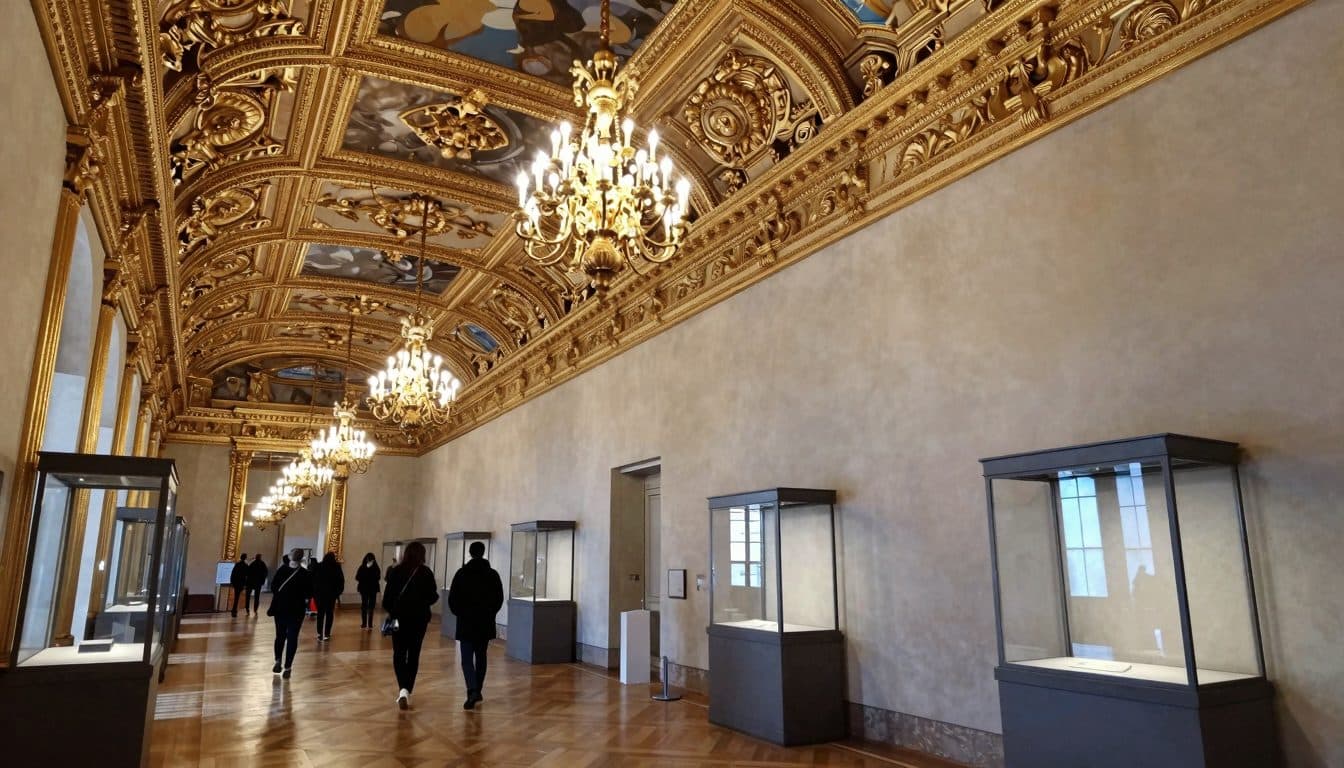
Louvre reopens Apollo Gallery after jewel heist – without its jewels
Paris, 21 July 2026
AI-generated image (z-image via Kie.ai)
Summary
Around nine months after the spectacular jewel heist, the Louvre is reopening the Apollo Gallery – but as an empty ceremonial hall without the crown jewels that were previously displayed there. The remaining pieces will be moved to a newly created, windowless vault.
Paris, 21 July 2026
The Louvre has reopened the Parisian Apollo Gallery around nine months after the jewel heist of October 2025 as a ceremonial hall, without showing the crown jewels once exhibited there.
The Galerie d'Apollon, one of the Louvre's most magnificent halls, reopened its doors on Wednesday – around nine months after the break-in – but as a largely empty space. Museum director Christophe Leribault announced that the collections and precious objects previously displayed in the hall would in future be moved to a windowless vault in another part of the museum. "We will create a secure space for them in another part of the museum – a windowless vault," said Leribault, according to AFP. However, it will still take some time before a suitable location is found and the financing of the extensive construction work is clarified.
The reason for the elaborate security measures is an incident from October 2025. At that time, four men had broken into the Apollo Gallery in broad daylight, entering the museum via a freight elevator. During the break-in in mid-October 2025, eight valuable pieces of jewelry, estimated to be worth around 88 million euros, were stolen, according to the report. The perpetrators have since been caught; however, there is still no trace of the stolen jewels.
The October 2025 Heist
The reopening of the gallery, which according to AFP is based on information from informed circles, was first reported by the French newspaper Le Parisien. Le Parisien also published an interview with Louvre director Leribault. In this conversation, Leribault explained that the stolen pieces could not be recovered and that the intangible or symbolic loss for the institution weighed more heavily than the material damage of 88 million euros.
In the interview, Leribault drew a comparison to the famous Mona Lisa: "This crown will be more famous than before – just as the Mona Lisa became after her theft in 1911." The museum director is convinced that the history of the crown will even enhance its radiance. This confidence may be surprising given a crime that has shaken France and the cultural world.
A Comparison with the Mona Lisa
The Apollo Gallery is to be brought back in line with its original 17th-century function – namely, as a so-called ceremonial or state gallery. Leribault compared the hall to the Hall of Mirrors at Versailles and spoke of a piece of the original royal palace that visitors could rediscover in today's museum. In future, the precious objects are to remain removed so that the ornate wall and ceiling decorations could once again come more strongly into their own, as the report further states.
The gallery's ceilings were designed in the 17th century by Charles Le Brun and later augmented by, among others, Eugène Delacroix. Without the relocated pieces of jewelry and collections, these artistic works will according to the museum come more strongly to the fore in the future. The hall is therefore being reimagined not only for security reasons, but also for curatorial considerations.
Return as a 17th-Century Ceremonial Hall
As the AFP news agency learned from informed circles, the crown of Empress Eugénie, which was damaged during the break-in, is currently being restored. Almost all elements of the crown have been preserved, Leribault explained. The crown itself is considered one of the most important pieces in the collection of French crown jewels.
An additional security concept provides that the remaining, non-stolen jewels from the Apollo Gallery have been moved to a secure location, according to Leribault. The decision to house all jewelry in future in a vault without windows is the direct consequence of the break-in. The Louvre wants to make a fresh start with the new presentation – "We want to make a fresh start," said Leribault.
This will, however, require extensive construction work. Leribault acknowledged: "This involves extensive construction work, but we must find the ideal location. And clarify the financing." When the vault can actually be occupied is currently unclear. What is clear is that for the time being, no jewelry will be on display in the Apollo Gallery after its reopening.
Vault Instead of Public Display
With the decision to open the gallery without its objects, the institution is making a clear break. For decades, crown jewels and precious objects stood at the center of visitor interest in the Apollo Gallery. Now the focus is shifting towards architecture, painting, and the historical impact of the space – a concept that ties in with the tradition of baroque gallery architecture.
The reopening on Wednesday came at a time when the investigation into the theft is not yet concluded. Although the suspected perpetrators have been arrested, the whereabouts of the stolen pieces remain unknown. The police and judiciary are continuing their investigations, while the Louvre is simultaneously making decisions about its future security architecture.
For visitors, the reopening means that they will be able to experience the hall in its baroque splendor – albeit without the familiar sight of the jewels. The experience will fundamentally change as a result, because the Galerie d'Apollon was considered for centuries the showcase of the French crown jewels and royal table silver.
Ongoing Investigations and Consequences
In the medium term, the Louvre also plans to give the crown more space after its return – both in terms of better security and improved visitor flow. These plans are part of a comprehensive concept intended to reorganize the presentation of the collection. The coming months will show whether and how the concept can be implemented in practice.
Parallel to the construction and restoration work, the investigations into the theft are continuing. The pieces remain missing, and the search for the perpetrators and any possible backers is not yet complete. The Louvre sees itself compelled to respond to the theft with a fundamental reorganization – aesthetically, in terms of security, and organizationally.
The reporting on the reopening was distributed by AFP on 21 July 2026; one day later the report appeared via APA. The original news of the planned reopening comes from Le Parisien. Multiple editorial desks are thus bundling information from Paris – an indication of the great international interest in the case.
Questions & Answers
When is the Apollo Gallery at the Louvre being reopened?
The Apollo Gallery at the Louvre was reopened on Wednesday, around nine months after the jewel heist of October 2025 – but as an empty ceremonial gallery without the pieces of jewelry previously displayed there.
What happened to the stolen crown jewels?
During the break-in in October 2025, eight pieces of jewelry worth around 88 million euros were stolen. The suspected perpetrators have been arrested, but the stolen jewels remain missing.
Where will the remaining jewels be kept in future?
Louvre director Christophe Leribault announced that the remaining pieces of jewelry will be housed in a newly created, windowless vault in another part of the museum.
Louvre reopens Apollo Gallery after heist without jewels | allfacts360