Lufthansa Dreamliner nose gear collapses at Frankfurt Airport, injuring five crew members
Frankfurt, 05 June 2026
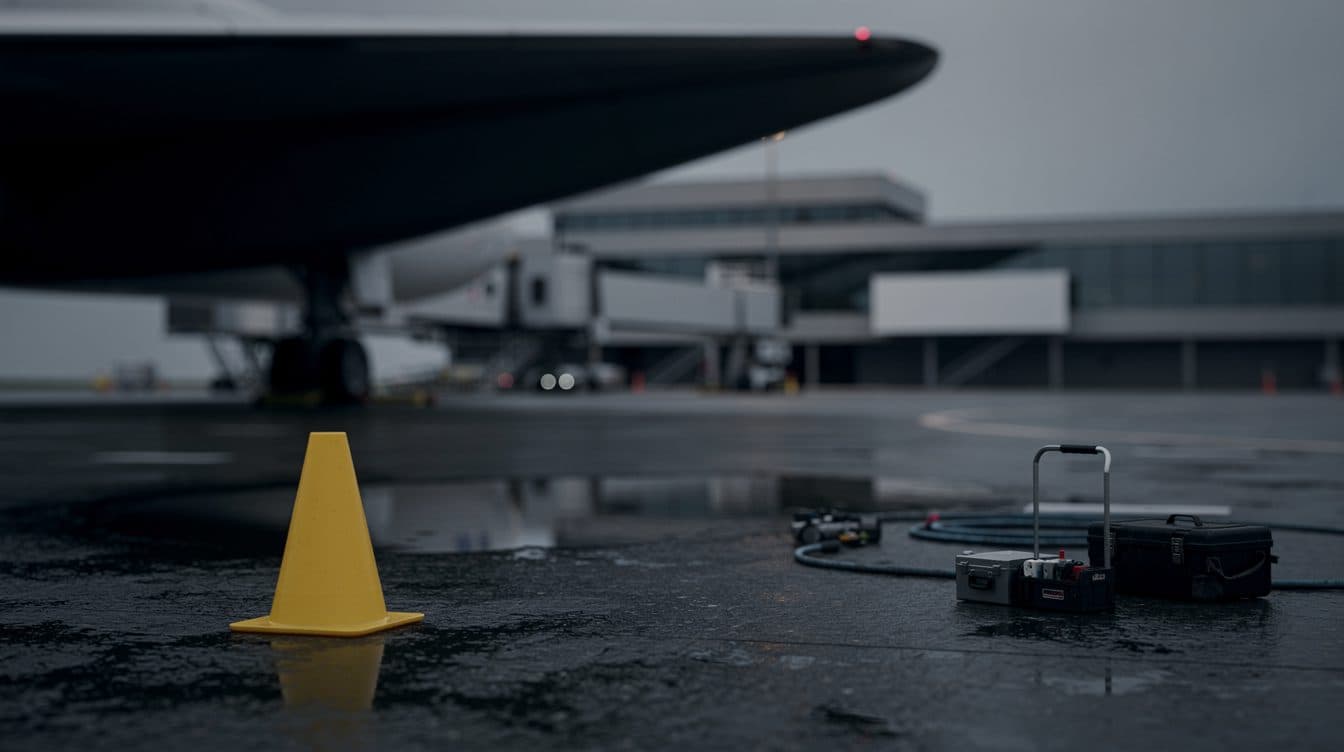
AI-generated image (flux-2/pro-text-to-image via Kie.ai)
Summary
The nose landing gear of a Lufthansa Boeing 787-9 Dreamliner collapsed while the aircraft was parked at Frankfurt Airport's Terminal 1 on Thursday, injuring five crew members. No passengers were on board at the time, and the cause of the collapse is under investigation.
Frankfurt, 05 June 2026
The nose landing gear of a Lufthansa Boeing 787-9 Dreamliner unexpectedly collapsed at a parking position in front of Frankfurt Airport's Terminal 1 on Thursday, injuring five people and prompting an investigation by Germany's aircraft accident investigators.
The incident occurred at approximately 12:45 p.m. at boarding position A15, according to information from the German press agency dpa. The aircraft, a brand-new Boeing 787-9 Dreamliner operating as flight LH450, had just arrived from the United States and was scheduled to depart at 1:50 p.m. for Los Angeles. Passengers were waiting to board and had not yet entered the aircraft when the nose gear buckled, causing the plane to sink nose-first onto the apron.
No passengers were on board at the time of the incident. The 13 Lufthansa crew members and several employees of partner companies were the only people inside the aircraft. Two Lufthansa cabin crew members and several employees of service companies were taken to a hospital for medical treatment; the injured members of the 13-person Lufthansa crew were able to leave the hospital by the evening, the airline said. "Alle anderen Mitglieder seien betreut und ihre Heimreise organisiert worden," Lufthansa stated.
Expert raises maintenance hypothesis
Aviation expert Heinrich Großbongardt, a former Boeing spokesperson, told hr-INFO in an interview that passengers were never at risk. "Die waren zu keinem Zeitpunkt in Gefahr," Großbongardt said, when asked by interviewer Werner Schlierike. However, he added: "Das war nichts Gravierendes und da befanden sich nur die Menschen, die in dem Moment um das Flugzeug herum standen. Für die gab es ganz sicherlich eine Gefahr." The danger, he explained, applied only to people standing around the aircraft at the time of the collapse.
Investigators from the German Federal Bureau of Aircraft Accident Investigation, the Bundesstelle für Flugunfalluntersuchung, have begun examining the cause of the collapse. "Die Ursache ist noch unklar," according to the dpa report. Authorities said it will take time before findings are available, and a final report is expected to be issued in due course. The damaged aircraft was scheduled to be moved into a maintenance hangar during the evening for further inspection.
How a turnaround works at Frankfurt
Großbongardt raised the possibility that a safety pin designed to lock the nose gear during maintenance work may have been forgotten or not inserted. "Das ist denkbar oder auch nicht auszuschließen, dass vergessen wurde, diesen Sicherungsbolzen, den man nur für bestimmte Wartungsarbeiten einsetzen muss, überhaupt einzusetzen," he said. The accident investigation, he stressed, will determine the actual cause. He noted that a similar incident occurred with a British Airways aircraft in Great Britain five years earlier, in which a safety pin in the landing gear had reportedly been inserted incorrectly by ground personnel. In that case, a fault message indicated that a nose gear door had not closed properly, leading to a repair decision before the next flight.
Großbongardt explained that nose landing gears on aircraft retract forward, against the direction of flight, a design intended as a safety feature. The forward-retracting configuration ensures that in case of a technical problem, the landing gear can extend by gravity with assistance from the airstream. Despite this design redundancy, the Frankfurt incident shows that a failure can still occur while the aircraft is stationary on the ground.
A Fraport spokesperson described the so-called turnaround process as a finely coordinated sequence of activities involving multiple partners. "Ein sogenannter 'Turnaround' beinhaltet fein aufeinander abgestimmte Prozesse, die durch verschiedene Partner durchgeführt werden," the spokesperson said. For arriving aircraft, the parking position is checked and cleared, the ground crew secures the aircraft with chocks and pylons, and ground power is connected. Stairs and passenger boarding bridges are attached, the cabin is cleaned, waste water is disposed of, and the aircraft is refueled and supplied with fresh water. In winter, de-icing is performed if necessary.
Fleet and repair outlook
For departing aircraft, passengers board, baggage and catering are loaded, and a pushback is carried out in which a special vehicle pushes the aircraft from its parking position. According to Fraport, the airline also carries out additional activities related to the aircraft's airworthiness. The time available for a turnaround depends on the aircraft type and contractual agreements, with a guideline of 45 to 90 minutes. The group size on the aircraft position typically ranges between four and six people, depending on aircraft type, though many additional operational staff work in the background, for example in loading or bus driving.
Lufthansa currently has 17 Boeing 787 Dreamliners in its fleet, according to the company. The other 16 aircraft are permitted to continue flying. The damaged aircraft will be out of service for several months for repairs. The nose landing gear will need to be replaced, and the carbon-fiber fuselage structure will be inspected for cracks, with any damage repaired. The aircraft was a recent addition to Lufthansa's long-haul fleet, having only recently been put into service.
Possible procedural changes ahead
The final report by the aviation accident investigators may recommend adjustments to maintenance procedures. One possible recommendation, Großbongardt suggested, would be to require a second technician to verify the safety pin before the landing gear lever is moved in the cockpit. Such procedural changes, if adopted, could apply across the industry and not just to Lufthansa. For now, investigators are gathering evidence at the scene, and a comprehensive account of what caused the nose gear to fail on a brand-new aircraft parked at one of Europe's busiest hubs will only emerge after detailed technical analysis.
Thursday's incident at Frankfurt, Germany's largest aviation gateway, drew immediate attention because of the aircraft involved. The Boeing 787 Dreamliner is a wide-body long-haul jet known for its fuel-efficient engines and composite fuselage. A nose-gear failure on the ground, while not catastrophic in outcome given the absence of passengers, nonetheless raises questions about ground-handling and maintenance protocols at a major hub.
Aircraft and investigation context
Lufthansa said it was cooperating fully with investigators and had organized care and return travel for the uninjured crew members. The airline did not immediately provide details on the exact nature of the injuries sustained by the five people taken to hospital, though it confirmed that all injured Lufthansa crew had been released by the evening. The airline emphasized that safety remained its top priority and that the incident would be reviewed in line with the investigation's findings.
Großbongardt's comparison to the British Airways case underscored that the Frankfurt incident is not unprecedented. In the earlier British incident, a safety pin that was supposed to prevent the nose landing gear from retracting was incorrectly installed by ground personnel, and a fault message prompted a repair decision before the next flight. The recurrence of such an event, Großbongardt suggested, points to the need for layered checks in maintenance routines, particularly for safety-critical components like landing gear locks.
The incident also highlights the complexity of the turnaround process at a major international airport. With multiple partners handling fueling, baggage, catering, cleaning, and aircraft servicing in a compressed window, any failure in coordination or in a single safety step can have outsized consequences. Fraport's description of finely coordinated processes reflects the operational reality at Frankfurt, where dozens of staff from various companies converge on a single aircraft during each turnaround.
Questions & Answers
What happened to the Lufthansa Boeing 787-9 at Frankfurt Airport?
The nose landing gear of a Lufthansa Boeing 787-9 Dreamliner collapsed while the aircraft was parked at boarding position A15 in front of Terminal 1 on Thursday at around 12:45 p.m., causing the plane to sink nose-first onto the ground. No passengers were on board; the 13 Lufthansa crew members and several partner-company employees were the only people inside.
Who was injured in the Frankfurt nose-gear incident?
Five people were injured, including two Lufthansa cabin crew members and several employees of service companies, all of whom were taken to a hospital for treatment. The injured Lufthansa crew members were able to leave the hospital by the evening, according to the airline.
What did aviation expert Heinrich Großbongardt say about the cause?
Großbongardt, a former Boeing spokesperson interviewed by hr-INFO, said it is conceivable that a safety pin designed to lock the nose gear during maintenance was forgotten or not inserted, and he compared the case to a similar British Airways incident in which a safety pin was reportedly installed incorrectly. He stressed that the actual cause will be determined by the accident investigation.
Lufthansa 787 nose gear collapses at Frankfurt Airport | allfacts360