Meinl-Reisinger China Trip: Shanghai, Economy, and the UN Security Council
Vienna, June 25, 2026
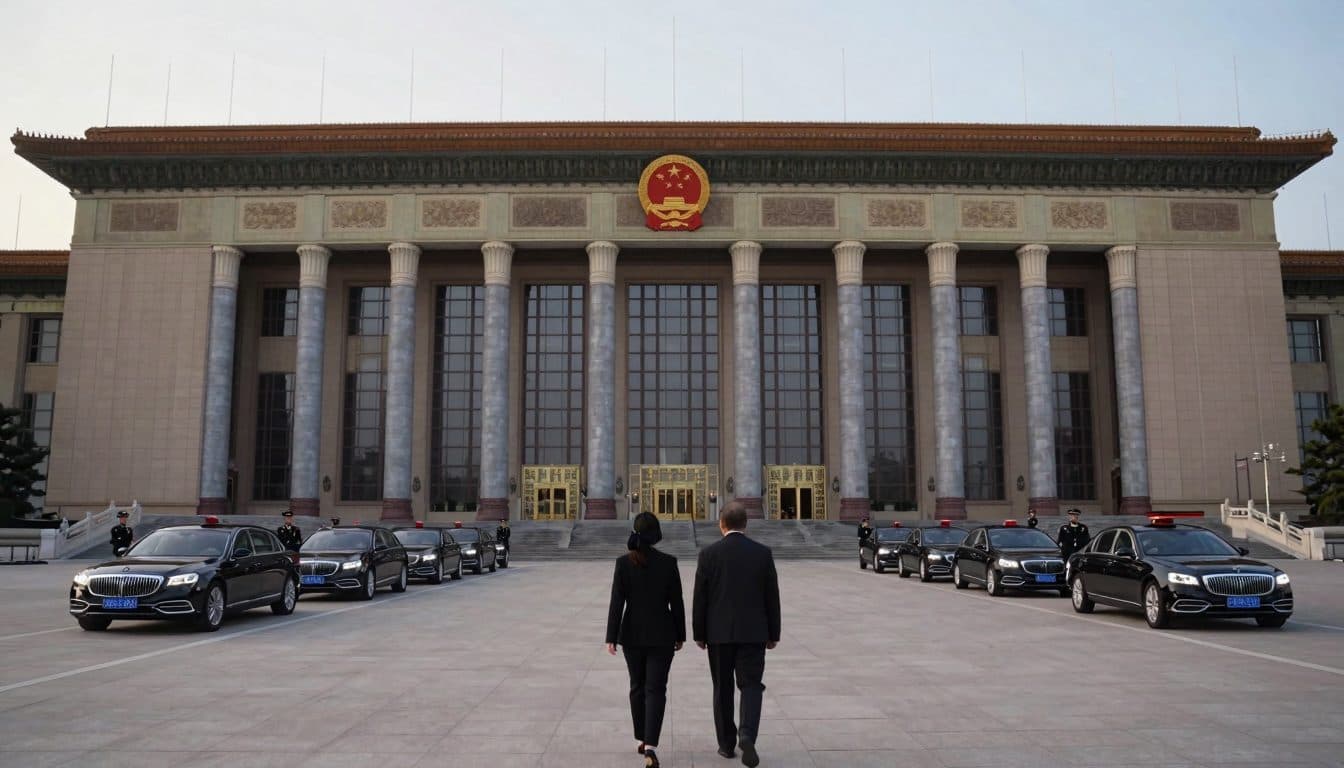
AI-generated image (z-image via Kie.ai)
Summary
Austrian Foreign Minister Beate Meinl-Reisinger is traveling to China with a business delegation to meet, among others, Gong Zheng in Shanghai. The focus is on economic relations, research, and cooperation in the UN Security Council, in which Austria holds a seat in 2027/28.
Vienna, June 25, 2026
Austrian Foreign Minister Beate Meinl-Reisinger has traveled to China with a business delegation to deepen bilateral relations in Shanghai and to gain a personal impression of the opportunities for cooperation in business, research, and innovation.
The trip falls in a symbolically significant year: according to the Foreign Ministry, 2026 marks 55 years of diplomatic relations and 60 years of official economic relations between Austria and China. Against this backdrop, the visit is also to be understood as a political signal to Beijing. According to the Foreign Ministry, Meinl-Reisinger will meet with the city's mayor, Gong Zheng, in Shanghai on Tuesday (local time).
Anniversaries as the Framework for the Trip
Shanghai is described in the travel documents as a financial and trading metropolis. For the minister, the metropolis is the central place to gain a personal impression of the opportunities that cooperation with China opens up for Austrian companies, research institutions, and innovation projects. Talks are planned with Austrian companies active in China, as well as with Chinese companies and investors active in Austria.
Meinl-Reisinger is accompanied by a business delegation. This underscores Vienna's focus on economic policy for the trip. In advance, the Foreign Minister formulated the goal in a statement to the press: "Uns geht es darum, die europäische Souveränität zu stärken, uns aus Abhängigkeiten zu befreien und gleichzeitig stabile Handelsbeziehungen mit China zu pflegen, die auf fairen, verlässlichen und regelbasierten Bedingungen basieren."
Difficult Issues and a Clear Position
At the same time, Meinl-Reisinger acknowledged that the talks would also cover difficult issues. "Natürlich gibt es auch schwierige Themen. Wir beziehen klar Position, wenn unsere Interessen auf dem Spiel stehen," she emphasized, without going into detail. In doing so, the minister signals that Vienna does not view the visit as uncritical rapprochement, but rather wants to openly address differences—on issues such as human rights or international security.
The trip takes on particular foreign policy significance due to the war in Ukraine. Meinl-Reisinger said: "China verfügt dabei über erheblichen Einfluss auf Moskau und kann einen wichtigen Beitrag zu einer friedlichen Lösung leisten." She thus explicitly links the trip to the hope that Beijing will use its relations with the Russian leadership for diplomatic progress. Given the state of Sino-Russian relations, this expectation is a central negotiating concern for Vienna.
The Ukraine War and Multilateral Cooperation
Austria also wants to use the visit multilaterally: in the UN Security Council, in which Austria will hold a seat in 2027/28, Vienna wants to work with China. The minister therefore views the trip not only as a bilateral economic mission, but also as an opportunity to lay the groundwork for future cooperation in the highest organ of the United Nations.
On the Chinese side, Xi Jinping announced in a letter to Alexander Van der Bellen at the end of May that he wanted to lift relations between Beijing and Vienna "auf eine neue Ebene." This signal is interpreted in Vienna as an upgrading of bilateral relations and forms the political framework for the current visit. The Austrian side understands the trip as a response and as an opportunity to set its own accents.
According to the Foreign Ministry, three thematic blocks are at the center of the content: the deepening of economic relations, the strengthening of scientific-technological cooperation, and coordination on international issues. In doing so, Vienna picks up on elements that have been prepared in bilateral working groups in recent years and now wants to confirm them at the ministerial level.
European Context and Economic Interests
The trip thus follows a pattern that European governments have increasingly pursued in recent months: the search for a pragmatic balance between economic interests and security-policy and values-based concerns vis-à-vis Beijing. Meinl-Reisinger captures this balancing act in her advance statement when she speaks on the one hand of fair, rules-based cooperation and on the other hand demands clear positions in the event of conflicts.
For the Austrian export economy, China has been an important, albeit recently volatile, sales market for years. The delegation accompanying the minister is intended to open doors for Austrian companies in sectors such as mechanical engineering, environmental technology, and life sciences, which are strongly represented in Shanghai and the broader Yangtze River Delta region. Meinl-Reisinger wants to convince herself of the general conditions, according to her own statements.
In parallel to the political level, meetings are planned with Chinese companies and investors that are already active in Austria or are building up an engagement. The background is that Chinese direct investments in Europe as a whole are coming under greater scrutiny; Vienna wants to set its own standards while preserving economic opportunities. The minister views investment as a reciprocal process that should be based on clear rules.
Program in Shanghai and Beijing
In the run-up to the trip, the Foreign Ministry also emphasized that Vienna wanted to talk in Shanghai about global supply chains, access to the Chinese market, and the protection of intellectual property. These issues have been recurring points of conflict between the EU and China for years and are also at the center of ongoing negotiations at the European level.
Political observers also see the trip as an attempt by Vienna to position itself as a reliable, dialogue-oriented partner in a phase of geo-economic tensions between the USA, the EU, and China. According to her own presentation, Meinl-Reisinger brings with her the prerequisites that allow Austria to play a constructive mediating role in the EU and the UN—notably, the upcoming Security Council seat.
At the meeting with Shanghai's Gong Zheng on Tuesday (local time), according to the Foreign Ministry, the focus will be primarily on city-political and economic issues. Shanghai is the seat of numerous Austrian company representations and is considered the gateway to the Chinese domestic market. Vienna hopes the meeting will send signals for a continuation of the existing cooperation agreements between the partner cities.
Meeting with Gong Zheng
According to information from Vienna, the trip ends in Beijing, where further political talks are planned. In addition to bilateral issues, the international crisis hotspots are to be at the center, in particular the war in Ukraine. Meinl-Reisinger has made it clear that she sees China as an influential actor on this issue and that Vienna wants to use the talks in Beijing to move Beijing's role toward a peaceful solution.
Questions & Answers
Who is Beate Meinl-Reisinger?
Beate Meinl-Reisinger is the Austrian Foreign Minister. She is traveling to China with a business delegation to meet, among others, Gong Zheng in Shanghai.
Why is the Foreign Minister traveling to China right now?
The trip falls in the anniversary year of 55 years of diplomatic and 60 years of official economic relations between Austria and China. In addition, China's Xi Jinping announced at the end of May that he wanted to lift relations with Austria to a new level.
What topics are central in Shanghai and Beijing?
The focus is on economic relations, research and innovation, as well as cooperation in the UN Security Council, in which Austria holds a seat in 2027/28. Meinl-Reisinger also wants to address China's potential role in a peaceful solution to the war in Ukraine.
Meinl-Reisinger China Trip: Shanghai, Economy, and the UN | allfacts360