Mercedes Employees Demonstrate Nationwide Against Intensified Austerity Course
Sindelfingen, July 3, 2026
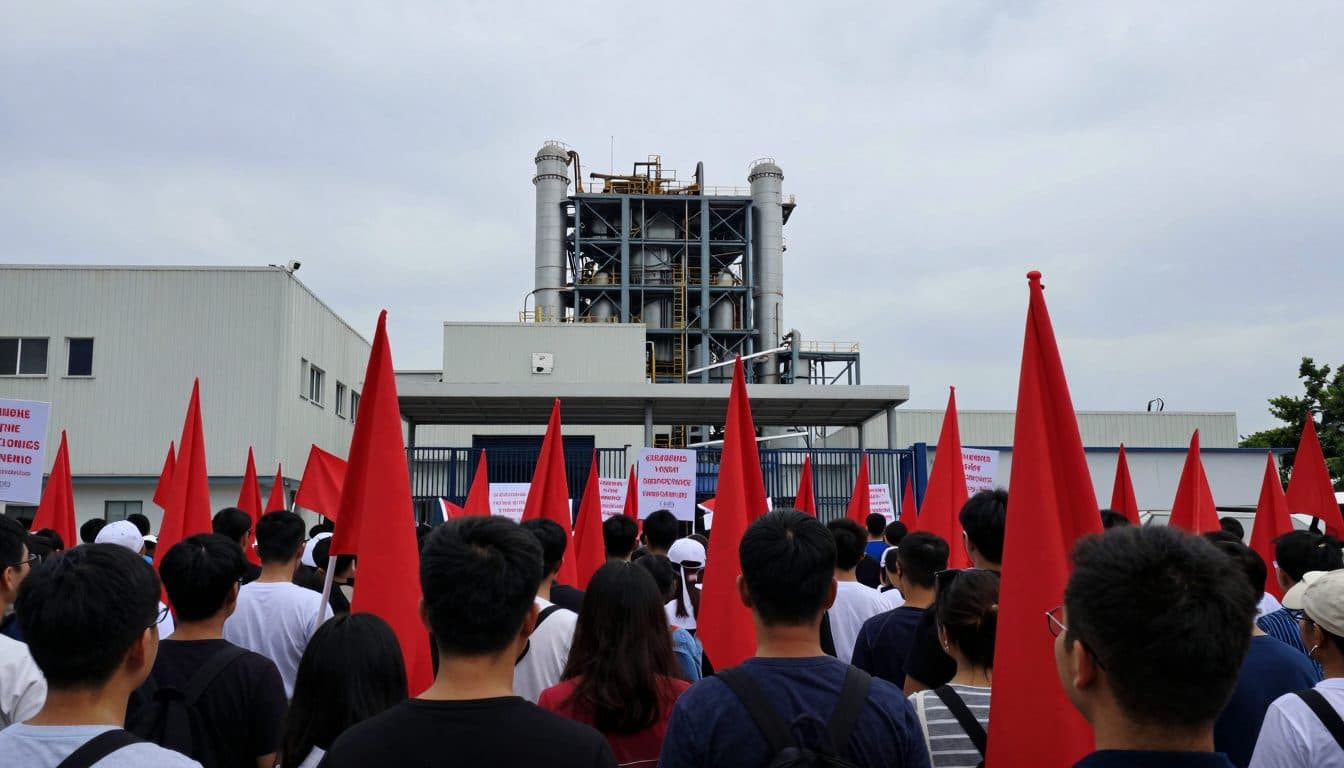
AI-generated image (z-image via Kie.ai)
Summary
Thousands of Mercedes-Benz employees demonstrated on July 3, 2026 in Sindelfingen and at other German locations against the automaker's intensified austerity course. IG Metall announced further protests at other manufacturers and suppliers.
Sindelfingen, July 3, 2026
Employees of Mercedes-Benz took to the streets on July 3, 2026 in Sindelfingen and at other locations in Baden-Württemberg as well as in several federal states to protest against the company's intensified austerity course, the postponement of a collective-bargaining special payment, and plans to extend working hours.
Background: What the Board of Management Is Planning
The IG Metall union had called for a day of action that, according to union information, took place at all German locations of the automaker. According to union figures, around 20,000 employees took part in the protest, while a company spokesperson spoke of 10,000 participants. IG Metall also announced that more than 33,000 employees had participated in the actions; the figure of 30,000 demonstrators had been reached nationwide. The demonstrations and rallies were directed against a package of austerity measures that the board of management had announced in a letter to the workforce.
Mercedes: Protest Against Austerity Course and 35-Hour Week | allfacts360
In the board of management's letter to employees in Germany, the company had communicated at the end of last week that it must "weiterhin mit Hochdruck die Kosten senken" in order to remain competitive on product prices. "Trotz all unserer Anstrengung ist die Situation heute in Deutschland dramatisch," the letter continued. The board announced: "Wir werden bei Mercedes-Benz Prozesse radikal beschleunigen und gewachsene Strukturen verschlanken".
The Special Payment Is Being Postponed
Specifically, the austerity course provides that around 90,000 of the roughly 108,000 employees in Germany will not receive a collective-bargaining special payment in July as expected, as an immediate measure. This special payment is the annual "Transformationsbaustein," which amounts to 18.4 percent of the regular individual monthly salary. The payment would be postponed to the coming year, according to the letter. According to the IG Metall website, the special payment can be postponed or suspended at companies in economic crises.
At the same time, management wants to negotiate with the works council in the coming weeks on extending working hours without wage compensation. Mercedes-Benz is considering an unpaid increase in working hours to 40 hours per week in order to make the German plants more competitive. The working hour must become cheaper, management explained. Employees currently work 35 hours per week under the collective agreement.
Reactions from the Works Council and IG Metall
Overall works council chief Ergun Lümali said at a rally on Friday in Sindelfingen that employees disagreed with the board's plans and with the dismantling of the welfare state. Management wanted to roll back hard-won achievements. He pointed to a series of burdens currently affecting the workforce: "Wir erleben aktuell eine Belastung nach der anderen: Diskussionen über verlängerte unbezahlte Arbeitszeit, über Einschnitte bei tariflichen Leistungen, über Verlagerung von Produkten und Funktionen sowie Angriffe auf bestehende Arbeitsmodelle."
IG Metall district leader Barbara Resch said of management's austerity plans in advance: "Die Beschäftigten haben Mercedes groß gemacht, und jetzt sollen sie die Zeche für Fehlentscheidungen im Vorstand zahlen." Future security would not be achieved through pressure and longer shifts, but through investments, good products, and respect for the employees' performance. In Rastatt she also declared that the 35-hour week was not a relic of the past, good collective agreements were not a locational disadvantage, and employees were not disposable material.
Solidarity from Other Corporations
IG Metall announced a "hot summer" for the auto industry. The union declared: "Die IG Metall und die Beschäftigten der Hersteller und Zulieferer werden den Unternehmenslenkern der Autoindustrie einen heißen Sommer und Herbst bescheren, solange sie weiter auf Arbeitsplatzabbau und Verlagerung setzen, statt echte Problemlösungen zu suchen." "Den Beschäftigten der Automobilindustrie reicht es," IG Metall continued. "Nicht länger lassen sie sich zum Sündenbock machen, wenn Managementfehler und geopolitische Konflikte Ursache der Krise sind."
The protest at Mercedes-Benz is, according to the union, to be the kickoff for further nationwide actions. IG Metall announced similar protests in the coming weeks at other automakers and suppliers. A car convoy by auto industry employees is planned for July 9 in the Baden-Württemberg state capital Stuttgart. According to IG Metall, protests were planned in Rastatt, Kuppenheim, Bremen, Berlin, Hamburg, and Germersheim, among others.
Further Protests Announced
Solidarity with the Mercedes employees came from other corporations. BMW's overall works council chairman, Martin Kimmich, said: "Wem heutzutage nichts anderes einfällt, als nach der 40-Stunden-Woche zu schreien, hat die Zeichen der Zeit nicht erkannt." Audi works council chairman Jörg Schlagbauer declared: "Die unverblümten Angriffe gegen die Tarifverträge bei Mercedes sollen uns alle treffen." In a time of sales collapses, global crises and conflicts, those responsible at Mercedes were trying to "die Gunst der Stunde zu nutzen, um hier tarifpolitische Grenzlinien zu verschieben und die Belegschaften zu erpressen," he criticized. He spoke of an "abgekarteten Foulspiel der Arbeitgeber."
IG Metall chairwoman Christiane Benner criticized the plans on Friday in Düsseldorf: "Während Aktionäre mehr als ordentlich profitieren, sollen die Beschäftigten ihre vertraglich festgeschriebenen Rechte opfern? Sicher nicht! So verspielt man Zukunft und Vertrauen." She demanded: "Der industrielle Kern dieses Landes darf nicht ausgehöhlt werden… Wir brauchen eine aktive Industriepolitik, die Transformation absichert – mit Investitionen, klaren Standortzusagen und guten Jobs."
The company's economic situation is strained: Mercedes-Benz's profit fell by 17 percent year-on-year in the first quarter to 1.43 billion euros. According to earlier statements, up to 100,000 jobs could be cut worldwide, twice as many as previously planned. At the end of 2025, around 164,000 people worked at Mercedes-Benz in Germany, according to company figures. According to calculations by the auditing firm EY, almost 50,000 jobs were lost in the German auto industry alone last year; since 2019, 111,000 jobs in the sector have been cut according to these figures.
History of the 35-Hour Week
The debate about the 35-hour week has a long history in the metal and electrical industry. The introduction of the 35-hour week was long fought over between IG Metall and the employers. In the 1980s, there was a labor dispute lasting several weeks, which also included lockouts. After almost seven weeks of industrial action, the breakthrough came: the gradual introduction of the 35-hour week. After warning strikes came the 37-hour week in 1987, in 1993 it went down to 36 hours, and in October 1995 the 35-hour week was finally reached in the western federal states.
The Mercedes employees also received support from politics. Lower Saxony's deputy head of government and VW supervisory board member Julia Willie Hamburg told the Deutsche Presse-Agentur: "Werksschließungen sind keine Zukunftsstrategie." A Green party politician declared with reference to Volkswagen: "Im Gegenteil: Volkswagen muss sich verändern." Europe's largest automaker Volkswagen is planning a radical corporate restructuring, which is to be accompanied by drastic job cuts and plant closures in Germany. There was also a major protest at Volkswagen in Emden.
A Mercedes-Benz spokesperson declared: "Wir nehmen mögliche Unsicherheiten und Sorgen ernst. Wir respektieren, dass sich der Betriebsrat zur Produktivitätsoffensive äußert." The employee representatives had informed the company in advance about the planned protests. Jan Otto, IG Metall district leader for Berlin-Brandenburg-Saxony, called longer and unpaid working hours "beschäftigungspolitischen Unfug, retten weder Jobs noch schaffen sie neue Aufträge".
IG Metall also pointed out that the corporation had to think about synergies and savings elsewhere: "Aber die Transformation muss den Konzern nachhaltig wettbewerbsfähiger machen und an seine Stärken anknüpfen – nicht seine industrielle Substanz schwächen." For example, there were many synergies that the corporation could still leverage. "Da liegt doch der eigentliche Hebel, auch wirklich Kosten zu senken," the union said. "Einfach nur Werke zu schließen, wäre viel zu kurz gesprungen."
Questions & Answers
What is the Mercedes-Benz board of management specifically planning?
The board has announced that it will cut costs with great urgency, postpone the collective-bargaining special payment "Transformationsbaustein" for around 90,000 employees in Germany, and negotiate with the works council on an unpaid extension of the weekly working time from 35 to 40 hours.
How many people protested?
IG Metall spoke of around 20,000, later of more than 33,000 or over 30,000 participants nationwide; a company spokesperson, however, cited around 10,000 participants.