
Mexico City, 11 June 2026
Mexico opened the 2026 FIFA World Cup with a 2-0 victory over South Africa on Thursday at the Azteca Stadium in Mexico City, a match that produced a record three red cards and was preceded by a colorful opening ceremony headlined by Shakira and Burna Boy.
A third opening at the Azteca
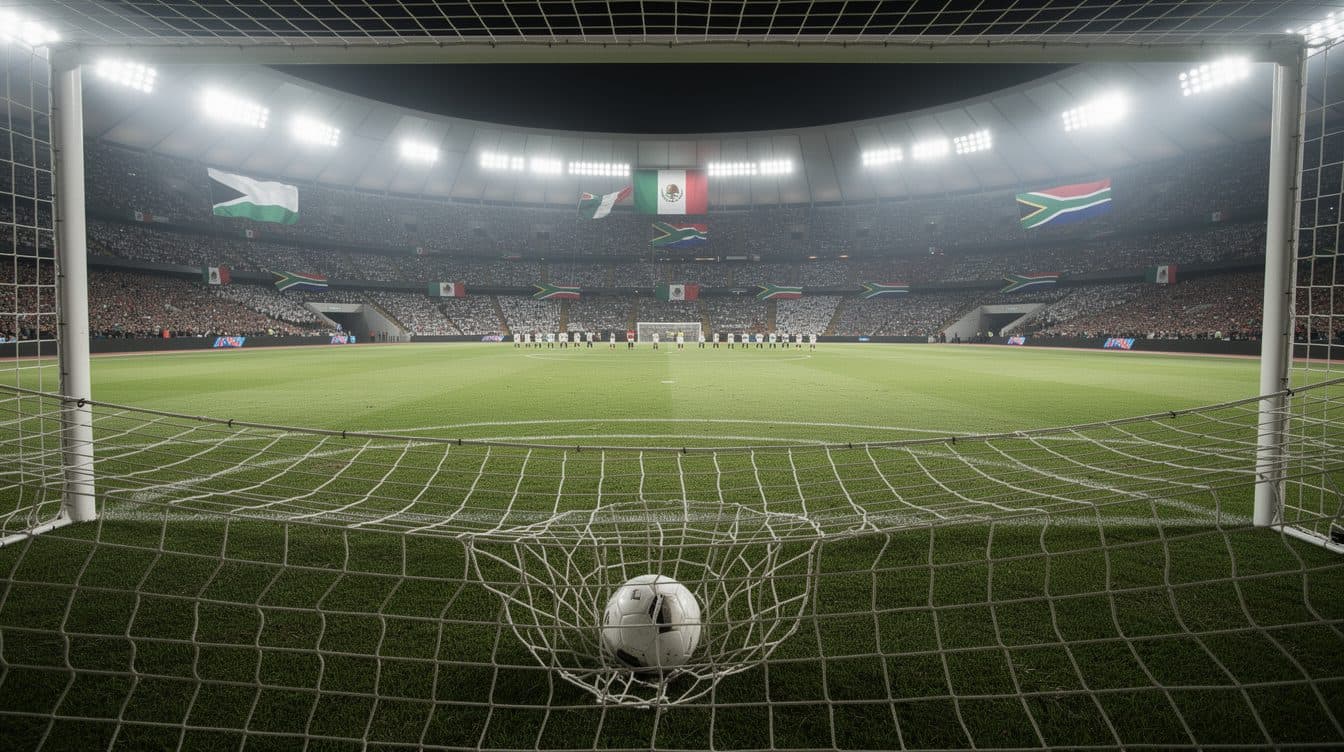
Mexico began the 2026 FIFA World Cup on Thursday evening with a 2-0 win over South Africa at the Azteca Stadium in Mexico City, a result that extended the hosts' unbeaten run and sent the 80,824 spectators home happy. The match kicked off at 13:05 local time, five minutes behind schedule, after both squads lined up for the national anthems at the center circle. For the first time, substitute players were allowed to stand on the pitch near the center circle during the anthems ceremony.
The opener was a rematch of the 2010 World Cup curtain-raiser in Johannesburg, which ended 1-1, and it took place in a stadium hosting a World Cup opening match for the third time, after 1970 and 1986. Mexico, nicknamed "El Tri," was playing an opening World Cup match for a record eighth time and entered the tournament on an eight-game unbeaten streak. South Africa, known as Bafana Bafana, deployed a five-man defensive line and had arrived in Mexico late because of visa issues.
Early breakthrough and second-half seal
Mexico drew first blood in the ninth minute through Julián Quiñones, who finished from about 16 meters after Erik Lira won the ball high up the pitch following a turnover by South African goalkeeper Ronwen Williams. Quiñones slipped the shot between the legs of Williams, and the strike was the third-fastest goal in World Cup history, behind César Sampaio's effort in the fourth minute in 1998 and Philipp Lahm's sixth-minute goal in 2006.
The hosts continued to press after the early breakthrough. In the 42nd minute, Quiñones struck the post with a low shot and goalkeeper Williams denied Raúl Jiménez twice in quick succession. Mexico held a 14-3 advantage in shots after an hour and a 6-0 lead in attempts inside the first 37 minutes, with the majority of play taking place in the South African half.
Mexico doubled the lead in the 67th minute through Jiménez, who headed in an excellent cross from Roberto Alvarado from the right. Jiménez, 35, plays for Wolverhampton Wanderers, and the goal was his 46th in 127 international appearances. Mexico coach Javier Aguirre had decided to start 26-year-old Raúl Rangel of Chivas in goal, leaving veteran Guillermo Ochoa on the bench at what was Ochoa's sixth World Cup.
An unprecedented night for red cards
South Africa's evening turned difficult in the 49th minute, when Yaya Sithole was shown a red card by Brazilian referee Wilton Sampaio for a professional foul on Brian Gutiérrez as the midfielder bore down on goal. The red card was the first in the 2026 World Cup. Shortly after the restart, Williams gifted the ball to Álvaro Fidalgo, but the Mexican failed to capitalize on the opportunity.
The match lost any remaining sense of contest in the 84th minute, when Themba Zwane was sent off for striking Alvarado in the face. Sampaio confirmed the decision after reviewing video footage (VAR), the second red card shown to South Africa. Mexico's César Montes then received a third red card in second-half stoppage time, 90+2, for a foul on Khuliso Mudau, and Sampaio did not require VAR for that call. Three red cards in a World Cup opening match was unprecedented, surpassing the previous record of two, set in 1990 when Cameroon beat Argentina 1-0.
Ceremony, music and a tepid crowd reaction
Mexico's 17-year-old Gilberto Mora, brought on in the 66th minute for Tijuana, became Mexico's youngest-ever World Cup player at 17 years and 240 days, one day older than Pelé was when he scored his first World Cup goal in 1958. Coach Aguirre, who was leading Mexico at a World Cup for the third time after 2002 and 2010, praised his team's performance in the post-match comments carried by AFP. South Africa head coach Hugo Broos, a former player at the 1986 World Cup, faced a different problem: his team had played the final minutes with nine men and now must regroup quickly. Aguirre and Broos had both been players at the 1986 tournament, adding a generational echo to the occasion.
Before kickoff, the Azteca, which sits at more than 2,200 meters above sea level on the cooled lava flow of an extinct volcano, hosted a 20-minute opening ceremony that began 90 minutes before the start. Approximately 300 performers took part, including Mexican rock band Maná, who opened the show with their hit "Oye mi amor," followed by Venezuelan pop singer Danny Ocean, J Balvin, Lila Downs and Alejandro Fernández. The ceremony leaned on pre-Hispanic Mexican imagery, with an oversized World Cup trophy, a golden stage, extras dressed in gold, and traditional warrior dancers in feather ornaments, while three priests in the white, red and green of the Mexican flag performed a ritual.
Protests, the fan zone and the price of a World Cup
Mexican-American artist Lila Downs and the rock band Maná were described in previews as having been pushed into a secondary role, but they did take part in the show. The biggest star of the night was Colombian singer Shakira, who performed the official World Cup song "Dai Dai," whose title is said to mean "Let's go," live for the first time together with Nigerian Afrobeats musician Burna Boy. Actress Salma Hayek and Italian tenor Andrea Bocelli also appeared, and a flag parade of all 48 participating nations preceded the match. FIFA President Gianni Infantino presented the trophy together with Hayek shortly before kickoff; he was booed by parts of the crowd when his name was announced.
After the final whistle, the ranchera hit "El Rey" by Vicente Fernández was played over the stadium speakers and sung by the entire stadium, capping a night that combined a Mexican football party, a showcase of Latin music and a stark reminder of the off-pitch tensions. Outside the stadium, a security exclusion zone had been set up around the venue, with vehicle access ending roughly 1.5 kilometers from the gates. In the days leading up to the match, teachers, students and relatives of disappeared persons had held protests highlighting government shortcomings in infrastructure, wages and the unresolved fate of more than 100,000 missing people, and a teachers' union had briefly blocked the stadium two days earlier. At the fan zone on the Zócalo square, thousands of fans pushed for entry; some threw water bottles and insulted police, prompting a staff member to plead through a megaphone: "Hört auf zu drängeln, es gibt Kinder, ihr benehmt euch wie Tiere."
Marcel Reif, the long-time German sports reporter, told Deutschlandfunk that the scale of the World Cup and the high ticket prices amounted to "Gigantomanie," and warned that some matches could be played in front of thinly filled stands because many supporters could not afford the cost. He also said that under Infantino, FIFA was mainly focused on money, and that while reaching the knockout stage was a must for the German national team, it was not among the top favorites. Germany, coached by Julian Nagelsmann, begins its campaign on Sunday against Curaçao, which has qualified for a men's World Cup for the first time.
What comes next
The 2026 World Cup is the largest in football history, featuring 48 national teams instead of the previous 32 and 104 matches spread over five and a half weeks across Mexico, Canada and the United States. Mexico's next group match is against South Korea the day after, while South Africa faces the Czech Republic the same day at the Atlanta Stadium, with kickoff at 18:00 CEST. The final will be played on 19 July in New Jersey. For Mexico, the opener brought a comfortable win but a missed chance for a landslide; for South Africa, the night ended in numbers and with a long road to recovery.
Match details: Mexico 2-0 South Africa (1-0 at half-time). Goals: Quiñones (9'), Jiménez (67'). Red cards: Sithole (49'), Zwane (84'), Montes (90+2'). Yellow cards: Gutiérrez, Mokoena, Sibisi. Attendance: 80,824 at the sold-out Azteca Stadium. Referee: Wilton Sampaio (Brazil).