More Desert Dust from the Sahara: Study Warns of Health and Energy Consequences for Europe
Berlin, 18 July 2026
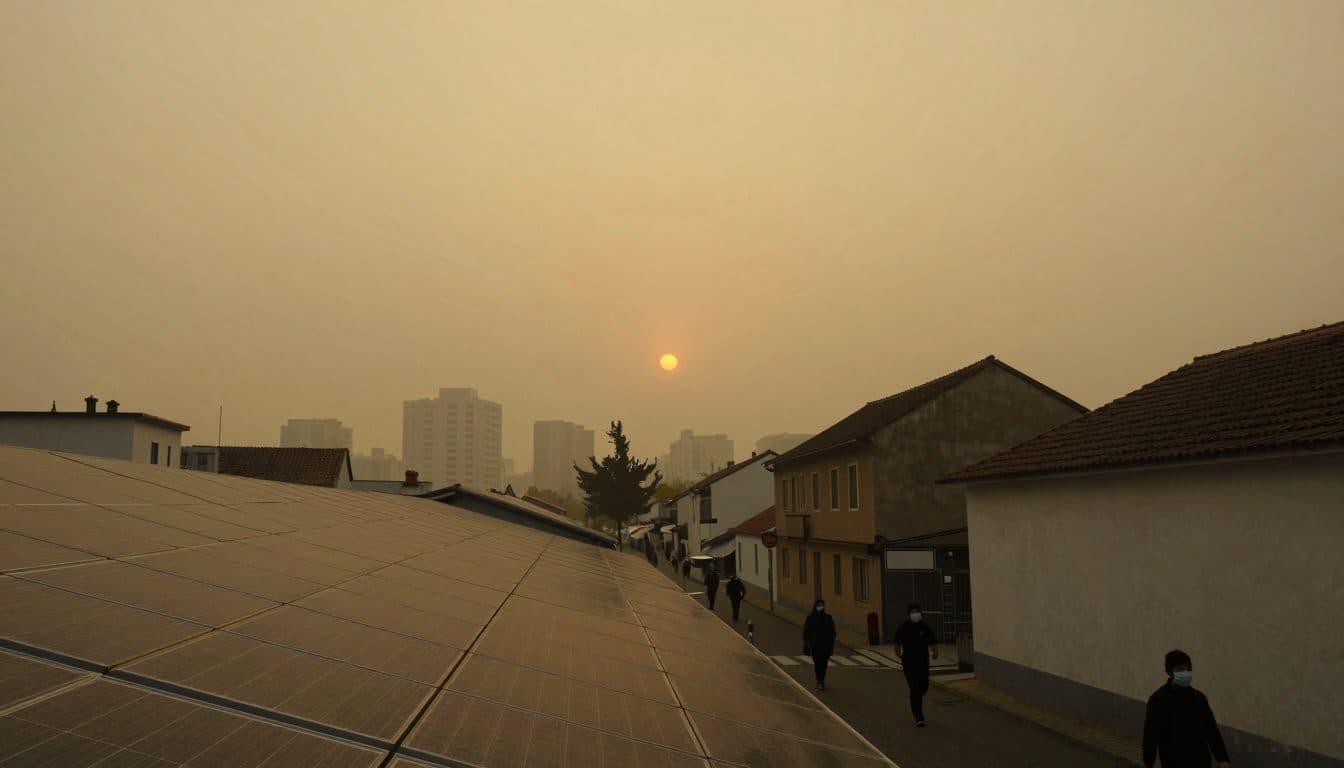
AI-generated image (z-image via Kie.ai)
Summary
Researchers at the Paul Scherrer Institute demonstrate in a Nature study a significant increase in Saharan dust over Europe and identify rising health risks as well as yield losses in solar power. The burden has more than doubled over the past 150 years; Southern Europe is particularly affected.
Berlin, 18 July 2026
Researchers at the Swiss Paul Scherrer Institute (PSI) report in the journal "Nature" that desert dust pollution in Europe has risen by ten to 25 percent over the past ten years and has more than doubled over 150 years.
The study, reported on by Deutschlandfunk on 18 July 2026, paints a nuanced picture of the development: it is not the number of dust storms that has increased, but rather the intensity of individual events. "Ursache seien nicht mehr Stürme, aber die einzelnen Stürme seien intensiver und transportieren mehr Staub", reads the report. The driver of this change is climate change: "Wüstengebiete wie die Sahara dehnen sich im Zuge des Klimawandels aus", the researchers write.
Background: Climate Change and Circulation
At the same time, atmospheric circulation has changed, according to the report: "Es gebe mehr starke Winde aus der Sahara-Region Richtung Europa." This combination of stronger storms and altered air flows ensures that more and more fine Saharan dust finds its way north.
How can desert dust actually be identified? "Man erkennt ihn an der gelblich-trüben Luft, rötlichen Sonnenuntergängen oder staubigem Belag etwa auf Autos." Anyone observing these signs is dealing with a concrete change in air chemistry. The dust can also be analytically clearly distinguished from other particulate matter sources: "Man kann Wüstenstaub anhand der Aluminiumkonzentration klar von Feinstaub aus Verkehr, Industrie oder anderen Quellen unterscheiden."
Geographic Distribution of the Burden
The geographic distribution of the burden is uneven. Southern Europe is particularly affected, from Greece through Italy to Spain and Portugal. "Dort liegt die durchschnittliche Wüstenstaubkonzentration bei 5,3 Mikrogramm pro Kubikmeter Luft – mehr als doppelt so viel wie in Mittel- und Nordeuropa mit 2,1 Mikrogramm." Those living in the Mediterranean region are therefore exposed to a significantly higher continuous burden than people north of the Alps.
That this is not a temporary phenomenon is demonstrated by ice cores from the Alps. "Daten aus Eisbohrkernen aus den Alpen zeigten zudem, dass sich die Belastung über die vergangenen 150 Jahre mehr als verdoppelt hat." This provides the researchers with a long-term trend that places the recent increase in a broader climatic context.
Long-Term Trend from the Alps
The development has direct consequences for public health. "Diese hätten gezeigt, dass an Tagen mit hoher Wüstenstaubkonzentration in der Luft mehr Menschen an Herzinfarkten und Atemproblemen sterben als sonst", the team writes. People with pre-existing conditions are particularly at risk: "Gefährdet sind vor allem Menschen mit Herz- oder Lungenerkrankungen sowie ältere Menschen."
As for the long-term consequences, the researchers see a research gap: "Für langfristige Folgen wie Asthma, chronische Bronchitis oder Staublunge fehlten aber noch Langzeitstudien." The current data demonstrate short-term correlations but leave open questions regarding chronic exposure.
Consequences for Health
In addition to health, energy generation is also affected. Saharan dust impairs solar installations in two ways: "Zum einen beschattet Wüstenstaub in der Luft die Anlagen, zum anderen lagert er sich auf Solarmodulen ab. Beides mindert den Stromertrag." Especially in Southern Europe, where the share of solar power in the energy mix is high, this could affect supply security.
The researchers therefore see a need for action in early detection. "Energieversorger könnten mit Vorwarnung andere Kraftwerke hochfahren und die Netzstabilität so sichern." They also advocate for more information for the general public: "Vorgeschlagen werden Warnsysteme, wie sie bereits für städtischen Feinstaub oder Pollenflug existieren."
Impact on Solar Energy
For vulnerable groups, the authors provide concrete guidance: "Wer gesundheitlich vorbelastet ist, könnte an solchen Tagen dann körperliche Aktivitäten im Freien einschränken und möglichst in Innenräumen bleiben." This means desert dust is not an abstract variable, but a weather and health factor that individuals can adjust to.
Overall, the study shows that desert dust in Europe is no longer a marginal issue. The combination of climate-driven expansion of the Sahara, altered circulation, and more intense individual storms has consequences for both health and solar power production. Such integrated analyses are necessary because air quality, weather, and the energy transition influence one another.
Proposals for Warning Systems and Behaviour
The publication in "Nature" underscores the scientific ambition of the analysis. It also suggests that political and infrastructural responses would need to go beyond traditional air pollution control — toward a system that treats desert dust as an independent risk factor.
The report also points to an open methodological question: the long-term effects on public health have so far only been derivable from daily data and statistical correlations. Dedicated prospective cohort studies mapping chronic progressions still need to be set up.
Politically, the study could fuel discussions about a Europe-wide air quality strategy that considers the Sahel and North Africa as source regions. Dust knows no borders — and early warning systems only work if they are conceived across national boundaries.
Questions & Answers
Wer hat die Studie zum Wüstenstaub in Europa veröffentlicht?
Forschende des Schweizer Paul Scherrer-Instituts (PSI) haben die Studie im Fachmagazin "Nature" veröffentlicht; der Deutschlandfunk berichtete darüber am 18. Juli 2026.
Wie stark ist die Wüstenstaubbelastung in Europa gestiegen?
Die Wüstenstaubmenge über Europa ist laut der Studie in den vergangenen zehn Jahren um zehn bis 25 Prozent gestiegen; Eisbohrkerne aus den Alpen zeigen zudem, dass sich die Belastung über 150 Jahre mehr als verdoppelt hat.
Welche gesundheitlichen Risiken sehen die Forschenden?
Die Autorinnen und Autoren berichten, dass an Tagen mit hoher Wüstenstaubkonzentration mehr Menschen an Herzinfarkten und Atemproblemen sterben; besonders gefährdet sind Menschen mit Herz- oder Lungenerkrankungen sowie ältere Menschen.
Desert Dust Europe: PSI Study in Nature on Consequences | allfacts360