More Explosions in Tehran – US Strikes Iran for Eleventh Consecutive Night
7/22/2026
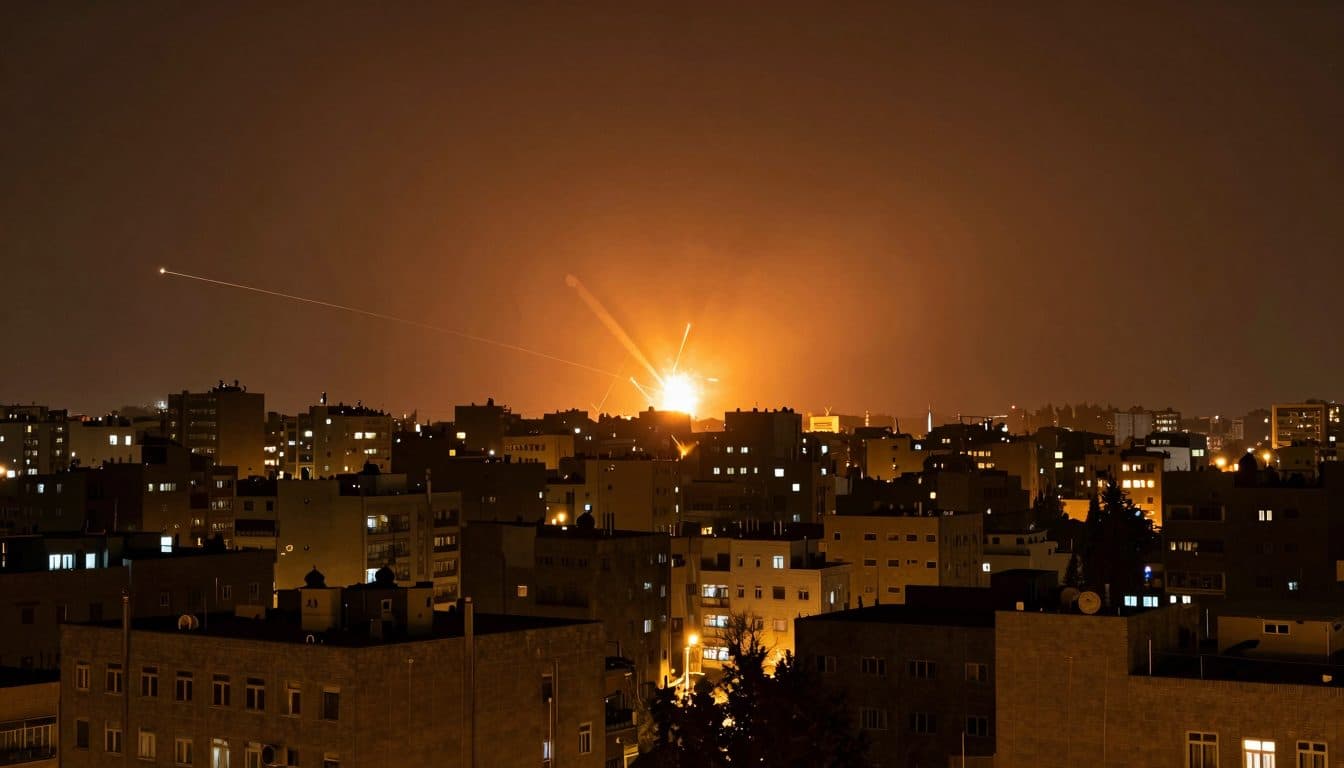
AI-generated image (z-image via Kie.ai)
Summary
On the night of July 22, 2026, muffled explosions were once again heard in northeastern Tehran, while Iranian air defenses were activated for the first time since the beginning of the latest escalation. In parallel, the US military announced a new wave of strikes on military targets in Iran – the eleventh night in a row.
Tehran/Washington, July 22, 2026 Explosions in Tehran: US Strikes Iran for 11th Consecutive Night
On the night of July 22, 2026, muffled detonations were heard in the northeast of the Iranian capital Tehran, according to a dpa reporter, while Iranian air defenses were activated for the first time since the latest escalation in the Iran war, and the US military simultaneously announced a new wave of strikes on military targets in Iran.
Explosions and Air Defenses in the Capital
The nighttime events mark a clear turning point: for the first time since the beginning of the latest escalation phase, explosions were once again reported in the Iranian capital. As a reporter for the dpa news agency reported, muffled detonations could be heard in the northeast of the metropolis of millions. Iranian state media also reported anti-aircraft fire in various districts of the city, which is home to around 15 million people.
In parallel with the explosions in Tehran, the US military announced a new wave of strikes on military targets in Iran. According to the responsible US Central Command (Centcom), the strikes were directed, among other things, against military command centers, drone storage facilities, and aircraft hangars. The roughly one-hour wave of strikes was declared over after about an hour, after which calm returned to the capital.
Targets of the New US Strike Wave
Centcom did not disclose the exact targets of the new strikes. On the X platform, the US command responsible for the region stated that the strikes were intended to weaken the country's ability to attack commercial ships in the Strait of Hormuz, which is important for oil trade. The goal was to weaken the country's capabilities to attack commercial vessels in the strategically vital Strait of Hormuz, the US Central Command (Centcom) responsible for the region announced on the X platform.
According to the US side, this is the eleventh consecutive night in which the US has struck the Islamic Republic. The US military has attacked military targets in Iran for the eleventh night in a row. Previously, hundreds of airstrikes had already been carried out on targets along Iran's southern coast. The targets of the roughly one-hour wave of strikes reportedly included military command centers, the Iranian navy, and air force installations.
Trump's Threat and the End of the Ceasefire
US President Donald Trump had threatened Iran with additional strikes just hours earlier, specifically naming an area around a facility known as "Pickaxe Mountain." Trump also stressed that the US military would target any facility that the leadership in Tehran intended to use for nuclear purposes. The Republican had previously threatened an attack on the complex, which is located in Mount Kuh-e Kolang south of the Natanz nuclear facility in central Iran.
Meeting with Lebanese President Joseph Aoun at the White House on Tuesday, Trump said: "We will target this area shortly, and with full force". At the same time, Trump declared the ceasefire agreed in early April – which had already been broken several times – and the framework agreement negotiated in mid-June to be over.
President Trump declared the ceasefire agreed in early April – which had already been broken several times – to be over. Tehran likewise no longer feels bound by the preliminary declaration of intent. This removes the last diplomatic link that had so far tenuously contained the conflict.
Background: The Conflict in the Strait of Hormuz
The conflict flared up again at the beginning of July after Iranian forces fired on commercial ships in the Strait of Hormuz. The US subsequently carried out hundreds of airstrikes on targets along Iran's southern coast. The Iranian armed forces responded with massive rocket attacks on American targets in the Gulf region. The Houthi militia, supported by Iran, has meanwhile said that within 24 hours it had forced several ships to turn around as part of its proclaimed "blockade."
This was reported by the Saba news agency controlled by the militia, citing its military circles. The Strait of Hormuz is one of the most important routes for global oil trade; any attack on shipping there has immediate consequences for the world economy.
The most recent attacks on Tehran had occurred at the beginning of June, more than a month ago. At that time, the Israeli Air Force had attacked targets in the city in response to Iranian rocket attacks. The most recent attacks on the metropolis had occurred at the beginning of June, more than a month ago.
Outbreak of the War and Background
The current war against Iran began at the end of February. At the end of February, Israel and the US began their war against Iran and attacked the country from the air for almost 40 days. Numerous influential generals and senior politicians were deliberately killed, including Iran's Supreme Leader Khamenei.
According to the US Department of Defense, the cost of the war to the US alone amounts to $37.5 billion, the equivalent of around 32 billion euros. Pentagon chief Pete Hegseth cited the figure at a hearing in the US Senate, explaining that it includes both previous expenditures and expected costs until the end of the fiscal year on September 30.
Costs and Military Planning in Washington
Hegseth called for an additional defense budget of $67 billion. He stated that the supplementary budget was intended to ensure military readiness, replace expended materials, and accelerate investments in munitions and new weapons. In view of the global security situation, he was aiming for a defense budget of $1.5 trillion for fiscal year 2026.
Hegseth also stated that the eleventh wave of strikes served to further weaken Iran's ability to threaten international shipping. The nighttime events in Tehran could indicate that the escalation of the conflict is entering a new phase.
This news was broadcast on July 22, 2026 on the Deutschlandfunk program. The article was published by APA on July 22, 2026.
The situation remains unclear: while the US presents its strikes as a targeted weakening of Iranian military capabilities, Tehran is threatening retaliation. The activation of air defenses in a city of 15 million inhabitants underscores that Iran, too, is bracing for a further intensification of the conflict.
Questions & Answers
What happened in Tehran on the night of July 22, 2026?
In the northeast of Tehran, muffled detonations were heard according to a dpa reporter, while at the same time Iranian air defenses were activated in several districts of the city. In parallel, the US military announced a new wave of strikes on military targets in Iran.
What were the targets of the US strikes?
According to Centcom, the strikes were directed, among other things, against military command centers, drone storage facilities, and aircraft hangars. The strike wave lasted about an hour; exact targets were not made public.
What is the current state of diplomatic efforts?
US President Donald Trump declared the ceasefire agreed in April and the framework agreement negotiated in June to be over. Tehran likewise no longer considers itself bound by the preliminary declaration of intent. IMAGE_PROMPT: Nighttime view of a Middle Eastern metropolis skyline with faint orange flashes on the horizon, silhouettes of anti-aircraft fire streaking upward into dark sky, military officials monitoring screens in a darkened command room.
Explosions in Tehran: US Strikes Iran for 11th Consecutive | allfacts360