Murder of Russian exile artist Skrepezki in Poland: Tusk speaks of political assassination
Warsaw, 21 June 2026
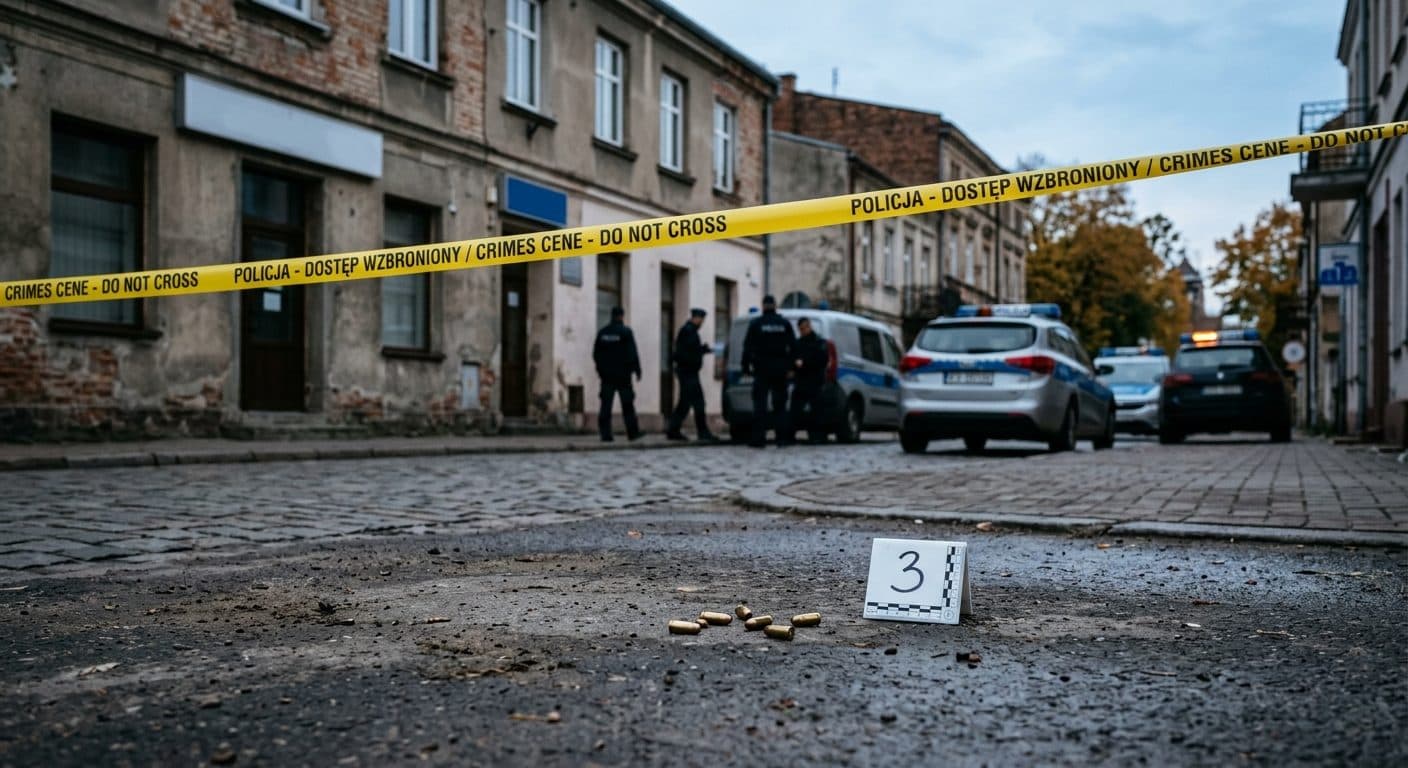
AI-generated image (google/gemini-3.1-flash-image-preview via OpenRouter)
Summary
The Russian exile artist Semyon Skrepezki was killed with five shots on 17 June 2026 in Biała Podlaska near his apartment. Polish Prime Minister Donald Tusk spoke of a probable political assassination and drew parallels to previous cases.
Warsaw, 21 June 2026
The Russian exile artist and Putin critic Semyon Skrepezki was killed at close range with five shots on 17 June 2026 in the small Polish town of Biała Podlaska; Prime Minister Donald Tusk spoke of a suspected political contract killing.
According to the Polish state prosecutor's office, Skrepezki was shot by an unknown assailant on 15 June at around 9:50 a.m. near his apartment in Biała Podlaska. Five cartridge cases and one bullet of 9 mm Luger caliber were found at the scene. The 44-year-old died at the scene. An official familiar with the circumstances told the Polish news portal Onet: "Es sah aus wie eine Hinrichtung".
Polish Prime Minister Donald Tusk addressed the press on 17 June, stating that everything pointed to a political assassination. If it had been ordered by Moscow, "then this is also a very serious matter with an international dimension," Tusk said on Wednesday. The shooting was in all likelihood a "politischer Mord". He added: "Das ist Staatsterrorismus."
Crime scene and state of the investigation
Skrepezki was a critic of Russian President Vladimir Putin and made fun of Putin and other rulers of the Russian Federation with satirical drawings and satirical paintings. He was born in 1981 in Russia and lived until 2021 in the Siberian Altai region. He then lived in exile, most recently in the small Polish town of Biała Podlaska not far from the Belarusian border. According to the Belarusian action artist Wlad Bokhan, Skrepezki has five children, his wife is now pregnant with the sixth, and life in a small town is easier for a large family.
Bokhan told Deutsche Welle that he had spoken with Skrepezki on the phone less than 24 hours before the murder. "Er wollte weiterarbeiten und schmiedete Pläne," Bokhan said. Skrepezki had constantly received threats – "von verschiedenen Seiten". The last post Skrepezki published in his Telegram channel a few hours before his death consisted of screenshots of threats he had received following an action in front of the Russian Embassy in Berlin on 12 June.
Background: Skrepezki's actions and threats
On 12 June, Skrepezki had carried out a protest action in front of the Russian Embassy in Berlin, which was documented on his Telegram channel. Only a few days later, according to activists, massive threats against him followed. Andrej, an activist from the Belarusian diaspora in Biała Podlaska, suspects: "Ich denke, nach dieser Aktion in Berlin hat jemand den Befehl gegeben, ihn zu beseitigen."
The online platform "Myrotworez" (German: Friedensstifter) has for years maintained a kind of public register of persons who "pose a threat to the sovereignty and territorial integrity of Ukraine." According to DW information, Skrepezki appears in this database. Polish media describe him as a "Kritiker Putins" and likewise raise the question of a possible contract killing.
Trail of the 9 mm Luger ammunition
The choice of ammunition is striking: cartridge cases and one bullet of 9 mm Luger caliber were recovered at the scene. According to the independent Russian portal Agentstwo, this is the same ammunition with which the Russian helicopter pilot Maxim Kuzminov, who had defected to Ukraine, was shot dead in Spain in 2024. The same ammunition was also used in the so-called "Tiergartenmord" in 2019 in Berlin, in which the Chechen field commander Zelimkhan Khangoshvili was killed.
Andrej, who knew Skrepezki from the local scene, said about the small town: "Du kennst jedes Auto, jeden Menschen." Skrepezki had stood out because he was out filming in the middle of the day and in full view of everyone. He had had the impression that Skrepezki had been "etwas Angst". The crime itself had occurred in broad daylight, at around 9:50 a.m., and near his apartment.
Bokhan told DW that this murder served "nicht nur der Ausschaltung einer Person, sondern auch der Einschüchterung. Er sendet ein Signal an diejenigen, die ähnliche Tätigkeiten ausüben." With this statement, he pointed to the deterrent element that such acts can have beyond the individual case. Russian exile activists in Poland have for years been exposed to growing threats.
Reactions from politics and the exile community
The Polish security authorities have opened investigations on charges of murder. According to Tusk, the General Prosecutor's Office and the Interior Ministry are working closely together. Polish media report that the investigations are being directed, among other things, toward possible involvement of Russian intelligence services. No concrete arrests or investigation results regarding the perpetrator have been made public so far.
In recent months, Skrepezki had planned and carried out street actions in Belarus, Poland and other countries, in which he attracted attention with ironic portrayals of Russian politicians. Colleagues describe him as tireless, but also as increasingly worried. Bokhan said: "Er wollte weiterarbeiten und schmiedete Pläne."
The small Belarusian and Russian exile community in Biała Podlaska is in shock after the murder. Andrej reports that the mood is subdued, and many hardly dare to meet in public anymore. "Es gibt hier keine Geheimnisse," he said, noting that in a small town like Biała Podlaska, almost nothing can be hidden and a conspicuous visitor can quickly be identified.
Possible links to previous cases
Parallels to earlier cases of Russian exile murders in Europe are being discussed intensively in the Polish media. In addition to the Kuzminov case in Spain and the Tiergartenmord in 2019 in Berlin, observers point to other unsolved deaths. The fact that the same ammunition was used fuels the suspicion of a higher-level structure behind the acts.
The German government has so far not publicly commented on the murder. According to information from Warsaw, the EU Commission in Brussels has been informed. Tusk announced that the Polish government would raise the case internationally, also with the European Union and NATO, should the suspicion of Russian involvement be substantiated.
In Russia, the state news agency TASS has so far not commented on the accusations. The Russian Embassy in Warsaw also initially did not respond to a request. Independent Russian journalists in exile see the act as a further sign that critics of the Kremlin are not safe even in the Western world.
Consequences for Poland and the EU
According to the family, Skrepezki's burial is planned for the end of the week in Biała Podlaska. The artist's widow and children are under police protection. Activists from Poland, Belarus and Ukraine have announced that they will attend the memorial service and commemorate Skrepezki's work.
Political observers in Warsaw see Tusk's swift public assessment as a signal to Moscow, but also to his own public. By using the term "Staatsterrorismus," the prime minister had deliberately crossed the threshold of political diplomacy, Gazeta Wyborcza wrote. Polish society, which has in any case taken a clear anti-Russian stance since Russia's attack on Ukraine in 2022, is responding with outrage and grief.
Questions & Answers
Who was Semyon Skrepezki?
Skrepezki was an action artist born in 1981 in Russia, who became known for satirical drawings and paintings about Vladimir Putin and other Russian rulers, and who had lived in exile since 2021, most recently in the Polish town of Biała Podlaska.
What does Prime Minister Tusk say about the murder?
Donald Tusk stated on 17 June 2026 that everything pointed to a political assassination, called the act "Staatsterrorismus"; should Moscow have placed the order, it would be a matter with an international dimension.
What evidence links the crime to previous cases?
Ammunition of 9 mm Luger caliber was recovered at the scene – the same caliber that, according to the portal Agentstwo, is also said to have been used in the murder of the defected Russian pilot Maxim Kuzminov in Spain in 2024 and in the Tiergartenmord in Berlin in 2019.
Skrepezki shot in Poland: Tusk sees political assassination | allfacts360