Zelenskyy open letter to Putin: meeting and ceasefire | allfacts360
Zelenskyy publishes open letter to Putin proposing personal meeting and ceasefire as first step toward ending the war
Kyiv, 5 June 2026
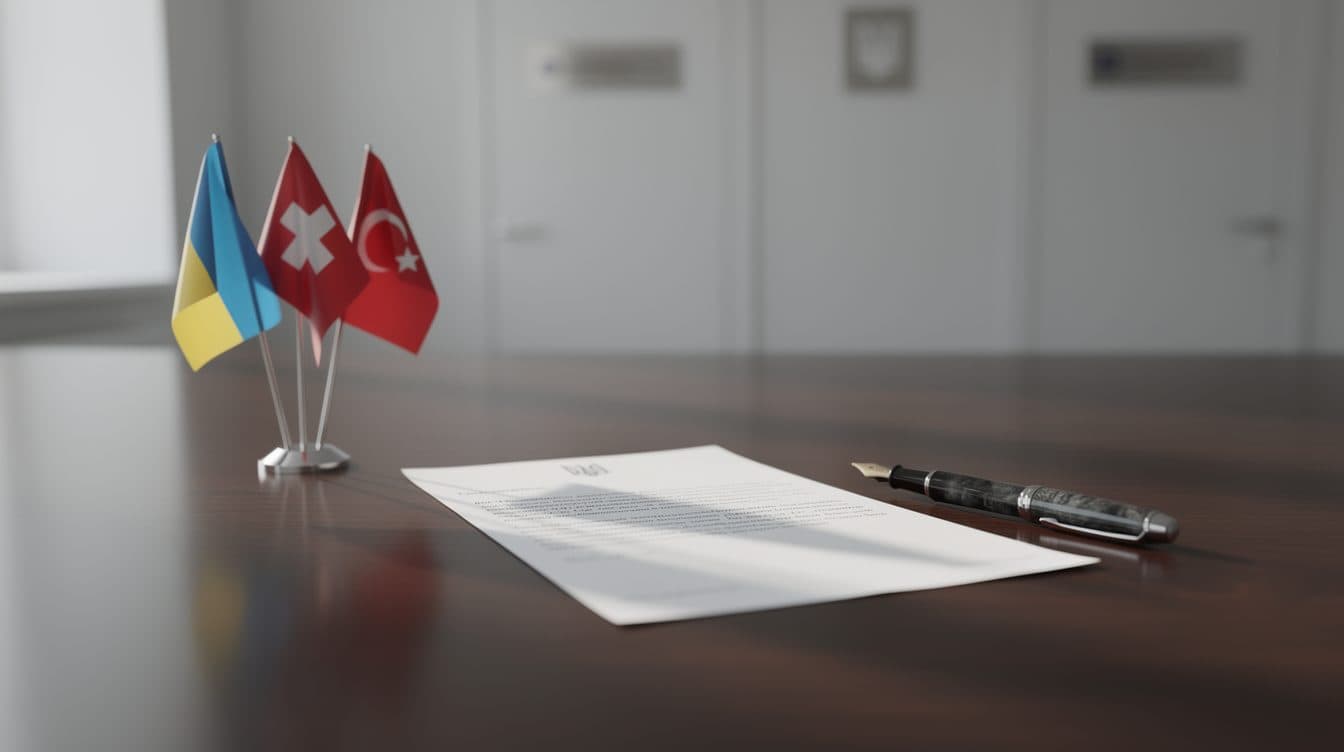
AI-generated image (flux-2/pro-text-to-image via Kie.ai)
Summary
Ukrainian President Volodymyr Zelenskyy has published an open letter to Russian President Vladimir Putin proposing a personal meeting in a neutral country and an immediate ceasefire along the front line as a first step toward ending the war. The letter, released on the Ukrainian presidency's website and on X, also calls for an all-for-all prisoner exchange, the return of deported civilians and children, and the participation of European and US representatives as guarantors. The Kremlin confirmed receipt of the letter but offered no substantive response, reiterating only that Zelenskyy could travel to Moscow, a venue he has repeatedly ruled out.
Kyiv, 5 June 2026
Ukrainian President Volodymyr Zelenskyy published an open letter to Russian President Vladimir Putin on 4 July 2026, proposing a direct meeting in a neutral country and a full ceasefire along the front line as a first step toward ending the war that began with Russia's full-scale invasion in February 2022.
A direct proposal, framed without diplomatic courtesies
The letter, dated 4 July 2026 at 21:20 and released on the Ukrainian presidency's website and on the platform X, is written in Ukrainian and contains no diplomatic courtesies. Zelenskyy opens by addressing Putin directly, arguing that the war is "Putin's personal decision, a war without real reason." He proposes a personal encounter in a neutral country, explicitly ruling out Moscow and Kyiv as venues, and names Switzerland, Turkey, or an Arab state as possible hosts.
Beyond the meeting, Zelenskyy sets out a sequence of concrete measures. The first is a comprehensive ceasefire along the entire front line for the duration of negotiations, monitored by the United States. He then demands an all-for-all prisoner exchange, the return of deported Ukrainian civilians, and the return of children he describes as "abducted during the war." Representatives of Europe and the United States, he writes, should participate in the talks as possible guarantors of any agreement.
The letter goes further in tone, attempting to depict a Russian leadership under mounting strain. Zelenskyy claims that "after 26 years in power, age is beginning to take its toll on Putin," that the Russian population is weary of Ukrainian drone and missile strikes, inflation, and fuel shortages, and that fear of a new mobilization wave is growing. He asserts that Russia is dependent on China and North Korea and that "Putin's own officials, businessmen, and propagandists look at him with obvious fatigue."
A sequence of concrete demands
Zelenskyy also pointedly contrasts the military situation with Putin's own public claims. While Putin has asserted that Russian forces are advancing along the entire front, Zelenskyy argues that Ukraine regained territory in May and that Russian losses in May alone exceeded 30,000 killed and severely wounded soldiers. He states that "no army in the 21st century can afford such casualty numbers" and warns that Ukraine's long-range drones, which he says recently struck targets more than 1,000 kilometers away, demonstrate that this distance is "not the limit" of Ukrainian capabilities.
The Kremlin's reaction was procedural rather than substantive. Kremlin spokesman Dmitry Peskov confirmed to Russian state media that Putin had been informed of the letter but declined to address its content, repeating only the standing offer that Zelenskyy could come to Moscow. Peskov added that "President Putin has said that Zelenskyy could come to Moscow if he wants to talk." Kyiv has categorically rejected Moscow as a meeting location, and Zelenskyy reiterated that exclusion in his letter.
Kremlin response: procedure, not substance
Putin himself did not respond directly to the proposal. Speaking at the International Economic Forum in St. Petersburg, an event he used to project Russia as a partner and investment destination, Putin insisted that Russian forces continue to gain ground and claimed territorial advances of 2,440 square kilometers since the beginning of the year. He again set full Russian control over the internationally recognized Ukrainian regions of Donetsk and Luhansk as a precondition for peace and said the basis for any agreement must be the understandings reached with US President Donald Trump in Anchorage, Alaska, in August 2025, the contents of which have not been publicly disclosed.
Military backdrop behind the diplomacy
The letter's publication coincided with other developments that underlined the gap between the diplomatic proposal and conditions on the ground. Ukrainian long-range drones struck an oil terminal in the port of St. Petersburg on the opening day of the economic forum, with thick plumes of smoke visible as guests arrived in Putin's hometown. Separately, a marine drone exploded near an oil terminal in the Romanian Black Sea port of Constanta, causing no injuries; the Romanian Defense Ministry said the drone type is also deployed in the war in neighboring Ukraine. Ukraine's military used drones to attack five ships in the Russian-occupied ports of Mariupol and Berdiansk, and a Russian drone attack on a food industry enterprise in Brovary district near Kyiv killed at least four people, according to regional governor Mykola Kalashnyk. In the Sea of Azov, a drone attack on two cargo ships killed five Azerbaijani citizens and injured three, according to Azerbaijan's Foreign Ministry.
International responses were cautiously favorable to Zelenskyy's initiative. US President Donald Trump told journalists at the White House that he would welcome a personal meeting between the two leaders, saying, "I think it would be great if they met," and adding, "I'm glad that they might be talking about a meeting. I think we had a lot to do with it." Trump also said both sides would need to compromise. The German federal government welcomed the letter but a government spokesperson said Russia currently shows no serious readiness for peace negotiations, emphasizing that Europe and the United States must be involved in any talks. German Foreign Minister Johann Wadephul called on Putin "to come to the negotiating table." French President Emmanuel Macron, speaking on the sidelines of an EU-Western Balkans summit in Montenegro, described Zelenskyy's initiative as "a good one" and announced a high-level meeting with European leaders in the coming days, confirming close coordination among France, the United Kingdom, and Germany.
International reactions: cautious welcome from Washington and Europe
The wider context is one of stalled mediation. US-brokered negotiations between Kyiv and Moscow are largely on hold, partly because Washington is preoccupied with the war in the Middle East. Zelenskyy wrote that the United States is "fully absorbed by the conflict with Iran" and that it would be wrong to wait until the Ukraine conflict returns to Washington's focus. The European Union, after reaching an agreement with Hungary, voted to open the first phase of accession talks with Ukraine and the Republic of Moldova, a development Putin said Russia does not oppose. In the US Congress, the House of Representatives passed a package providing $1 billion in direct support and up to $8 billion in loans for Ukraine, along with additional sanctions on Russia's financial, oil, and mining sectors, by 226 votes to 195; the bill still requires Senate passage and a presidential veto from Trump is considered likely.
The St. Petersburg forum itself became a stage for competing narratives. Several German AfD politicians traveled to the event, including Frohnmaier, deputy leader of the AfD parliamentary group in the Bundestag, who said during a discussion that it is not in Germany's interest to refrain from trading with Russia and criticized Western sanctions. Putin, asked about the AfD's presence, said Russia would work with people who want to work with Russia. The German Foreign Office had explicitly advised the AfD against traveling, stating that "creating an impression of normality against the backdrop of Russian attacks on Ukraine runs counter to the federal government's foreign and security policy principles."
Stalled mediation and competing narratives
At the forum, Putin also raised the prospect of mediation, saying he would prefer talks with former German Chancellor Gerhard Schröder among all European politicians and defending him as a statesman who represents German interests. Schröder, 82, was sighted this week at the Hotel Kempinski in Moscow by a German television correspondent; the Kremlin confirmed his stay but did not disclose its purpose. Putin also addressed a string of other issues, calling warnings of Russian aggression against a NATO member "nonsense" and a "deliberate provocation," stating that Russia has an air defense system that needs to be improved, and saying the basis for any agreement with Kyiv must be the Anchorage understandings. The German federal government described Putin's proposal to involve Schröder as a "sham offer," and EU chief diplomat Kaja Kallas warned that Russia must not name a negotiator on Europe's behalf.
The exchange of prisoners continued in parallel with the diplomatic posturing. Russia and Ukraine exchanged 185 prisoners of war each, according to Russian state news agency RIA, a step that Zelenskyy's letter had framed as a confidence-building measure that should follow any ceasefire. Near the Zaporizhzhia nuclear power plant, Europe's largest with six reactors and under Russian control since March 2022, an IAEA-mediated local ceasefire took effect to enable repairs on a power line, even as radioactive material continues to be stored at the shut-down facility. EU Commission President Ursula von der Leyen, reacting to the Constanta drone explosion, warned of a threat to all countries on the EU's eastern border and reiterated that "our solidarity with every member state exposed to these threats is absolute."
Zelenskyy closed his letter with both an offer and a warning. He wrote that the war is now in its fifth year, that Russia has spent almost half of Putin's 26 years in power fighting Ukraine, and that "if Russia grows tired, change comes, and Ukraine can work toward that fatigue." He cited the fall of Viktor Orbán in Hungary, where Peter Magyar has become the new premier while maintaining central positions, as an example of those who support Russia ending in disgrace. He also warned that Ukrainian intelligence reports indicate Putin wants to continue the war until 2027 and 2028, with plans that include ballistic missiles, greater involvement of Belarus, and a staged operation in the Moldovan breakaway region of Transnistria. Should Russia refuse the offer, Zelenskyy wrote, the Ukrainian army is ready to continue striking deep into Russian territory. The letter's central line, addressed personally to Putin, remains the same: "I propose a meeting."
Questions & Answers
What did Zelenskyy propose to Putin in the open letter?
Zelenskyy proposed a direct meeting with Putin in a neutral country such as Switzerland, Turkey, or an Arab state, a comprehensive ceasefire along the entire front line for the duration of negotiations, an all-for-all prisoner exchange, the return of deported civilians and children, and European and US participation as guarantors.
How did the Kremlin and Putin respond to the letter?
Kremlin spokesman Dmitry Peskov confirmed that Putin was informed of the letter but declined to address its content, repeating only that Zelenskyy could come to Moscow, a venue Kyiv has categorically ruled out. Putin did not respond directly to the proposal, reiterating at the St. Petersburg forum that Russia demands full control over Donetsk and Luhansk as a precondition for peace.
What is the status of wider peace efforts between Russia and Ukraine?
US-brokered negotiations between Kyiv and Moscow are largely on hold, partly because Washington is preoccupied with the war in the Middle East, and the German government has said Russia shows no serious readiness for peace talks, while Trump, Macron, and the German government have welcomed Zelenskyy's initiative and insisted that Europe and the United States be involved in any settlement.