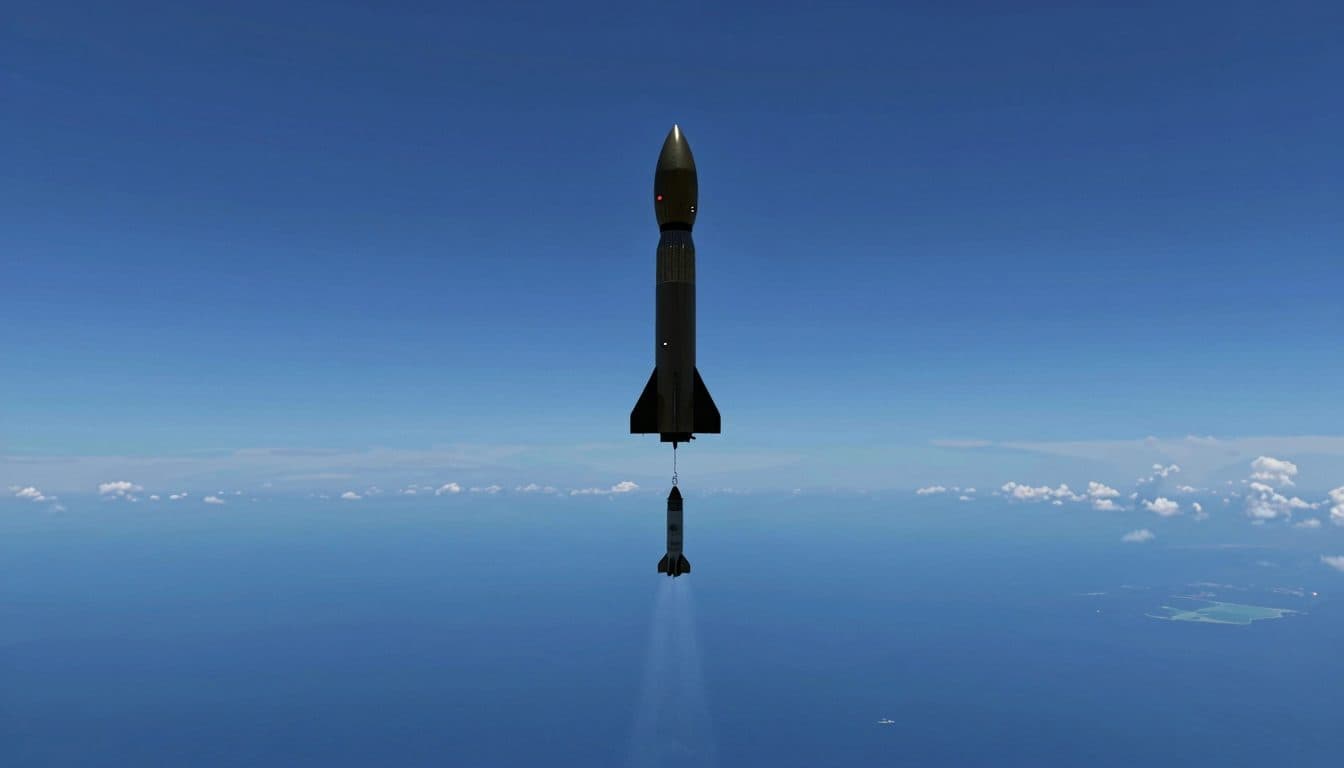
Nasa launches unprecedented rescue mission for satellite "Swift"
Berlin, July 3, 2026
AI-generated image (z-image via Kie.ai)
Summary
The US space agency Nasa launched an unprecedented rescue mission for the "Swift" space telescope on Friday. An unmanned towing spacecraft called "Link" is to bring the research satellite, which has been active since 2004, back to its original orbit over several months.
Berlin, July 3, 2026
The US space agency Nasa launched an unprecedented rescue mission for the "Swift" space telescope on Friday, in which the unmanned towing spacecraft "Link" is to bring the research satellite back to its original orbit over several months.
The launch in the South Pacific
The launch of the "Link" towing spacecraft took place on Friday at 10:36 a.m. CEST from an atoll in the Marshall Islands in the South Pacific. As Nasa announced, a "Pegasus-XL" rocket was first carried to an altitude of around 12,000 meters by a "Stargazer" aircraft and released there.
The "Pegasus" rocket, built by the US defense and aerospace corporation Northrop Grumman, had not flown since 2021 before this mission. The rocket has existed since the 1990s and has already completed dozens of flights.
On board the rocket was "Link," a roughly 400-kilogram spacecraft with three robotic arms, three main propulsion units, and numerous other instruments. It was developed and built for Nasa by the US space company Katalyst Space. The contract for the mission was awarded in September 2025, and the budget, according to Nasa, is around 30 million dollars (approximately 26 million euros).
Why a "Pegasus" rocket was necessary
For comparison: the launch of a "Falcon 9" rocket alone would cost 75 million dollars. A conventional rocket is also unsuitable for this mission because the inclination of the "Swift" orbit relative to the equator is difficult to reach from a fixed platform.
The research satellite is the "Neil Gehrels Swift Observatory," an unmanned sky observatory with three telescopes. It was launched into space from the Cape Canaveral spaceport in 2004 and has since primarily studied massive energy eruptions in the universe, so-called gamma-ray bursts. In 2018, it was renamed in honor of the deceased research director.
"Swift" has been providing important research data on so-called gamma-ray bursts for around 20 years – described as "die stärksten Explosionen im Universum." The telescope provides information on gamma-ray bursts and is of great importance to Nasa.
The "Swift" space telescope
According to Nasa, the satellite is generally in good condition, but it is in danger of crashing out of its original orbit. The reasons for this include strong geomagnetic storms triggered by solar eruptions that heated the atmosphere, increasing drag on the satellite.
In order for "Swift" to be rescued, its orbit must not drop below 300 kilometers. The satellite is currently running in power-saving mode. If successful, "Swift" could deliver scientific data again from autumn – and, according to scientists' expectations, possibly for another five years or more.
Due to the central importance of the research data provided by "Swift," Nasa decided at short notice on the unprecedented rescue mission. The original "Swift" telescope cost 250 million dollars at its launch.
Mission plan over several months
According to the mission plan, the rocket will take about a month to reach the vicinity of the satellite. "Link" is then to orbit "Swift" for several weeks in order to find the best point at which the towing spacecraft can grasp the satellite with its robotic arms. After that, a further two to three months are planned to bring the satellite back approximately to its original orbit.
The roughly 400-kilogram "Link" spacecraft is to approach the research satellite and bring it back close to its original orbit over a period of several months. "Swift" has been sending data on energy eruptions in the universe since 2004, but is now in danger of crashing out of its original orbit.
Jared Isaacman has been head of the space agency Nasa since the end of last year. Isaacman had previously attracted attention with the idea of saving the Hubble Space Telescope. The Hubble Space Telescope is also increasingly losing altitude and could soon cease operations due to various technical problems.
Importance for science
The mission is considered unprecedented in spaceflight: Nasa has never before attempted to bring a crashed research satellite back to its original orbit using a towing spacecraft built specifically for that purpose. If "Link" is successful, this would be a technological milestone.
Scientists hope that the extended lifespan of "Swift" will yield new insights into gamma-ray bursts, which are considered the most energetic events in the known universe. These observations are regarded as key to understanding extreme astrophysical phenomena.
A new approach in spaceflight
The news of the launch of "Link" was broadcast on July 3, 2026, including on the Deutschlandfunk program. The mission exemplifies a trend toward reusing satellites in space rather than abandoning them at the end of their original mission.
With the successful launch of "Link," a phase begins in which Nasa will closely monitor the towing spacecraft's maneuvers over the coming weeks and months. If the docking with "Swift" succeeds, this would, according to experts, be important proof that older satellites can also be reused with new technologies.
Questions & Answers
What is the "Swift" space telescope and what is it used for?
"Swift" is an unmanned sky observatory with three telescopes that was launched into space from the Cape Canaveral spaceport in 2004 and has been researching gamma-ray bursts – described as "die stärksten Explosionen im Universum" – for around 20 years.
What is the "Link" towing spacecraft and what are its tasks?
"Link" is a roughly 400-kilogram, unmanned spacecraft with three robotic arms and three main propulsion units, built for Nasa by the company Katalyst Space, which is to bring the "Swift" satellite back to its original orbit over several months.
Why did Nasa decide on the rescue mission at short notice?
Nasa decided at short notice on the unprecedented rescue mission because of the central importance of the research data provided by "Swift," after the satellite had increasingly lost altitude due to strong geomagnetic storms and was in danger of crashing out of its original orbit.
Nasa rescue mission: "Link" to save satellite "Swift" | allfacts360