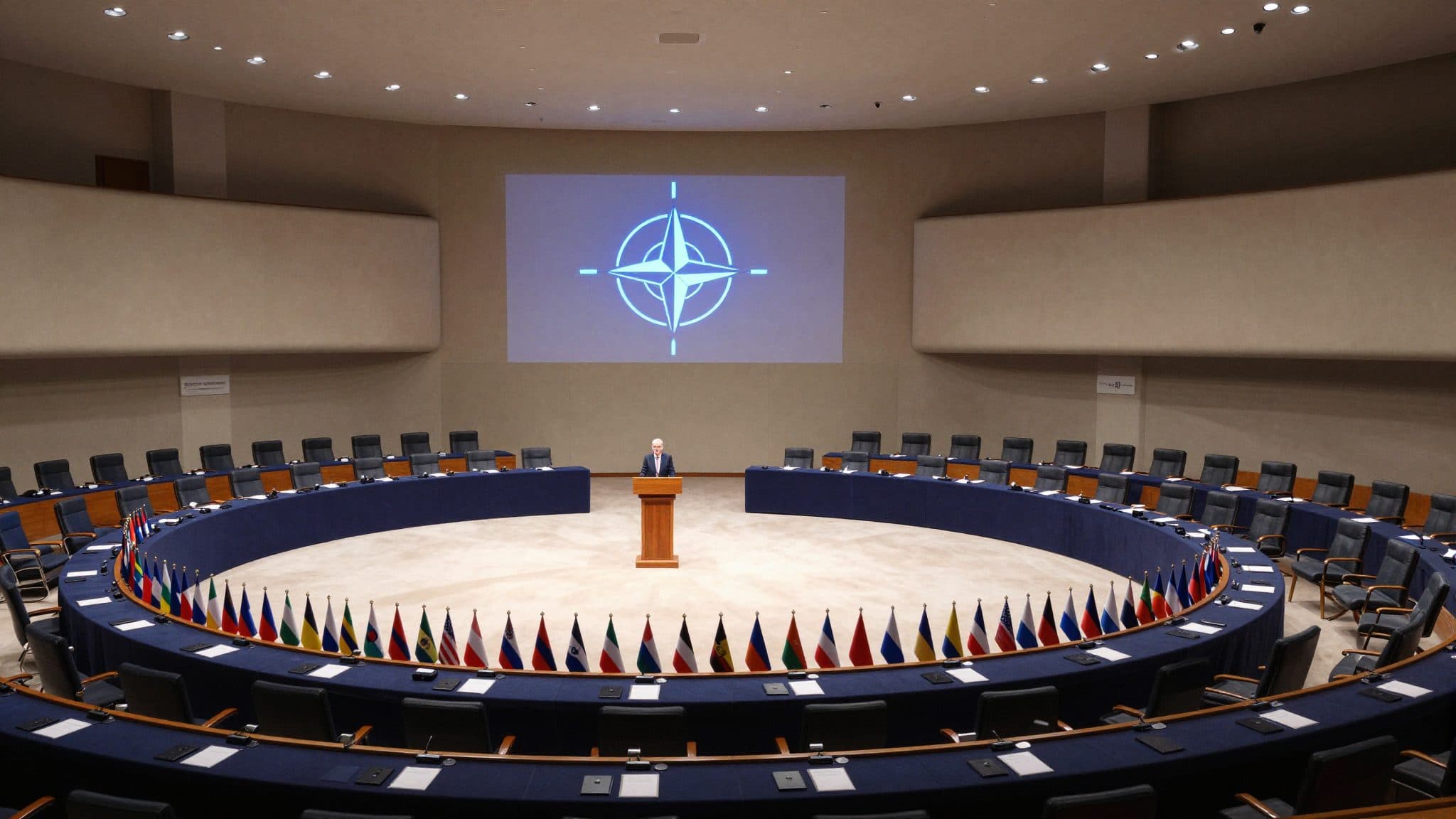
NATO Summit in Ankara: Trump Wavers Between Threats, Slip-Ups and Declarations of Love
Ankara, July 9, 2026
AI-generated image (z-image via Kie.ai)
Summary
At the NATO summit in Ankara, US President Donald Trump once again turned the alliance into a stage for his domestic politics. Between territorial claims on Greenland, threats against Spain and surprising declarations of affection, what remained in the end was above all uncertainty.
Ankara, July 9, 2026
At the NATO summit in Ankara, US President Donald Trump put the alliance under pressure with territorial claims on Greenland, threats against Spain and a series of verbal slip-ups, before surprisingly ending the meeting with the words "Es liegt ein Gefühl von Liebe in der Luft."
Trump and Greenland: Annexation Fantasies Without End
Hardly had one headline been written before the next one followed: At times the US president threatened allies, then he claimed Greenland for the USA, he insulted the leadership of Iran, committed several spectacular verbal slip-ups and finally ended the summit with a sentence that hardly anyone had expected: "There is a feeling of love in the air." The appearance in the Turkish capital resembled a rollercoaster ride that gave the European partners above all one thing: uncertainty.
Right at the beginning, Trump renewed his claim to Greenland, opening one of the most explosive side lines of the summit. When asked whether the USA might withdraw its troops from Europe, he replied: "A lot will depend on Greenland." This linking of the American military presence in Europe with his claims on the Danish-controlled island caused considerable alarm among the European allies. Even before his departure, Trump had made clear, according to CNN, that a "sehr guten Deal in Grönland" would be needed for his government not to withdraw further military personnel from Europe.
Denmark reacted in a routine manner. Head of government Jens Frederik Nielsen has sounded for months like a stuck record: "Leider muss ich erneut wiederholen, dass Grönland nicht zum Verkauf steht." Danish Foreign Minister Lars Løkke Rasmussen did not want to be distracted in Ankara by the US president's shouting and pointed to ongoing negotiations: "Wir sind fest davon überzeugt, dass dies gelingen kann." Ulrik Pram Gad, an expert on Arctic security policy at the Danish Institute for International Studies, was however skeptical in remarks to the STANDARD: "Meine Analyse besagt, dass es deshalb kein Abkommen geben wird. Die Verhandler arbeiten und zeigen, dass sie eine Lösung wollen, dass sie fast fertig sind."
Spain Under Pressure: Between Threats and Comeback
A main point of the negotiations from the Pentagon's perspective is likely to be the protection of the island against Russian and Chinese interests. Greenland, as an Arctic great power, is gaining increasing importance in the strategic competition, both in terms of raw materials and militarily. Greenland's Prime Minister Jens Frederik Nielsen had made clear before the summit: "Leider muss ich erneut wiederholen, dass Grönland nicht zum Verkauf steht." Trump had ignored this stance repeatedly before, and it quickly became clear in Ankara as well that the annexation fantasies are by no means a thing of the past.
A telling remark came from the Danish chief diplomat, who called Trump's endeavor "fantastisch": "Das bestätigt, was wir schon die ganze Zeit gewusst haben, nämlich: Wenn Trump alles zu sagen hätte, wäre Grönland schon morgen amerikanisch. Aber Grönland möchte nicht zu den USA gehören." With that, the tone was set: The US president's annexation fantasies regarding Greenland are by no means a thing of the past – even if now negotiations on the status of the island in the high Atlantic North are taking place "only" at the diplomatic level.
An unusual role in this tug-of-war is played by the Greenlanders themselves, whose political representatives repeatedly emphasize that the island is by no means suitable as a bargaining chip for other conflicts. "A lot will depend on Greenland," Trump had said – a statement understood in Copenhagen and Nuuk as interference in internal affairs. Danish Foreign Minister Lars Løkke Rasmussen stressed that Denmark continues to rely on dialogue and diplomatic channels, and appeared remarkably composed in the face of the threatening gestures from Washington.
Alongside Greenland, it was Spain in particular that caused a scandal. Because of Spain's rejection of the five-percent target for defense spending and the Spanish position on the Iran conflict, Trump called the country a "terrible partner" and declared: "They don't participate. They don't pay." At times he even threatened to restrict trade relations with Spain. Trump had thus mocked Spain and ordered his Treasury Secretary Scott Bessent to halt bilateral US trade with Spain immediately and comprehensively.
Ukraine as the Winner: Patriot Deliveries and Respect
Trump's choice of words toward the Iranian leadership was particularly drastic. He called them "scum", "lunatics" and "sick people". These verbal insults marked a new low point in the already shattered relations between Washington and Tehran and posed the question for the European allies of how to deal with this escalation.
Spain's head of government Pedro Sánchez, however, remained composed. "And had they not done that, we wouldn't even be talking to them." Sánchez had in fact announced that Spain would "naturally" participate in the greater financial commitment of the European NATO partners and Canada – admittedly only on the premise that the Spanish welfare state not suffer as a result. Sánchez was therefore able to very calmly have Trump told that Spain would continue doing "business as usual" with the USA. The latter had obediently replied on camera with "Ja, Sir!" – fully aware of how absurd and illusory such a step would be; after all, Spain is the EU's fourth-largest economy, which, due to its EU membership, cannot be treated separately or even sanctioned.
The turnaround came on the return flight: On the flight back to Washington, Trump eventually spoke of an "impressive comeback" by Spain. As justification he said: "Spain has made an impressive comeback today." At the same time he qualified the praise: "And had they not done that, we wouldn't even be talking to them." It was ultimately once again the language of money that Trump understands best: Yes, there had been "Probleme" with the government in Madrid, he conceded on the flight back to Washington, but he also said: "Spanien hat heute ein beeindruckendes Comeback hingelegt." The reason for these suddenly so friendly words: The NATO partner had acceded to a request for a larger payment.
Verbal Slip-Ups and Confusion on the Sidelines
Among the apparently big winners of this year's meeting was Ukraine: Trump presented himself in Ankara together with his Ukrainian counterpart Volodymyr Zelensky to the media – in a setting very similar to that of the meeting one and a half years ago in Washington that went catastrophically for the Ukrainian: Here the US delegation, there the one from Kyiv. But this time there were no accusations against Zelensky for a lack of gratitude toward Washington or for clothing allegedly inappropriate to the occasion: This time the US president paid great respect to the Ukrainian army in its defensive fight against the Russian aggressor, saying it was "sehr effizient".
In addition, Trump announced the delivery of Patriot systems to Ukraine: "Wir werden ihnen die Patriots nicht liefern, aber sie sollen sie einfach nachbauen." Zelensky can count this as an immense political success. Trump, however, simultaneously displayed a peculiar confusion: He asked the journalists present: "Any questions for President Putin?", even though Zelensky was sitting next to him.
Several verbal slip-ups also caused confusion. He spoke of the "Islamic Republic of Japan", although Iran was obviously meant. Shortly afterwards he mistakenly referred to the international nuclear agreement with Tehran as "JCPOC" instead of the correct abbreviation "JCPOA". These slip-ups fueled doubts about the substantive preparation of the US president for the summit and gave the European allies further ammunition for the already tense debate about the reliability of the USA as an alliance partner.
Sudden Reconciliation: "Love in the Air"
Despite all the drama, Trump sought a conciliatory ending in the end. He called the meeting a "very successful NATO summit", spoke of great unity within the alliance and declared: "There is a feeling of love in the air." Literally he said: "I'm not happy with NATO because of what they did with Greenland". And Trump suddenly played the reconciler at the summit: Meloni had, in his view, made "Fehler" – but he finds her "eigentlich nett".
The Dutch prime minister was in any case able to report afterwards of "große Harmonie und Einigkeit" in the meeting room. "Wir wollen bei euch bleiben," Trump said, according to concurring statements from several heads of state and government. The Italian reported in Ankara of a "freundlichen Kontakt". In the Bundestag, the German chancellor reported on the NATO summit: "Das Ergebnis übertrifft alle meine Erwartungen."
Europeanization of NATO as the Answer to Trump
But the core question remains: Is NATO, despite Trump's capriciousness, the right framework for strengthening European defense? "Müssen die NATO nicht neu erfinden" – so tagesschau.de formulated it. And: "Müssen NATO-EU-Beziehungen in Angriff nehmen" – under that headline tagesschau.de asked: If Trump nevertheless remains as capricious as we have experienced in the time since his election victory, and NATO cannot rely on this feeling of "Liebe" lasting: Has it then, with this summit and in the time since Trump's return, taken the right measures to be able to deter if necessary without the USA?
Security expert Stefanie Babst summed it up in an interview: "Jetzt geht es um die Europäisierung der NATO. Europäer und Kanadier haben verstanden, dass sie die Europäisierung der NATO vorantreiben müssen." The proposal to further develop the Joint
NATO Summit Ankara: Trump, Greenland, Spain, Ukraine | allfacts360