NATO Summit in Ankara: Merz Campaigns for a "Spirit of Ankara" – Trump Ramps Up Pressure on Europe
Ankara, July 7, 2026
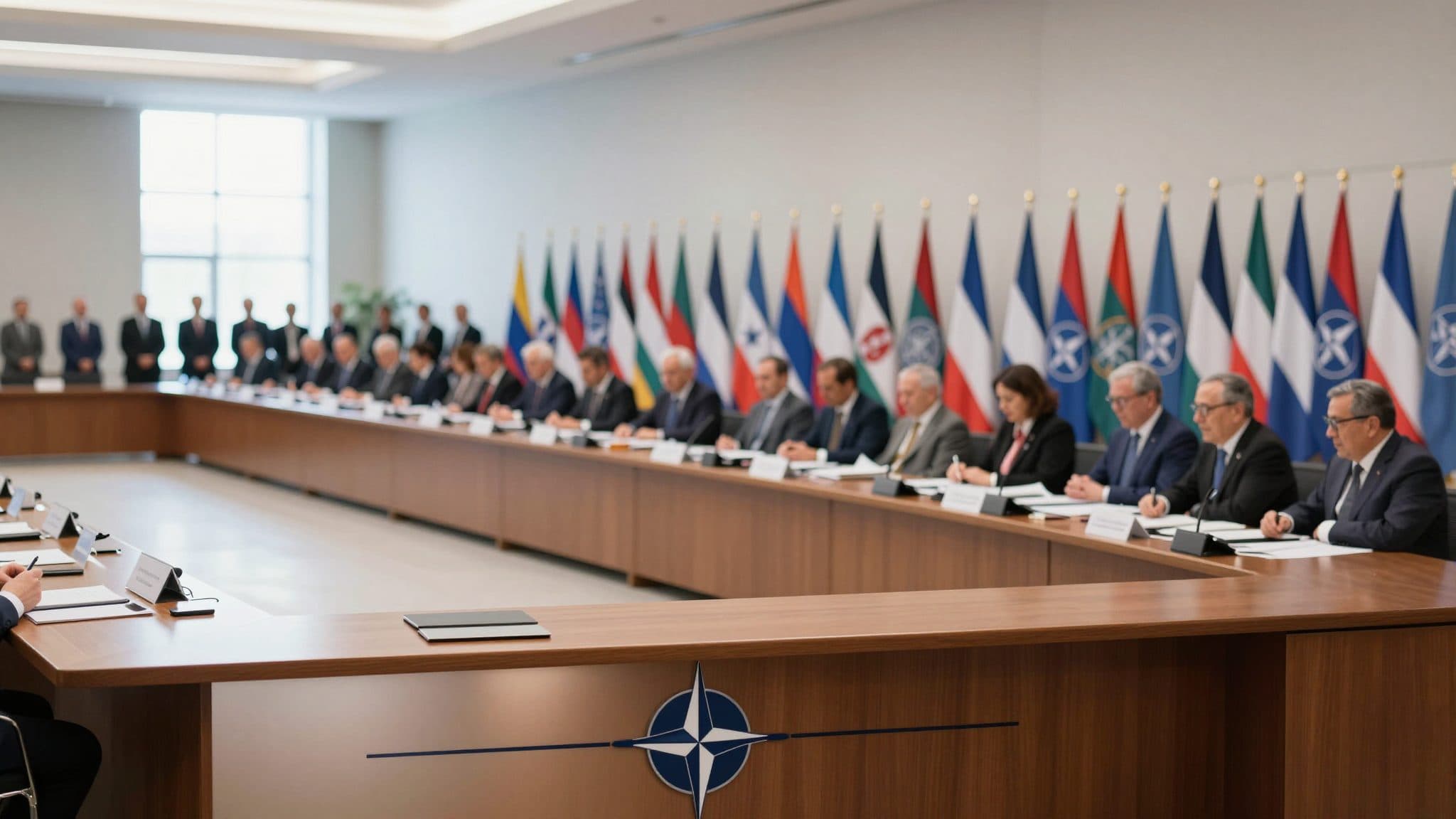
AI-generated image (z-image via Kie.ai)
Summary
At the NATO summit in Ankara, Chancellor Merz and the European allies are campaigning for higher defense spending and more aid for Ukraine. US President Trump simultaneously accuses the alliance of an unequal burden-sharing and stokes additional conflict with a view to Russia and Iran.
Ankara, July 7, 2026
At the NATO summit in the Turkish capital Ankara, Chancellor Friedrich Merz and the European allies called on July 7, 2026 for higher defense spending, billions in aid for Ukraine, and a strengthening of the European pillar of the alliance, while US President Donald Trump criticized the burden-sharing and tightened his demands on the partners.
Rearmament and Drone Defense
The NATO summit in Ankara takes place in the shadow of two wars and a deep dispute over burden-sharing within the alliance. The wars in Iran and in Ukraine, as well as the unequal distribution of defense burdens, provide enough conflict material at the meeting of the 32 heads of state and government in the Turkish capital, according to German government circles. Chancellor Friedrich Merz nevertheless tried to spread confidence with a historical reminiscence of the "Spirit of Camp David": "I wish that, together, we succeed in awakening a spirit of Ankara."
Merz also stressed that the increased efforts were not a favor to Washington. "We are not making this effort in order to do anyone a favor," he said. With a view to Russia, he formulated a clear expectation of the Kremlin: "The Kremlin should by now realize that Russia will not prevail in this war and will not achieve its war aims." He underscored the growing threat of daily Russian tests of resolve with the words: "Every day, Moscow tests our resolve."
At the center of the deliberations is an extensive rearmament and support package. A fleet of 14 AWACS surveillance aircraft is to be replaced. In addition, the allies want to invest more than 40 billion dollars over the next five years in capabilities for drone defense. For Ukraine, a financial minimum provision of 70 billion euros per year over two years is envisaged – a total of 140 billion euros, of which the NATO states, after deducting American contributions, would still have to raise around 80 billion euros from their national budgets. Through a US model, Ukraine is to receive around 60 billion euros for defense-related expenditures by the end of 2027.
Zelensky Presses for NATO Perspective
Ukrainian President Volodymyr Zelensky used the summit to step up pressure for a clear perspective for his country within NATO. He asked the allies whether it was right "to leave a country and a people with such a level of defense capability outside NATO." With that, Zelensky made clear that Ukraine wants to join NATO. Ukrainian Foreign Minister Andriy Sybiha had also demanded beforehand that the summit must not only produce "empty words," but must deliver more protection for Ukraine. Following the latest massive Russian attacks on Kyiv and other cities, he also called for domestic production of "Patriot" air defense missiles.
Merz assessed the US participation in Ukraine financing announced just before the summit as a "strong sign" of transatlantic cooperation. He expressed conviction that an agreement was closer "than people believe." At the same time, he scaled back expectations for Ankara with self-criticism. "Do you really believe that?" – so he formulated the big caveat that he linked to the hope that Ankara might mark a turning point in this war.
Dispute over Burden-Sharing
The dispute with the USA over burden-sharing has shaped the summit from the start. US government officials such as Defense Secretary Pete Hegseth and Secretary of State Marco Rubio had recently described the course of European allies as "shameful" and announced a reassessment of US relations with NATO. Trump himself called the German NATO contribution "ridiculous" and complained that Europe earned more money from the alliance than it paid in. Merz countered indirectly: "I sort of put people to the test." Looking at the summit, Trump said: "We will talk about it, and I think we will work it out." It is, however, not the first time the US president has made such statements.
Foreign Minister Johann Wadephul pointed to concrete figures on Deutschlandfunk: "We look at the numbers, and they are pointing upward." The German government reaffirmed the goal of raising the defense share of gross domestic product to 3.5 percent by the end of the decade. According to information from the dpa news agency, this is to include around 2.5 percent for classic defense spending and 1.5 percent for other defense-related spending such as infrastructure. Merz also stressed that "what Germany is doing" is "also seen in Washington." NATO Secretary General Mark Rutte had recently stated during a visit to Berlin: "Germany leads and Germany delivers."
The New Spending Figures
NATO Secretary General Mark Rutte underscored the trend reversal in alliance spending in Ankara. The Secretary General emphasized that Europeans and Canadians had spent almost 20 percent more on classic defense last year than in the previous year. For 2025 and 2026 combined, that means 258 billion US dollars additionally. Rutte also recalled that in March, in a report for the European NATO countries and Canada, he had recorded classic defense spending of 2.33 percent of gross domestic product. Germany's new 3.5-percent target will thus be significantly above the previous European average.
Despite these increases, Merz warned against illusions about a quick peace in Ukraine. Trump once set the goal of settling the war against Ukraine within 24 hours of taking office. So far, little of that is apparent. Instead, Trump reminds the alliance of its own history of assistance. He said, addressing the Europeans: "We have always been there for them." Rutte replied: "Just as you said it in your speech." The tone between the capitals thus remained cordial, but tense.
Trump, Meloni, and a Side Dispute
An additional point of conflict came to the summit through the dispute between Trump and Italian Prime Minister Giorgia Meloni. The trigger was Trump's claim that Meloni had begged him for a photo with him at the G7 summit in the French town of Évian. Meloni described this as "completely made up." Above the photo, in capital letters, it read: "Restraining order needed" – which roughly means "Kontaktverbot erforderlich" or "Annäherungsverbot erforderlich." With that, the US president caused a diplomatic rift that had to be worked through on the margins of the NATO meeting.
The European allies tried to settle the mood with a view to the joint project of a "more European NATO." Merz said that, "Trump's barbs notwithstanding," Ankara should send the message: "We are building a more European NATO, so that this NATO can remain transatlantic." With that, he linked the short-term disputes over arms goals with the longer-term project of a stronger European pillar within the alliance – while also tying in the historical resonances of conferences such as Yalta or Camp David.
The Attempt at a "Spirit of Ankara"
With the linking of rearmament, Ukraine aid, and transatlantic unity, the Ankara summit has become a stress test for NATO. The allies must decide how much money they will in future put into their own capabilities, into support for Ukraine, and into the European pillar of the alliance. If Ankara succeeds in formulating a common signal, it could become the "Spirit of Ankara" invoked by Merz. But if the disunity persists, the reassessment of US relations with NATO announced by Trump and his government officials is likely to intensify further.
On the margins of the summit, the role of the host, Recep Tayyip Erdoğan, is also likely to gain in importance. Turkey sees itself as a bridge between West and East and is striving for a mediating role in the Ukraine war. By choosing Ankara as the venue, the allies sent a signal to Moscow. Whether this will lead to a political turning point depends not least on whether the 32 heads of state and government in Ankara can agree on concrete decisions on arms, Ukraine aid, and burden-sharing.
What is certain is that NATO is heading into a phase of heightened demands with the Ankara summit. The sums involved are huge, the political fronts hardened. For the coming months, it will be decisive whether the decisions taken in Ankara are translated in the capitals into concrete budget plans, arms contracts, and military aid – and whether the much-invoked "Spirit of Ankara" is more than a political metaphor.
From a German perspective, the summit has already set a direction: Berlin wants to press ahead with the 3.5-percent target and position itself as one of the most reliable contributors within the alliance. "What Germany is doing is also seen in Washington," Merz said. With that, the German government ties in with the image that Rutte had drawn in Berlin and at the same time tries to defuse one of Trump's main criticisms – what he sees as Germany's too-low defense spending.
Questions & Answers
Who is Friedrich Merz in this context?
Friedrich Merz is the Chancellor of Germany and traveled to the NATO summit in Ankara, where he called for higher defense spending, more aid for Ukraine, and a "Spirit of Ankara." He tied this in with the historical formula of the "Spirit of Camp David" and advocated for a more European, but still transatlantic, NATO.
How much money is Ukraine to receive under the summit plans?
The allies want to provide at least 70 billion euros per year over the next two years for military equipment, support, and training for Ukraine – a total of 140 billion euros. Of that, the NATO states, after deducting American contributions, would still have to raise around 80 billion euros from their national budgets. Q
NATO Summit Ankara: Merz, Trump, and Europe's Rearmament | allfacts360