NATO Summit in Ankara: Turkey Positions Itself as a Power Broker in the Alliance
Ankara, 05 July 2026
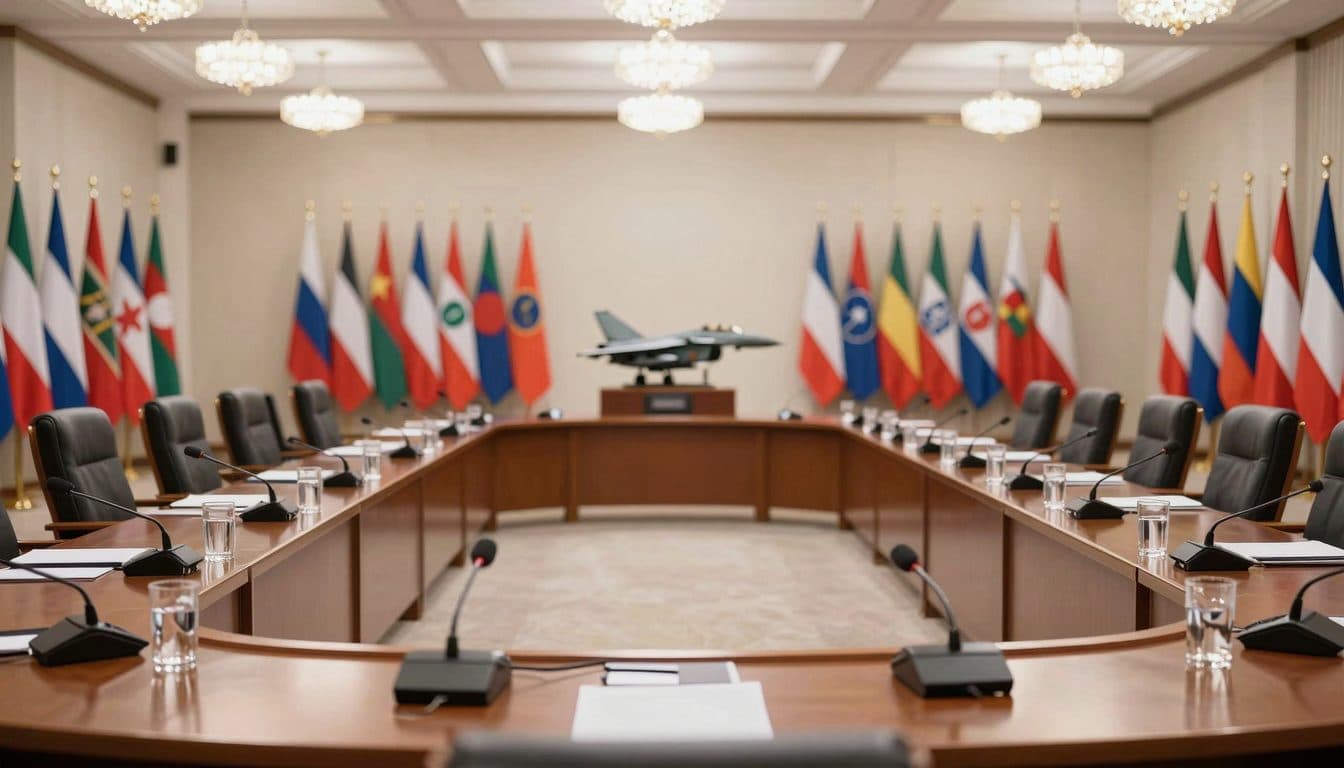
AI-generated image (z-image via Kie.ai)
Summary
At the NATO summit in Ankara, President Recep Tayyip Erdogan is hosting around 30 heads of state and government, including US President Donald Trump and German Chancellor Friedrich Merz. Turkey is using the stage to showcase its growing role as the alliance's second-largest army and its defense industry.
Ankara, 05 July 2026
At the NATO summit in Ankara, Turkish President Recep Tayyip Erdogan will host around 30 heads of state and government next week, including US President Donald Trump and German Chancellor Friedrich Merz, casting Turkey as an indispensable power broker in the alliance.
The NATO summit in Ankara, taking place this Tuesday and Wednesday, is only the second time the Western defense alliance has held a top-level meeting on Turkish soil since the country's accession in 1952. Around 32 heads of state and government are traveling to the capital, including Trump and Merz. President Recep Tayyip Erdogan will receive the guests at the presidential palace, with tens of thousands of security personnel deployed to ensure smooth proceedings. The military airport in Ankara has been expanded for the occasion, and the capital is under a state of emergency.
Turkey as Host
Turkey views the summit as a stage for its new foreign policy ambitions. "It is a signal to the domestic audience: look, we are playing in the global league," says Turkey expert Cengiz Günay, director of the Austrian Institute for International Affairs, in an interview with KURIER. Ankara wants to show its allies that, as the second-largest army in the NATO alliance, it is a pillar member. Recent developments in the Middle East have also underscored Turkey's geopolitical significance: in Syria, a former Islamist long backed by Turkey is in power, who has resolved the Kurdish problem for Erdogan.
Günay calls what Turkey has achieved in recent years strategic autonomy. The country's arms production is increasingly seen as independent: high-tech drones such as the Bayraktar TB2, also used by Ukraine, are considered showpieces. Turkey ranks eleventh among the world's arms producers and aims to break into the top ten. NATO Secretary General Mark Rutte has already spoken of a "revolution" in Turkey's defense industry. Turkey is currently building an underground fuel pipeline that is to be integrated into a 28-billion-dollar NATO infrastructure project to strengthen the alliance's supply security. By 2028, a multinational command center for NATO ground forces in Adana and a maritime hub in Istanbul are also slated to be established.
Defense Industry and Strategic Autonomy
At the center of Turkish expectations, however, is a different host gift: a return to the US F-35 fighter jet program. Ankara was expelled from the arms program after purchasing Russian S-400 air defense systems, and major weapons deliveries were also restricted for a time. In December 2025, Erdogan is said to have asked Russian President Vladimir Putin to take the S-400s back. Trump raised new hopes for Turkey's return to the program last week, and also announced that the US was considering providing Turkey with engines for Turkish Kaan fighter jets. Trump had announced his visit to Ankara with the words: "Ich komme nur aus Respekt für Präsident Erdoğan".
Waiting for the F-35
Turkey's domestic political situation stands in contrast to its foreign policy staging. Opposition politician Ekrem Imamoglu, the former mayor of Istanbul, has been in custody for just over a year. The CHP named Imamoglu its presidential candidate shortly after his incarceration and presented its election platform in the autumn. In the 2024 local elections, the CHP became "erstmals seit Jahrzehnten stärkste politische Kraft im Land". CHP leader Özgür Özel has since organized weekly demonstrations in rotating Istanbul districts and regular protests in other provinces. The next regular election is scheduled for 2028.
Domestic Political Tensions
Turkey expert Sinem Adar, head of the Center for Applied Turkey Studies at the German Institute for International and Security Affairs in Berlin, sees democracy in the country under pressure for some time. "Die Türkei erlebt seit etwa 10 bis 15 Jahren einen schrittweisen, systematischen Abbau demokratischer Strukturen", says Adar. With the 2010 constitutional amendment, the Constitutional Court and the High Council of Judges and Prosecutors were restructured. The 2016 coup attempt gave Erdogan the opportunity for sweeping purges in state institutions, and in 2018 the transition to the presidential system took place, institutionally anchoring the dominance of the executive. "Die Gewaltenteilung in der Türkei ist weitgehend ausgehöhlt", says Adar. "Der Handlungsspielraum der Opposition ist eng. Die Gewaltenteilung ist stark beschädigt, die AKP-Regierung und ihre Verbündeten kontrollieren einen grossen Teil der Medienlandschaft".
Ahead of the summit, the Turkish government has banned gatherings, events, and protests under strict security measures. Many local government-critical news organizations were also denied press accreditation to cover the summit. In the week before the meeting, 103 people and leading civil society figures were reportedly arrested on charges of supporting terrorism.
Turkey's relations with its NATO partners have repeatedly been strained in the past. Ankara pushed back in 2009 against the appointment of Danish politician Anders Fogh Rasmussen as NATO Secretary General because a Danish newspaper had printed Mohammed cartoons. "Die Liste der Provokationen ist lang", reads the reporting. Intra-European tensions surrounding the Iran war are also weighing on the mood: Spanish Prime Minister Pedro Sánchez denied the US the use of Spanish military bases, Italy denied US aircraft landing at the Sigonella base in Sicily. Trump threatened Spain with penalties multiple times. Sánchez replied that "blinder und unterwürfiger Gehorsam" was not an expression of leadership. Italian Prime Minister Giorgia Meloni rejected the US president's claim that she had begged him for a photo at the G7 summit, calling it "völlig erfunden".
Trump himself had demanded at the previous NATO summit in The Hague that the Europeans pay more for transatlantic defense. NATO Secretary General Rutte got the allies to promise Trump a significant increase in their defense spending, and tried to mediate with flattery. In The Hague, Rutte said: "Europa wird kräftig zur Kasse gebeten werden - so wie es sein sollte - und es wird dein Sieg sein." In front of running cameras at the White House, Rutte presented display boards, one of them bearing the title "The Trump Trillion" in golden letters. Rutte had previously referred to Trump as "Daddy". At the G7 summit in Évian, Chancellor Merz tried to improve the mood with a Germany jersey for the US president's 80th birthday; Trump only briefly smiled. Trump had publicly called Germany's defense spending "lächerlich" and announced the withdrawal of 5,000 US troops from Germany. Merz, for his part, said Germany did not need to hide from anyone with its doubling of the defense budget within four years, and that he would "auch in aller Bescheidenheit zum Ausdruck bringen" this at the NATO summit.
Trump, Rutte, and the Shortened Agenda
The Ankara summit has also been shortened to an unprecedentedly brief format. As reported by SRF News, citing former NATO senior official Jamie Shea, the program was streamlined "damit sich US-Präsident Donald Trump nicht langweilt und es wenig Raum für einen Eklat gibt". Shea said: "Trump hat mit seiner Schocktherapie erreicht, dass ein Prozess nun in zehn Jahren stattfindet, der sonst wohl zwanzig oder dreissig Jahre gedauert hätte." Shea also argued that Europe should strengthen its defense capability "dass Grönland geschützt werden kann, ohne auf eine amerikanische Besetzung angewiesen zu sein".
Alongside Turkey, European defense efforts are also in the summit's focus. The question to be clarified is how the countries intend to implement the agreed goal of spending five percent of their gross domestic product on defense by 2035. French President Emmanuel Macron has sparked a debate over a collective European nuclear bomb. Experts see acute need for action in the area of air defense and drone defense: Russia violated European airspace with drones thirty times in the past month alone. There are also grave weaknesses in the fight against cyberattacks, sabotage, disinformation, and propaganda.
Europe's Defense in Transition
Adar sees two strategic goals for Turkey at the summit: strengthening its position within NATO and building institutional arms cooperation with the European Union. Ankara fears being excluded from EU efforts to establish itself as a security policy actor. Günay sums up the European position with the sentence: "Man arrangiert sich mit Erdoğan." Some European heads of government would rather accept "das bekannte Übel" than the uncertainty that an internally unstable or weakened Turkey could bring. 56 percent of Turkish exports go to Western countries; the defense industry's export business is worth ten billion.
The US, for its part, is pushing ahead with its own arms projects in Europe. Washington has concluded several new bilateral stationing agreements with European allies, particularly in Scandinavia, and has launched an extensive infrastructure program for bases in Great Britain. At the same time, the US wants to modernize its nuclear weapons stationed in Europe. Trump, however, wants to withdraw thousands of US troops from Europe; the Tomahawk cruise missiles promised by his predecessor Joe Biden two years ago are also no longer to be delivered. Trump has so far said nothing about weakening or lifting the American nuclear guarantee for Europe.
Günay sees a double message in Turkey's role as host. "Man hat sich innerhalb des Bündnisses Freiräume geschaffen, die aus Sicht der Regierung für die eigenen nationalen Sicherheitsinteressen notwendig sind", he says. And: "Es ist eine Botschaft an die Nachbarn, die der Türkei nicht
NATO Summit Ankara 2026: Turkey as Host | allfacts360