E5 Summit in Berlin: Europeans coordinate common course on Ukraine ahead of NATO meeting
Berlin, June 24, 2026
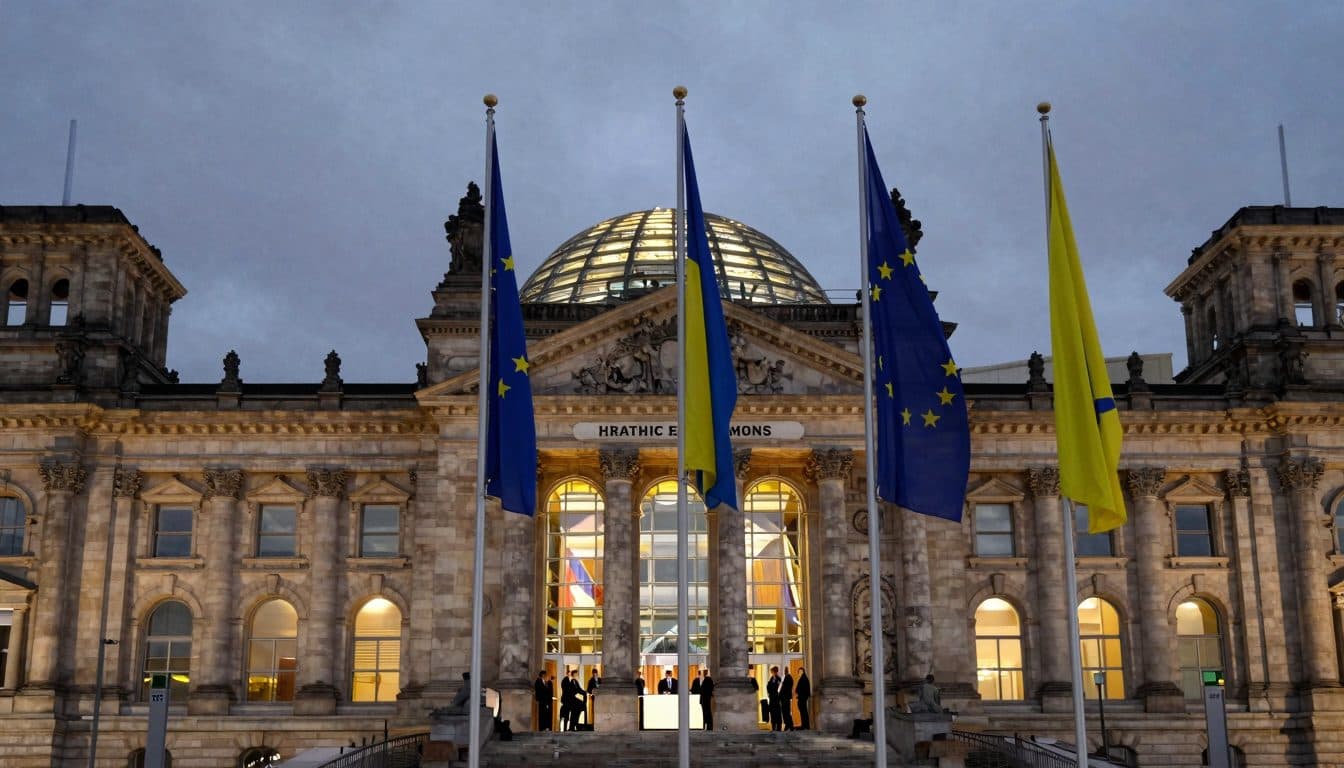
AI-generated image (z-image via Kie.ai)
Summary
Ahead of the NATO Summit in Ankara, the heads of state and government of Germany, France, Great Britain, Italy, and Poland met in Berlin. Chancellor Merz announced five joint messages – including a strong financing commitment for Kyiv.
Berlin, June 24, 2026
The heads of state and government of Germany, France, Great Britain, Italy, and Poland met on Wednesday evening at the Berlin Chancellery for a summit of the so-called E5 group, in order to coordinate a common course ahead of the NATO Summit in Ankara.
Five Messages to the World
It was the first top-level meeting of the E5 since the NATO Summit in June 2025 in The Hague. Chancellor Friedrich Merz received French President Emmanuel Macron, Polish Prime Minister Donald Tusk, Italian Prime Minister Giorgia Meloni, and British Prime Minister Keir Starmer at the Chancellery. NATO Secretary General Mark Rutte joined by video link from Washington, where he subsequently met with the US President.
After the meeting, Merz formulated five joint messages from the group. A successful outcome of the NATO Summit "serves our security in dangerous times," he said. The German government also proposed "that we, as Kyiv's European NATO allies, give a strong financing commitment." The message to Russia was: "Ukraine remains strong." Moscow must draw conclusions from this: "It is time to enter into peace talks."
Merz: Germany's Role in the Alliance
According to Merz, the E5 states aimed, first, to reaffirm the transatlantic partnership. Second, they wanted to "renew" the alliance, strengthen its European pillar, and invest massively in their own defense. Third, emphasis was to be placed on the fact that NATO cooperates closely on defense matters. Fourth, the NATO Summit should, at the E5's behest, "send a strong signal of support for Ukraine." Fifth, the E5 welcomed the fact that the United States and Iran had agreed on a framework agreement.
For Germany, this integration into the alliance derives "from our history, our geography, and our Basic Law," Merz said. The aim was to "anchor Germany, its armed forces, and its defense industry firmly in the alliance and in Europe." "Our neighbors should feel safer when Germany grows stronger." Everything would be done "to ensure that the countries directly threatened by Russia's aggressive policy – that is, the countries of the eastern flank – are also represented in all formats."
Macron Sees Rapprochement with Washington
Following the recent G7 Summit, French President Macron expressed optimism and spoke of a "rapprochement between the Europeans and the Americans." This development should find continuation at the NATO Summit in Ankara. "We are engaging with vigor, we are boosting our budgets, we are expanding our capacities," he said. Macron stressed the will of the European NATO states to step up their involvement in the transatlantic partnership.
Italian Prime Minister Meloni made clear that Europe "must assume its responsibility with regard to defense and security." In the view of the five heads of state and government, this also meant: spending more on armaments. The follow-up negotiations in Switzerland on Ukraine would be supported by the E5 states, it was said after the meeting.
Merz Praises Starmer's Teamwork
Merz praised the outgoing British Prime Minister Starmer for his "teamwork." The Briton had announced his resignation two weeks earlier. "I am proud of the work of the past two years to rebuild our relationship with our allies in Europe and around the world," Starmer said. Observers interpreted this as a sign of the British Prime Minister's cooperative style in international coordination.
Dispute Over an Envoy to Moscow
Shortly before the E5 Summit, Italian Foreign Minister Antonio Tajani had argued in the newspaper "La Verità" in favor of agreeing on a single negotiator for Europe. "We must find a person – a man or a woman – who speaks with Moscow in the name and on behalf of all of Europe," he said. This person could be "a head of state or government of a medium-sized European country, it could be an institutional authority, for example President Costa." Personally, he advocated "someone from the institutions," said the former President of the European Parliament. The German delegation, by contrast, saw the initiative as an affront to the smaller E3 format.
Background: Pressure from Washington
The background to the Berlin meeting is the pressure from Washington – long-standing and particularly vocal since the US presidency – for the European NATO states to take on more responsibility for the defense of alliance territory. Berlin had previously coordinated on this issue primarily in the smaller E3 format with London and Paris, which had caused displeasure in Warsaw and Rome. The inclusion of Poland in the talks and the joint appearance in the E5 format were intended to smooth over these irritations.
Poland was "an absolutely indispensable link to talk seriously about the future of Ukraine and the region," Tusk had said two weeks earlier, according to the PAP news agency. The group consists of the four European G7 countries and Poland, which borders Russia and sees itself as a representative of the interests of the Eastern European states.
The NATO Summit will take place on July 7 in Ankara. The heads of state and government of the 32 NATO member states are expected to attend. "As far as NATO is concerned, I know that there is disappointment, but we should also bear in mind that these are isolated cases," Rutte told the US broadcaster Fox News. The NATO Secretary General, known as the "Trump whisperer," is expected to be keen to smooth the waters in Washington ahead of the summit.
According to diplomatic circles, much will depend on Rutte as to whether the summit will be a success and whether the détente initiated at the G7 Summit in relations between the US and the Europeans will continue after much acrimony during the Iran war. The European states see it as their duty to speak with one voice in preparing the summit.
Outlook for the Summit in Ankara
According to Merz, the E5 states wanted to send "five messages" with the meeting in Berlin. In addition to the reaffirmation of the transatlantic partnership and the renewal of the alliance, these included a strong signal to Ukraine and an acknowledgement of the US-Iran framework agreement. The message to Russia was clear: Ukraine remains strong, and it is time to enter into peace talks.
Observers also saw the Berlin meeting as an attempt by the five major European NATO states to demonstrate unity vis-à-vis Washington. The inclusion of Poland in the circle was also intended to bind Warsaw in more closely and send a signal to the eastern alliance partners that their security interests are being negotiated at the highest level.
The Italian initiative for a joint negotiator vis-à-vis Moscow had previously caused irritation in Berlin, as it was interpreted as a weakening of the E3 format. At the same time, the discussion underscored the growing pressure on the European states to formulate a coherent Russia strategy. The coming weeks until the Ankara Summit are therefore likely to be shaped by further coordination within the E5 framework.
Questions & Answers
Who is taking part in the E5 Summit in Berlin?
The meeting at the Chancellery was attended by Chancellor Friedrich Merz, French President Emmanuel Macron, Italian Prime Minister Giorgia Meloni, Polish Prime Minister Donald Tusk, and British Prime Minister Keir Starmer. NATO Secretary General Mark Rutte joined by video link from Washington.
What are the five messages of the E5 states?
According to Merz, the E5 wanted to reaffirm the transatlantic partnership, renew the alliance, emphasize cooperation on defense issues, send a strong signal for Ukraine, and welcome the US-Iran framework agreement.
When will the next NATO Summit take place and what is expected there?
The NATO Summit will take place on July 7 in Ankara. The heads of state and government of the 32 NATO member states are expected to attend. The meeting is expected to reaffirm support for Ukraine and advance burden-sharing in defense.