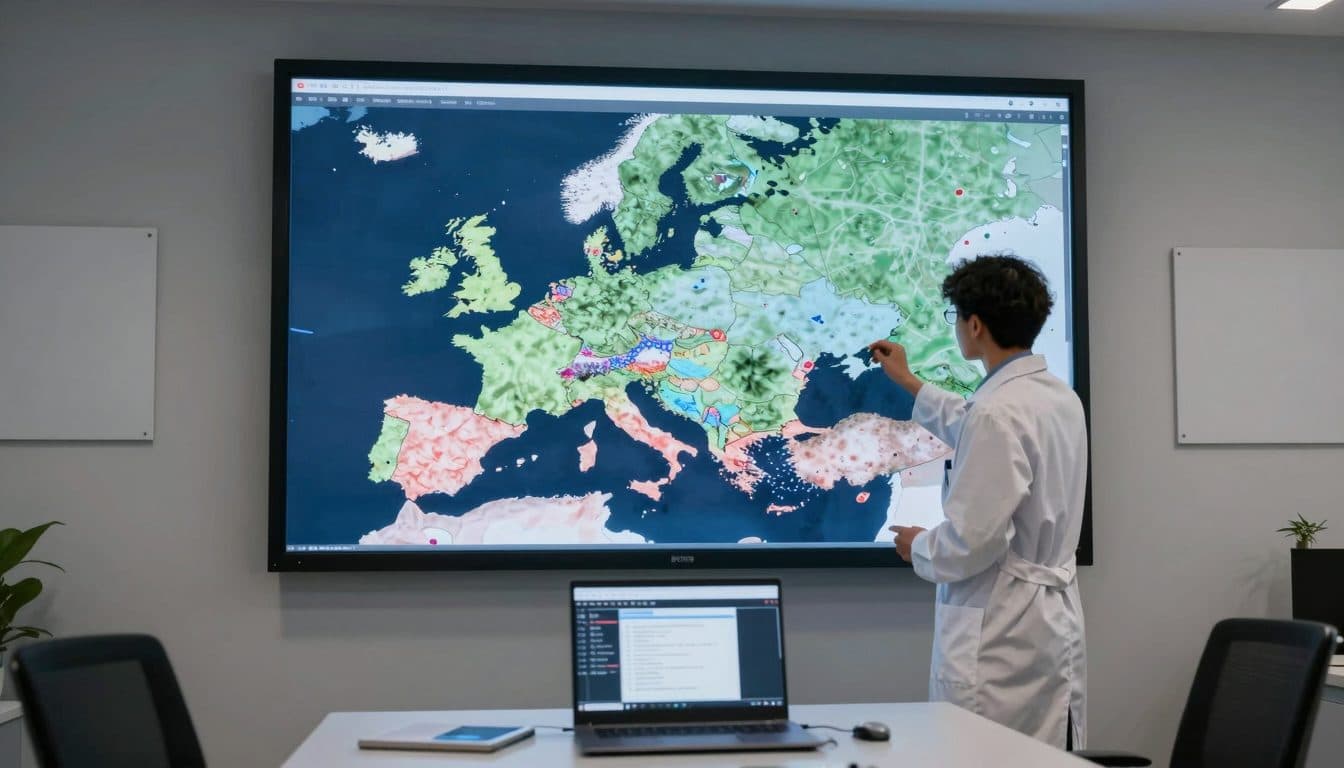
New map reveals Austrian municipalities' digital dependence on US providers
Vienna, 07 July 2026
AI-generated image (z-image via Kie.ai)
Summary
A new interactive map from the Linz-based digital university IT:U shows that 60 percent of Austrian municipal websites and only 13 percent of the email services used are operated by European or domestic providers. Research lead Florian Holzbauer sees this as a growing dependence on large non-European providers such as Microsoft.
Vienna, 07 July 2026
A new interactive map developed by the Linz-based digital university IT:U shows that around 60 percent of Austrian municipal websites, as well as only 13 percent of the email services used in the municipalities, are operated exclusively by European or domestic providers.
One map, 30 countries, 95,500 municipalities
The platform is called "Municipalytics" and brings together data on around 95,500 municipalities in a total of 30 European countries. It was developed at the Interdisciplinary Transformation University Austria (IT:U), based in Linz, and makes visible which providers operate the digital infrastructure of European cities and municipalities. According to research lead Florian Holzbauer, the map is the result of linking Eurostat data with around 89,000 Wikidata entries on municipal websites.
The result, as Holzbauer told the APA, is that Austria lies "somewhere in the middle." For municipal websites, the domestic or European hosting rate is comparatively solid at 60 percent; for email services, however, the situation is significantly worse: only 13 percent of the mail services used by Austrian cities and municipalities come exclusively from European or Austrian providers – the remaining 87 percent involve at least some non-European providers.
The range across Europe is particularly striking. In Germany, the share of municipal websites hosted domestically or in Europe is 97 percent – while the email services of municipal authorities in Germany are operated by a provider outside the country's own borders in only 20 percent of cases. Ireland manages just 14 percent domestic or European hosting for its websites. The discrepancy is even more extreme in the Nordic countries: in Finland, 99 percent of municipalities use a non-domestic email provider, which according to Holzbauer is mainly attributable to the high share of Microsoft services.
Where the hosting world is in order
Holzbauer pointed to the example of Germany and Poland: "In Germany and Poland, a lot is hosted domestically. What was surprising was that there is a competitive market with many regional providers that municipalities can turn to. That is also very resilient, because public institutions retain more control over their data and digital infrastructure." This regional provider structure counts as resilient in his view, because public institutions retain greater sovereignty over their data and the underlying infrastructure in this way.
The picture is different in northern Europe. "In the north, Microsoft is used very heavily for mail services. If you send an email to a municipality, the probability is high that the message ends up in the Microsoft Cloud," said Holzbauer. The finding from Finland, where 99 percent of municipalities rely on non-domestic mail providers, illustrates this concentration on a single externally dominant provider.
Email as a weak point
Austrian municipalities share this risk with regard to email: 87 percent of the email services used in cities and municipalities involve non-European providers, mostly Microsoft. According to Holzbauer, the platform classifies a dependency as already present as soon as at least one provider outside the EU is identified – even if other, possibly domestic providers are used alongside it.
In the researcher's view, this new sensitivity is rooted in changed conditions in the United States. "Now the consequences of the US government's interventions – for example, that people were excluded from services and that data was shared – are being felt more strongly," said Holzbauer. The previous logic of focusing primarily on cost and convenience when selecting digital services is increasingly being called into question as a result.
US politics and the consequences for Europe
In general, the researcher noted, municipalities in Eastern Europe and parts of Central Europe tend to rely more on domestic infrastructure solutions, while cities and municipalities in Northern and Western Europe more often access externally controlled ecosystems. For website hosting, the European share is generally higher than for email services, since many municipal websites are still operated locally.
According to IT:U, the map is intended to enable political decision-makers, administrations, and citizens to see at a glance which providers dominate the digital infrastructure in their region. The platform is available at https://municipalytics.internetwarte.eu/ and consolidates hosting and mail data from 30 European countries.
Political course-setting expected
Holzbauer expects the pressure at EU level to continue to increase. "In the future, it will probably be specified more often by the countries which services municipalities are allowed to use," said Holzbauer. National requirements could thus restrict the previous freedom of municipalities in selecting providers.
At the same time, the researcher warns against expecting too much from quick European alternatives. "But significant efforts by policymakers and business are needed to bring European solutions up to the level of global providers," Holzbauer said. European products would have to match the functionality, scalability, and pricing of global providers before municipalities could switch on a large scale.
The publication of the map is part of a broader European debate on digital sovereignty. Observers see the increasing market concentration – in cloud services, email, and collaboration platforms, for example – as a risk to the data sovereignty of public institutions. The IT:U map now makes this concentration visible comprehensively for the first time.
Outlook: what the map is still set to show
For Austria, this means: for websites, there is still a comparatively broad domestic hosting landscape, while for email services, dependence on non-European providers is already a reality. If the provider structure does not change, a message sent from Austria to a municipality – from an official communication to a citizen's inquiry to a registration confirmation – would frequently leave the domestic legal sphere.
The research group led by Holzbauer plans to further expand the platform in the coming months. The plan is to incorporate more municipalities and additional services such as cloud storage or video conferencing systems. The map is thus intended to become a continuously updated monitor of digital dependencies in Europe.
This article was published by the APA as a service report; content responsibility for the map and data lies with IT:U and the team led by Holzbauer. The editorial team added the contextualization within the ongoing debate on digital sovereignty in the EU.
Questions & Answers
Who developed the digital map "Municipalytics"?
The interactive map was developed by researchers at the Linz-based digital university IT:U (Interdisciplinary Transformation University Austria), led by research lead Florian Holzbauer.
Where does Austria stand compared with other EU countries?
For municipal websites, Austria is in the middle of the pack with 60 percent domestic or European hosting; for email services, the domestic or purely European share is significantly lower at just 13 percent.
Why do the researchers see Microsoft in particular as a risk?
In Nordic countries such as Finland, 99 percent of municipal email services are operated by non-domestic providers, mainly Microsoft; 87 percent of Austrian municipalities also use mail services that involve non-European providers.
Digital dependence: Austria's municipalities in an EU | allfacts360