Nine Years After Launch: Germany and France End the FCAS Fighter Jet Project
Paris, 09 June 2026
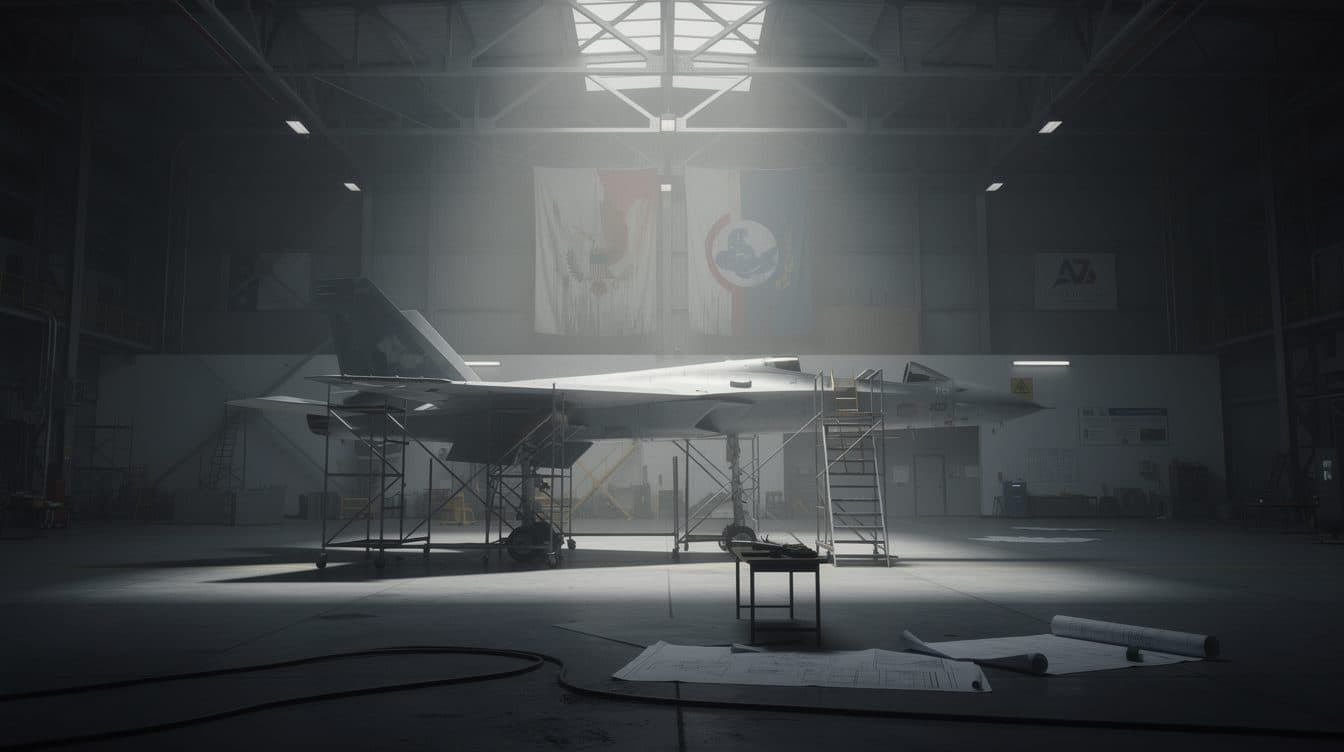
AI-generated image (flux-2/pro-text-to-image via Kie.ai)
Summary
After nine years and prolonged disputes between Airbus and Dassault, Chancellor Friedrich Merz and French President Emmanuel Macron have declared the Franco-German combat aircraft project FCAS ended. As an interim solution, the Bundeswehr intends to procure additional US F-35 aircraft.
Paris, 09 June 2026
Chancellor Friedrich Merz (CDU) and French President Emmanuel Macron declared the joint combat aircraft project FCAS failed on Monday, after roughly nine years and bitter industrial disputes between Airbus and Dassault.
A Project of Historic Ambition
This officially ends one of the most ambitious and costly defense undertakings in European history. FCAS – the Future Combat Air System – was intended, according to the wishes of its political initiators, to become a sixth-generation fighter jet along with drones, sensors, and a networked "Combat Cloud," replacing the Eurofighter of the Bundeswehr and the Spanish Air Force as well as the French Rafale from 2040 at the latest. The project was planned with a budget of over 100 billion euros and was regarded as the largest and most expensive European defense project to date, involving not only Germany and France but also Spain.
The venture was politically launched in July 2017, when the then-French President Emmanuel Macron and the then-Chancellor Angela Merkel ceremonially inaugurated FCAS at the Paris Air Show in Le Bourget. From the very beginning, the project was also a symbol of the two historic rivals' ability to cooperate in defense policy. That symbolic power is now lost.
Industrial Dispute Rather Than Political Discord
In the end, the venture failed less because of political differences than because of a bitter industrial dispute between the two industrial partners, Airbus (Germany) and Dassault (France). The central point of contention was the question of who would assume technological leadership on the so-called New Generation Fighter – the manned core of the program. While Berlin insisted on the originally agreed equal partnership, Dassault CEO Éric Trappier suddenly demanded 80 percent of the leadership share in 2025, effectively claiming the role of chief architect. Airbus rejected this, because Dassault would thereby have controlled the industrial licenses and intellectual property. The dispute escalated, and a final mediation attempt failed in April 2026.
According to German government circles, Chancellor Friedrich Merz (CDU) and French President Emmanuel Macron had "arrived at the shared assessment that the companies cannot come together to build a joint combat aircraft." According to this, Merz had suggested to Macron that the construction of a joint combat aircraft should not be pursued further. However, there was no joint public statement by the two heads of government on the project's end: Merz commented through "government circles," Macron did not comment at all. The Élysée Palace in Paris only confirmed the end of the project hours later, noting that "the German authorities are of the opinion that it was not possible to exert any more pressure on the companies involved."
Merz and Macron: Separate Signals from Berlin and Paris
Notably, according to observers, is also the fact that Chancellor Merz apparently allowed news of the project's end to leak without informing the Élysée Palace in advance. This was perceived in Paris as an affront and is seen as evidence of the strain the failed venture has placed on the Franco-German relationship.
In substance, the project had already drifted apart before then. France needs a carrier- and nuclear-capable aircraft for its nuclear deterrent that can also operate from the aircraft carrier Charles de Gaulle. Germany, on the other hand, needs – in Merz's words – a "high-performance jet for air sovereignty" – without carrier or nuclear requirements. Views on design also diverged sharply: the French wanted a smaller fighter that could land on their aircraft carrier; the Germans, by contrast, wanted to be able to carry a high payload.
Different Requirements for the Aircraft
The Green party chair Franziska Brantner spoke of a "severe setback for European security and defense policy in an increasingly dangerous world." She also held the federal government partly responsible for the failure and warned in the Handelsblatt: "If things go badly, in the end there will be no modern European combat aircraft at all, or only one with an American engine. That is reckless." The Green co-chair also criticized the lack of political leadership: "Where industry blocks progress, it is the task of politics to show leadership and enforce it."
The defense policy spokesperson of the Union faction, Thomas Erndl (CSU), also commented in the Augsburger Allgemeine – and explicitly assessed the project's end as an opportunity. The failure of cooperation between Airbus and Dassault was "a groundbreaking and correct decision." SPD defense politician Christoph Schmid expressed a similar view: he saw in the decision "rather an advantage, because now there is clarity."
Reactions in Berlin: From Regret to Approval
Defense Minister Boris Pistorius (SPD) regretted the end. "Every Franco-German project that is not successful is one that I do not like," he said. At the same time, he stressed that the failure changes nothing about the relationship with France. "This was an ambitious, great, European project that has now been dashed on the rocks of reality. That is a lesson we must draw from it." Pistorius did not want to publicly "speculate" about an alternative jet project.
The chairman of the Bundestag's Defense Committee, Thomas Röwekamp (CDU), likewise regretted the end. At the same time, it was good that after years of blockages and uncertainties there was now clarity, the CDU politician stressed to the Rheinische Post. "Now we should seize the opportunity to forge new and viable partnerships on an equal footing that strengthen Europe's technological progress and industrial sovereignty," Röwekamp said. Great Britain, Spain, and also Sweden are strong European partners with great interest in developing the next generation of air combat systems.
Possible New Partners: Sweden, Great Britain, Spain
The Swedish defense group Saab is now above all under discussion, as it has experience in military aircraft construction with the Gripen and finds itself in a comparable security-policy situation to Germany. However, according to information from the Financial Times, cooperation with Saab within the framework of a joint aircraft project is considered not very realistic. Great Britain, meanwhile, is already committed – the United Kingdom is working with Japan and Italy on the Global Combat Air Programme (GCAP). A German entry into GCAP would massively reduce the say of a late entrant. SPD politician Siemtje Möller emphasized: "Now it is important to quickly find suitable partners for the development of the combat jet."
In the short term, the Bundeswehr intends – according to information from Der Spiegel – to procure additional F-35 fighter jets from the United States. These aircraft can be equipped with nuclear warheads – the command authority for the nuclear warheads, however, remains with the United States. The Bundeswehr would thereby be doing precisely what it had originally wanted to avoid.
F-35 as an Interim Solution and Financial Consequences
Financially, the failed project leaves deep scars. Berlin has already invested almost 500 million euros; according to the NZZ, a further 1.214 billion euros is earmarked in the 2026 draft budget. With the end of FCAS, funding for the preliminary work at Airbus Defence and engine manufacturer MTU will also fall away in autumn 2026. Without a follow-on contract, industry sources say, hundreds of highly qualified engineers will disappear from the market.
The FCAS project is not, however, completely off the table: the development of the "Combat Cloud" as well as the unmanned escort drones are to be continued as a joint Franco-German undertaking. This is regarded as a smaller, but technologically significant, element of the original concept.
What Remains: Combat Cloud and Drones
In mid-July 2026, the defense ministries of both countries intend to present a "contemporary roadmap" for defense-industrial cooperation at the Council of the European Union – the Council of Ministers. It is to focus on "a few realistically relevant projects." This is a political response to a reality that observers bluntly formulate as follows: two industrial colossi, two national vanities, and two irreconcilable military doctrines are apparently a combination that no project management in the world can handle.
Outlook: Council of Ministers in July and the MGCS Risk
In parallel, the second major Franco-German defense project – the Main Ground Combat System (MGCS), a joint battle tank to succeed the Leopard and the Leclerc – is also in difficulties. Macron had some time ago raised the possibility of scrapping MGCS if the FCAS jet came to nothing. That threat is now also in the air.
The outcome of the FCAS project is regarded by many observers as a litmus test for future European defense cooperation. Brantner put it in a sentence that can be read as the political legacy of this decision: "When European cooperations fail, the nationalists always profit."
Questions & Answers
What is the FCAS project and who launched it in 2017?
FCAS stands for "Future Combat Air System" and was the largest and most expensive European defense project. It was set in motion in July 2017 by the then-French President Emmanuel Macron and the then-Chancellor Angela Merkel.
Why did the Franco-German combat aircraft project fail?
The project failed primarily because of industrial disputes between Airbus and Dassault over the leadership role on the New Generation Fighter. A mediation attempt failed in April 2026, after which the relationship was considered beyond repair.
What is Germany planning as a replacement for the Eurofighter after FCAS?
The Bundeswehr needs a short-term Plan B. As an interim solution, it intends to procure additional F-35 fighter jets from the United States; in the medium term, new European partners are to be sought – possible options are Sweden with
FCAS Ends: Germany and France Conclude Fighter Jet Project | allfacts360