Regional Plan Ruhr Overturned: OVG Declares Plan Invalid | allfacts360
OVG Münster Overturns Entire Regional Plan Ruhr – Municipalities and Industry React with Annoyance
Münster, June 13, 2026
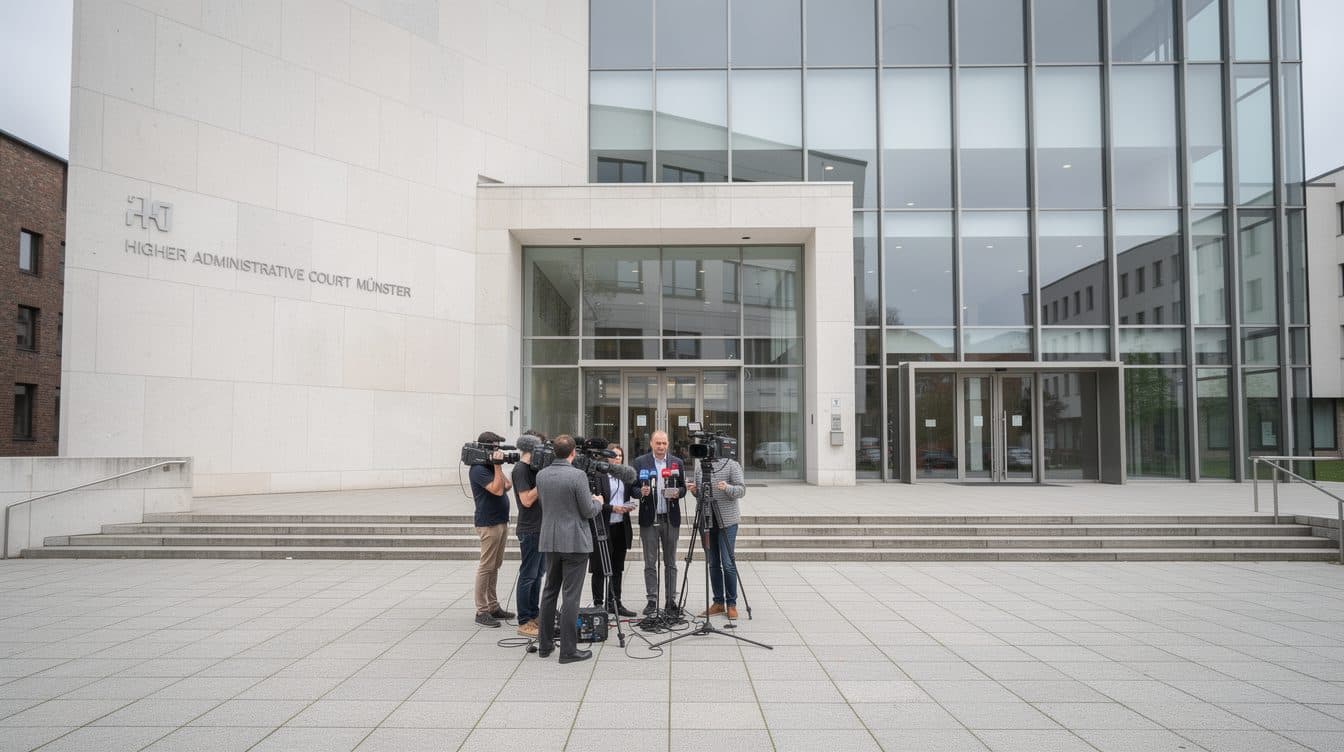
AI-generated image (flux-2/pro-text-to-image via Kie.ai)
Summary
The Higher Administrative Court of Münster has declared the Regional Plan Ruhr invalid in its entirety and did not allow appeal. Municipalities, industry, and the NRW Ministry of Economics are now demanding swift new planning security for the region with 5.1 million inhabitants.
Münster, June 13, 2026
The North Rhine-Westphalian Higher Administrative Court (OVG) in Münster has declared the Regional Plan Ruhr, central to the Ruhr area, completely invalid and did not allow appeal against the ruling.
What the Regional Plan Regulates
The Regional Plan Ruhr had been in force since the end of February 2024 as a central instrument for the long-term development of the region. It determines where residential and commercial areas are to be created, where wind farms are designated, and how local recreation areas and cold air corridors for the major cities are to be secured. With the ruling of the 22nd Senate on Friday evening, this planning basis has now completely ceased to exist – not only the regulations on gravel extraction, which were at the center of the lawsuit.
Plaintiffs included several cities on the Lower Rhine, including Wesel, Hamminkeln, and Kamp-Lintfort, as well as property owners and companies. A raw materials company had also filed a lawsuit, but with the argument that too few extraction areas had been designated. In the district of Wesel, the Regionalverband Ruhr (RVR) had established 17 new dredging holes for sand and gravel. The region between Wesel, Kamp-Lintfort, and Rheinberg is one of the most gravel-rich areas in Germany.
Dispute Over Gravel Extraction on the Lower Rhine
The plaintiffs primarily objected to what they saw as overly generously sized priority areas for gravel extraction. They viewed this as destruction of the landscape on the Lower Rhine. The mayor of Kamp-Lintfort, Christoph Landscheidt, said on the matter: "Es gehe nicht darum, dass überhaupt kein Kies mehr abgebaut werden soll. Es könne nur nicht sein, dass er unbegrenzt abgebaut werden soll – unter Verzicht auf jeglicher Abwägung." Landscheidt also described it as a "Märchen" that there is currently too little gravel. "Wir haben nach unseren Berechnungen und Einschätzungen für die nächsten Jahrzehnte ausreichend Kies", so Landscheidt.
Industry sees things quite differently. Sascha Kruchen, Managing Director of the industry initiative "Zukunft Niederrhein", warned that the region's raw materials supply was "massiv gefährdet". Current figures showed that raw materials supply was only secured for the next five years. In addition, the price of gravel had risen by 90 percent in ten years – this also demonstrates the scarcity. Gravel is considered an essential natural raw material, used predominantly in the construction industry as well as in garden and landscape construction; the largest portion of extracted gravel serves as an aggregate for concrete, providing buildings with stability and longevity.
Court's Reasoning: Outdated Data
Presiding Judge Hans-Joachim Hüwelmeier justified the decision with serious errors in the planning process. "Bei der Planung seien Fehler passiert, die dieses Urteil unausweichlich gemacht hätten", he said. Specifically, the Senate objected that the RVR had based its forecasts for future demand for gravel and sand on outdated figures, although more recent data suggested that the construction industry tended to need less of these raw materials. "Dass ein älterer Bericht für eine Zukunftsprognose geeigneter sein soll als ein aktueller, ist erstmal nicht selbsterklärend", Hüwelmeier criticized during the hearing. However, he conceded: "Das ist kleinlich, das ist uns auch bewusst." On the whole, the plan was made "recht ordentlich", the judge emphasized.
The ruling came at the end of the oral hearing and surprised the parties in its scope. Wesel's Landrat Ingo Brohl (CDU) had hoped the court would only overturn the provisions on gravel extraction. "Der RVR steht jetzt vor den Scherben seines Handelns", he said after the verdict was announced. Brohl pointed out that the municipalities had always pushed to separate the issue of raw material extraction from the overall plan. The RVR's planning documents fill 150 file folders – and now must be largely redrafted.
Among other things, the Regional Plan provided for the construction of 140,000 residential units over the next 20 years. Commercial areas were also designated in which 195,000 people could find work. The expansion of wind energy was also part of the plan. The Regional Plan is the central instrument for the long-term development of the region with its 53 municipalities and 5.1 million inhabitants.
Reactions: Association, Politics, and Industry
The Regionalverband Ruhr initially declined to comment on the judges' decision upon request. The association stated that the ruling needed to be reviewed first. However, it had already become known beforehand that the RVR had insisted on block letters for objections and had expressly excluded cursive writing – a formality that also played a role in the proceedings.
The NRW Ministry of Economics expressed concern similar to that of industry. It was clear that the Ruhr area needed planning security again as quickly as possible, it said from Düsseldorf. This puts the state government under pressure to swiftly initiate the complex process of establishing a new regional plan.
The Senate did not allow appeal against the OVG's ruling. However, a complaint against non-admission of appeal at the Federal Administrative Court in Leipzig remains possible. The RVR can attempt in this way to still achieve a review of the ruling. Whether the association will take this step was initially open.
Possible Complaint in Leipzig
Even before the ruling, it had become clear that the Regional Plan was particularly controversial on the Lower Rhine. The region is one of the most gravel-rich areas in Germany, which is why the conflicts between raw material extraction, landscape protection, and municipal planning sovereignty come to a head here. The case is considered a litmus test for how strongly municipalities can defend themselves against higher-level planning.
There was also a reaction from the construction industry. It pointed out that without secured priority areas, investments in new extraction areas could fail to materialize – with corresponding consequences for construction projects throughout the region. Kruchen warned that without sufficient raw materials supply, rising construction costs and delays in housing and infrastructure projects threatened.
What the Ruling Means for the Region
For citizens on the Lower Rhine, the decision initially means legal uncertainty about the future of the gravel extraction sites in their neighborhood. Several residents had joined the lawsuits and see the ruling as confirmation of their protest against an expansion of the extraction areas.
How things proceed from here also depends on whether the RVR takes the path to Leipzig. Observers expect the association to first await the written ruling before making a decision on a complaint. Until then, the region with 5.1 million inhabitants lacks a valid land-use plan for the coming years – and thus a central instrument for steering the growing need for housing, commercial space, and recreation areas.
Questions & Answers
Why did the OVG Münster overturn the Regional Plan Ruhr completely?
The 22nd Senate of the Higher Administrative Court of Münster declared the entire Regional Plan Ruhr invalid because the Regionalverband Ruhr based its demand forecasts for gravel and sand on outdated figures, although more current data was available. Presiding Judge Hans-Joachim Hüwelmeier spoke of serious errors that made the ruling unavoidable.
Who sued against the Regional Plan Ruhr?
Several cities on the Lower Rhine had sued, including Wesel, Hamminkeln, and Kamp-Lintfort, the district of Wesel, six affected municipalities, property owners, and residents. A raw materials company also went to court – but with the argument that too few extraction areas had been designated.
What consequences does the ruling have for housing construction and the economy in the Ruhr area?
The Regional Plan provided, among other things, for 140,000 new residential units and commercial space for 195,000 jobs in the coming years. Without a valid plan, the region with 5.1 million inhabitants now lacks the basis to secure these projects under planning law – the NRW Ministry of Economics is demanding new planning security as quickly as possible.