Pistorius visits exercise of Panzer Brigade 45 in Lithuania and reaffirms readiness by end of 2027
Vilnius/Pabradė, June 21, 2026
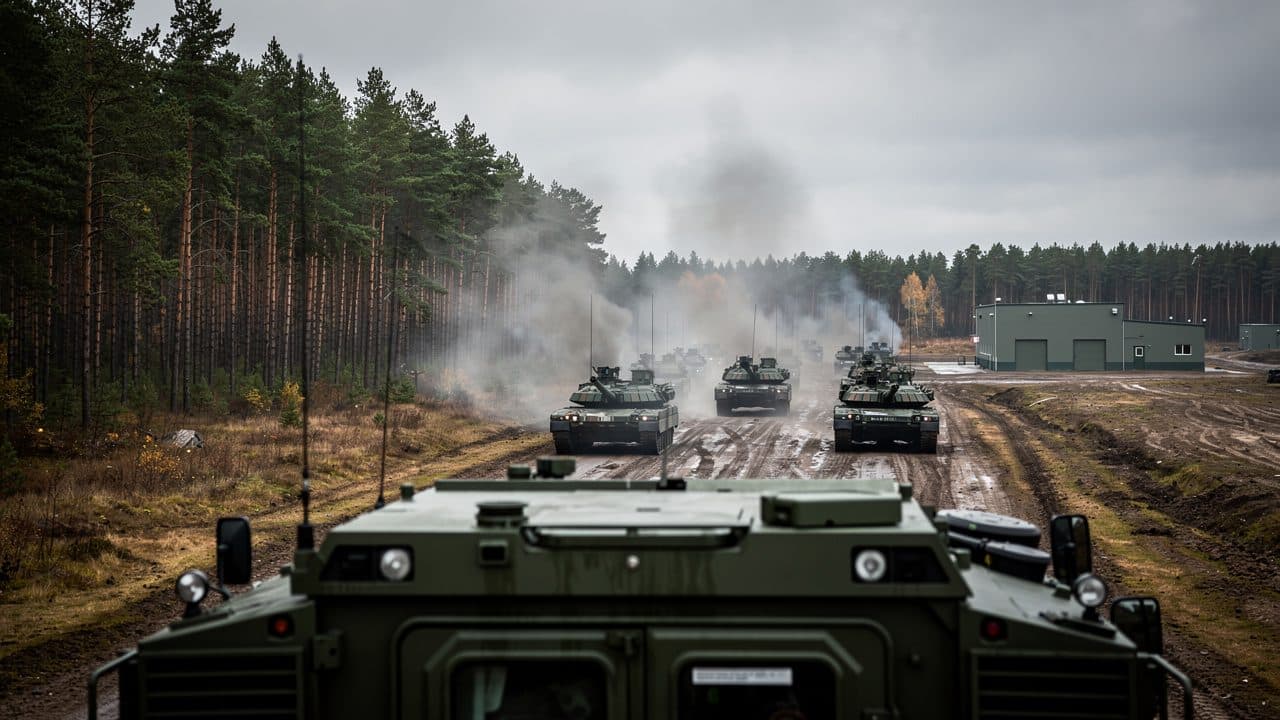
AI-generated image (flux-2/pro-text-to-image via Kie.ai)
Summary
Defence Minister Boris Pistorius on Monday visited the "Freedom Shield" exercise of the Bundeswehr's Panzer Brigade 45 near the Belarusian border. He reaffirmed the goal of reporting the brigade fully operational by the end of 2027 and did not rule out compulsory enlistment if necessary.
Vilnius/Pabradė, June 21, 2026
German Defence Minister Boris Pistorius on Monday visited the "Freedom Shield" exercise of the German Panzer Brigade 45 at the Pabradė training area near the border with Belarus and reaffirmed the unit's operational readiness by the end of 2027.
During his visit to Lithuania, Pistorius was briefed on the progress of the build-up of Panzer Brigade 45, which is considered the core element of Germany's NATO reinforcement on the eastern flank. According to the Ministry of Defence, the exercise near the Belarusian border is the brigade's first major exercise on the ground. Pistorius observed the manoeuvre from a Boxer-type armoured personnel vehicle, according to sources in Vilnius.
"Freedom Shield" exercise with around 2,900 soldiers
According to official figures, around 2,900 soldiers are taking part in the "Freedom Shield" exercise, of whom approximately 2,300 are from Germany. Conventional weapons systems such as Leopard main battle tanks and Puma infantry fighting vehicles are being deployed, supplemented by drones and other modern systems. A total of 350 drones and 650 trucks for transporting weapons, ammunition and personnel were used. Dutch and Norwegian NATO units played the role of the attacker in the scenario.
Defence Minister Pistorius classified the manoeuvre as realistic preparation for possible future conflicts. "Freedom Shield shows what the land warfare of the future will look like," the SPD politician said. A Eurofighter combat aircraft had flown in directly from Germany and overflown the exercising troops on the ground at an altitude of only 40 metres. According to the minister, exercises of this scale should take place at least twice a year in future.
The Inspector of the Army, Lieutenant General Christian Freuding, underlined the timeline. "And we will be operational by the end of 2027. Full stop," Freuding said with regard to the brigade's full combat readiness. Its commander, Brigadier General Christoph Huber, declared: "Die Panzerbrigade 45 ist bereit, heute Nacht zu kämpfen." The unit has a total of 75 main battle tanks and 70 infantry fighting vehicles available for the exercise.
Build-up of the brigade is on schedule
According to current planning, the brigade is to reach a total strength of around 4,800 soldiers and 200 civilian employees. According to the ministry, around 2,000 German soldiers are so far permanently stationed in Lithuania. Around half of the personnel target has thus been achieved. The deployment is a response to the growing threat from Russia and, according to government sources, is the largest military infrastructure project in Lithuania's history.
The brigade's main location is to be Rudninkai, around 35 kilometres from Vilnius and not far from the border with Belarus. The Pabradė training area where the exercise is taking place is around 20 kilometres from Belarus and in the immediate vicinity of the Russian exclave of Kaliningrad. The military site there was already declared a training area by a special Lithuanian law in May 2022, shortly after Russia's attack on Ukraine. The future facility is being built in a forested area approximately 1.5 kilometres from the centre of a village with around 500 inhabitants.
The brigade includes, among others, the Panzerbataillon 203 from Augustdorf in North Rhine-Westphalia and the Panzergrenadierbataillon 122 from Oberviechtach in Bavaria, which are still stationed in Germany. From next year, the unit is to be equipped with loitering munitions; training with them has already begun, according to the ministry. In February, the previous NATO Battlegroup of seven other nations was placed under Panzer Brigade 45, which is also known internally as the "Lithuania Brigade."
Voluntariness, conscription if necessary
When it comes to personnel recruitment, the Bundeswehr continues to rely in principle on volunteers, according to Pistorius. "Man setze weiterhin auf Freiwilligkeit und bemühe sich, den Familienangehörigen bestmögliche Bedingungen zu bieten," the minister said. However, he did not rule out issuing compulsory enlistments if necessary: "Und im Zweifel wird dann auch eine Verpflichtung ausgesprochen." The conditions for multi-year deployment have been made more attractive by law.
Pistorius also pointed to occasional bottlenecks, particularly in specialists for IT and logistics as well as in other specialist areas. "Alles scheint planmäßig zu verlaufen," he said on the state of the build-up. The Generalinspekteur Carsten Breuer has set the year 2029 as the target for the overall war-fighting capability of the entire Bundeswehr, according to reports. Western intelligence agencies assume, according to the Ministry of Defence, that Russia, given its massive weapons production, could be in a position to attack a NATO country by 2029.
High approval in Lithuania
The deployment of the German brigade enjoys a high level of prestige in Lithuania. At a ceremonial event in May 2025 in Cathedral Square in Vilnius, which was also attended by Federal Chancellor Friedrich Merz, the unit was officially raised. The event was broadcast live on Lithuanian television. Merz's words "Die Sicherheit Litauens ist auch unsere Sicherheit. Der Schutz von Vilnius ist der Schutz von Berlin." were immortalised in December 2025 on the wall of the historic Vilnius Town Hall.
Lithuania's Defence Minister Robertas Kaunas welcomed Pistorius in Pabradė and pledged that Lithuania would do everything necessary in terms of military and civilian infrastructure. Speaking to the "Welt," Kaunas also said his country was ten months ahead of schedule on the first construction phase of the brigade's infrastructure. Soldiers and their families are already relocating to Lithuanian locations; their children are to attend a new German school in Vilnius. The deployment of the brigade is mentioned in a Lithuanian school textbook for its contribution to the country's security.
Sabotage acts from Russia on the increase
In parallel with the build-up, the German Ministry of Defence is reporting increasing Russian sabotage acts. Attacks have already been carried out on Bundeswehr satellites used for communication with the Lithuania Brigade, it said. The ministry expects such actions to increase further as the build-up of the brigade progresses. Belarus is considered a close ally of Russia in this context.
With the permanent deployment of the brigade, a total of around 5,000 Bundeswehr members and their families are to relocate to Lithuania. With Panzer Brigade 45, a large Bundeswehr unit is being permanently stationed abroad for the first time; previous foreign deployments were time-limited. According to current planning, the brigade is to be ready to deploy by the end of next year (2026) and fully operational as a combat unit by the end of 2027.
Pistorius emphasised that the Bundeswehr wanted to cover the brigade's personnel requirements primarily with volunteers and was therefore also offering information trips for soldiers to experience the living and operating conditions on the NATO eastern flank. Should the number of volunteers be insufficient, personnel discussions would initially be held and "im Zweifel" a compulsory enlistment issued. This would provide a legal basis for compulsory relocation to the Baltic NATO state.
Pistorius' visit to the Pabradė training area coincided with the first major manoeuvre of Panzer Brigade 45. According to the Ministry of Defence, the exercise also includes live-fire exercises with Leopard main battle tanks and Puma infantry fighting vehicles. This is intended to prepare the brigade under realistic conditions for its future mission on the NATO eastern flank. Lithuania's population, as surveys show, regards the deployment with a high degree of approval and sympathy.
Questions & Answers
What is Panzer Brigade 45?
Panzer Brigade 45, also known as the "Lithuania Brigade," is a permanently stationed Bundeswehr unit in Lithuania with a planned strength of 4,800 soldiers and 200 civilian employees, which is to be operational by the end of 2027.
What is the "Freedom Shield" exercise?
"Freedom Shield" is a NATO exercise near the Lithuanian-Belarusian border with around 2,900 participants, of whom about 2,300 are German soldiers, in which the defence of the eastern flank is practised using main battle tanks, infantry fighting vehicles and drones.
Why might the Bundeswehr conscript soldiers for Lithuania?
Defence Minister Boris Pistorius did not rule out the possibility that the planned personnel strength cannot be achieved through volunteers alone, and announced that "im Zweifel" a compulsory enlistment would be issued, particularly in bottleneck areas such as IT, logistics and CBRN defence.
Pistorius in Lithuania: Freedom Shield exercise and | allfacts360