Police Center Instead of Pilgrimage Site: Austria Reopens Hitler's Birthplace as a Station
Braunau am Inn, July 22, 2026
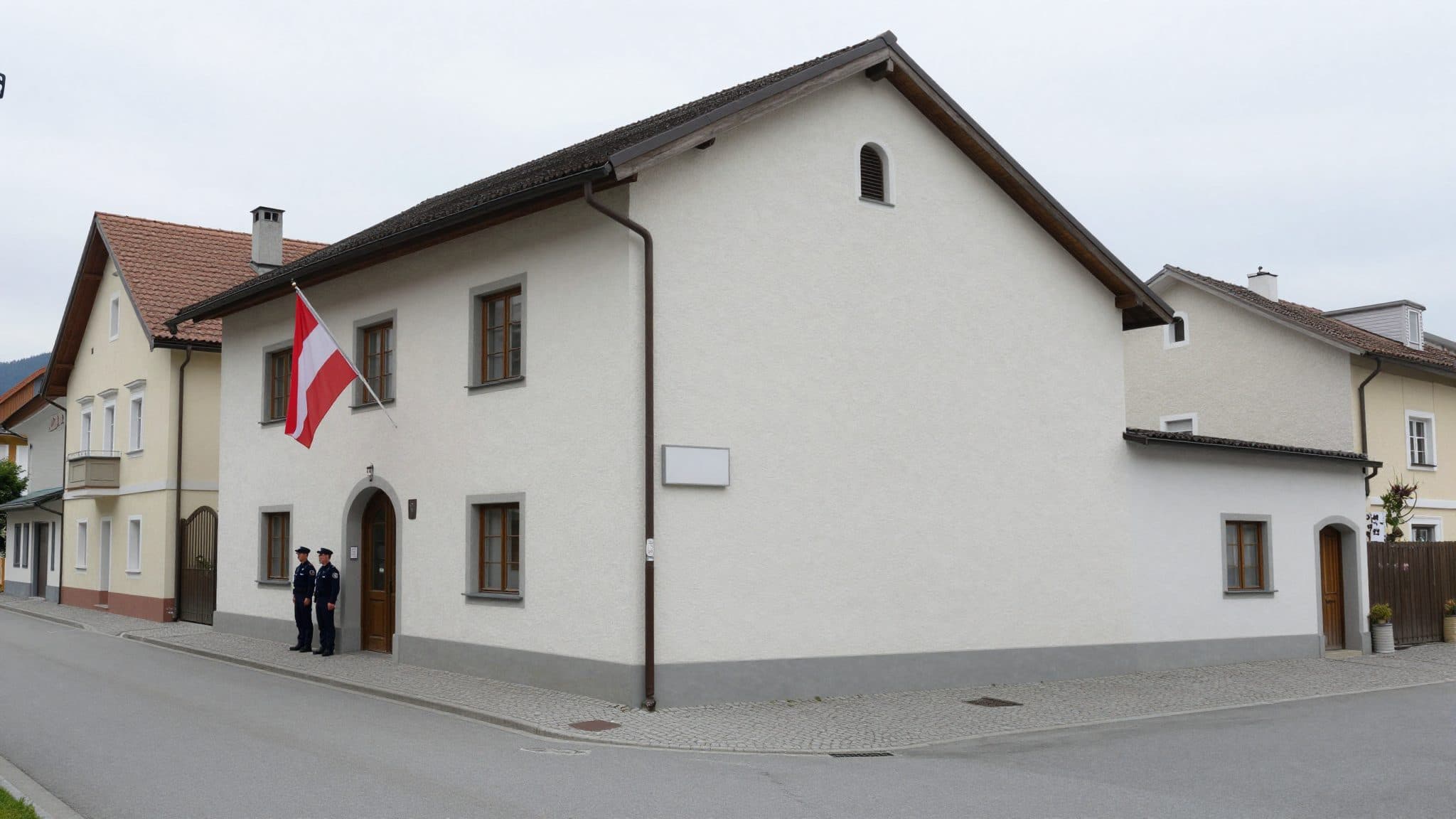
AI-generated image (z-image via Kie.ai)
Summary
The converted birthplace of Adolf Hitler in Braunau am Inn was ceremonially opened on Wednesday as a police center. Some 45 officers will work in the building in the future; after years of dispute over an appropriate use, its facade was gutted and its interior modernized.
Braunau am Inn, July 22, 2026
In Braunau am Inn, the converted birthplace of Adolf Hitler was officially opened on Wednesday as a police center after three years of renovation; in the future, it will house the city police and the district police command.
The building at Salzburger Vorstadt 15, where Adolf Hitler was born on April 20, 1889, has undergone a fundamental change. According to its own figures, the Interior Ministry invested around 20 million euros in the conversion, which gutted the facade and modernized the interiors. "Helle Gänge, saubere Wände, modernes Licht" describes the state of the house, which, in the words of Stephan Mlczoch, head of the Department for Historical Affairs at the Interior Ministry, is "ganz typisch für einen Neubau."
Hitler's Birthplace Braunau: Police Center Opens | allfacts360
Architects based the exterior design on 18th-century templates to minimize the building's recognizability. The characteristic yellow, crumbling plaster and the windows with semicircular stucco arches that for decades had marked the building as a pilgrimage site for right-wing extremists have disappeared. In their place is a plain, light-colored plastered facade that blends inconspicuously into the townscape.
Architectural Gutting
The construction site was monitored out of concern for neo-Nazi collectors; according to the ministry, construction debris was shredded on site and mixed with other material to render it unrecognizable. Interior Minister Gerhard Karner was expected to attend the opening; according to APA reports, 42 national and international media outlets – including the BBC and Al Jazeera – had announced their attendance.
In recent weeks, the executive has moved into the building gradually, as the ministry stated. "In den vergangenen Wochen hat die Exekutive den Bau nach und nach bezogen," the statement said. "Rund 20 Millionen Euro hat das Innenministerium in die Hand genommen, um Adolf Hitlers Geburtshaus zu einer Polizeistation umzubauen." In the future, 45 police officers will work in the building, which comprises 3,000 square meters including an underground garage; parts are air-conditioned.
Background: Expropriation After Years of Dispute
The conversion is the result of a long political and legal dispute over the building's future. Until 2011, it housed, among other things, a workshop for people with disabilities run by the Lebenshilfe organization; afterwards it stood largely empty. The former owner refused necessary renovations – such as the installation of an elevator and barrier-free access. In 2016, the National Council unanimously passed a law enabling expropriation; in 2017, the house was expropriated by the Republic of Austria after a legal dispute.
Even before that, an expert commission had drawn up recommendations for handling the building. It spoke out against demolition and against the establishment of a museum, and instead explicitly recommended "eine sozial-karitative oder behördlich-administrative Nutzung." The reasoning: a museum could also attract right-wing extremists, while demolition would amount to erasing history. ÖVP Interior Minister Wolfgang Sobotka had previously proposed demolition; Braunau's FPÖ had advocated for the establishment of a maternity ward.
Police Instead of Pilgrims
With the conversion, the Republic is pursuing the declared goal of removing the building's appeal as a "brown" pilgrimage site. For decades, the address was a draw for neo-Nazis: motorcycle groups and coach tours from neighboring Bavaria would stop in Braunau to pose in front of the building. "Die Zeiten, in denen sich Rechts- und Linksdemonstranten an seinem Geburtstag gegenüberstanden, sind längst vorbei," said district police commander Stefan Haslberger. "Wer nicht hier wohnt, stellt sich das schlimmer vor, als es ist."
The police are now present in the building with technical surveillance. The building is under video monitoring, and suspicious visitors can be checked immediately, according to the ministry. All newly assigned officers must also complete a mandatory e-learning module covering, among other things, the Prohibition Act and the Symbols Act. This is to ensure that officers working in the building are trained to handle right-wing extremist incidents.
Mayor: "Kümmert euch um die Lebenden"
In front of the house there remains a memorial stone made of granite, originating from the former Mauthausen concentration camp. It bears the inscription "Millionen Tote mahnen." A traveling exhibition titled "Hitlers Exekutive" will also stop in Braunau from September 18; it was last shown at Schloss Hartheim. The exhibition was created after an external research team was granted access to archives and personnel files.
Mayor Johannes Waidbacher (ÖVP) sees the conversion as a conscious engagement with history, not its repression. "Es ist ein historisches Faktum, dass Adolf Hitler hier auf die Welt gekommen ist, damit werden wir für immer leben müssen," he said. At the same time, he rejected the accusation that the Republic had shirked responsibility with the conversion. He referred to Holocaust survivor and Hollywood director Branko Lustig, who visited Braunau years ago and said: "Hitler ist tot. Kümmert euch nicht um die Toten, sondern um die Lebenden." Asked about the former owner's years of silence regarding municipal usage concepts, Waidbacher said: "Aber bis zum heutigen Tag haben wir von ihr kein einziges Ja oder Nein gehört."
Waidbacher emphasized that Braunau's political establishment had been united on the issue. The only point of contention had been the personal stance of the owner: "Es liegt an ihr persönlich." Over the years, there had repeatedly been incidents in the city – in 2021, a then 57-year-old Berliner is said to have laid wreaths in front of the building; on April 20, 2024, two German couples reportedly placed flowers in the window niches and took photos; one woman is said to have given the Hitler salute while doing so.
Ongoing Open Debate
With the police move-in, the building's function is fundamentally changing. Mlczoch said that through the police moving in, the building had become a "Haus der Demokratie und Rechtsstaatlichkeit," "ohne jede weitere Assoziation mit Hitler." He pointed to the OGM Vertrauensindex from October 2025, according to which "keine Institution in Österreich mehr Vertrauen genießt als die Polizei" – 69 points. Asked whether the building should not still show traces of its history, he answered with the curt verdict: "Gut so."
At the same time, the debate over how to deal with the site is not yet over. Historians and memorial site experts continue to call for a visible, multilingual engagement with the history at the location. There is also a desire for at least one multilingual information board near the building. Wednesday's opening is therefore not the last word in a discussion that has been ongoing in Braunau for decades.
The building complex dates from the 17th century. Around 1889, the front part housed a tavern, the middle part apartments, and the rear part a brewery. Hitler's family moved to another apartment in Braunau only a few months after his birth. Over the decades, from 1960 onward, the building housed a library, a school, a bank, and finally the Lebenshilfe day center.
Historical Context
In the coming weeks, the police station will become fully operational. The Bezirkspolizeikommando Braunau and the Polizeiinspektion Braunau share the building; the Interior Ministry speaks of a "deutliches Bekenntnis der Republik Österreich zu einer konsequenten Bekämpfung von Rechtsextremismus und Nationalsozialismus."
The conversion is also set against the background of concern about a continuation of the site's right-wing extremist appeal. In the past, there were repeated incidents in front of the building, including the laying of flowers and wreaths and the display of banned Nazi symbols. The conversion, video surveillance, and police presence are intended to put a stop to this.
For comparison: Hitler's former nine-room apartment on Prinzregentenplatz in Munich has also belonged to a police inspection for decades. In the case of Braunau, however, the debate was particularly intense because that is the birthplace of a dictator who, on January 30, 1933, was appointed Reich Chancellor, dismantled democracy in Germany within a short time, unleashed the Second World War in 1939, and bears responsibility for the persecution and murder of roughly six million Jews under his National Socialist regime. Hitler had volunteered for the German Army at the start of the First World War; on November 9, 1923, he led the failed Hitler Putsch, during his subsequent imprisonment writing "Mein Kampf." Eva Braun married the dictator shortly before their joint suicide.
Two years after the German capitulation, Soviet troops blew up the Führerbunker in Berlin. In Braunau, the Republic is now banking on consequence rather than a museum: a place of pilgrimage is to become a place of the rule of law.
Questions & Answers
Who decided on the new use of the birthplace?
An expert commission appointed by the Austrian state explicitly recommended "eine sozial-karitative oder behördlich-administrative Nutzung" and spoke out against both demolition and a museum. After an expropriation in 2017, the Interior Ministry converted the building in the following years into a police station for around 20 million