Polish President Vetoes Registered Partnership Law
Warsaw, July 17, 2026
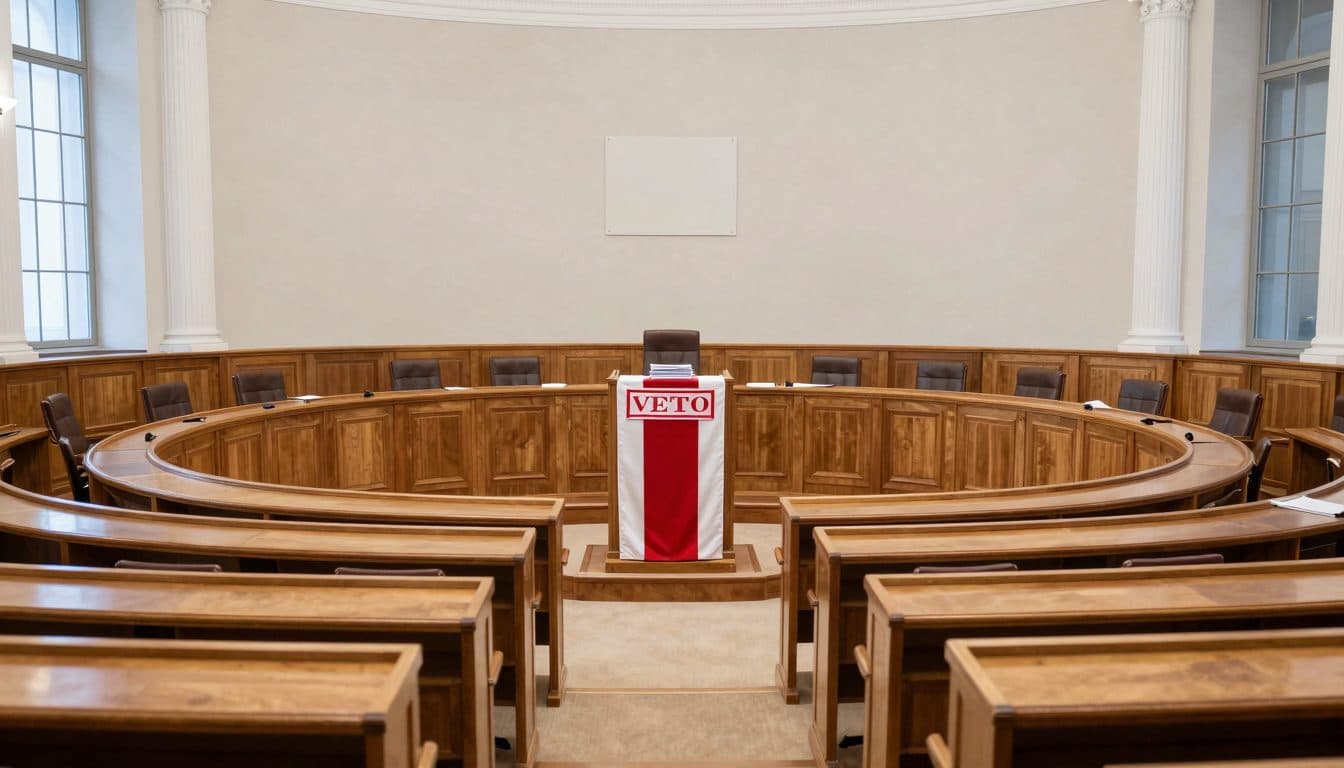
AI-generated image (z-image via Kie.ai)
Summary
Polish President Karol Nawrocki has vetoed the registered partnership law passed by the Sejm. The law would have also enabled same-sex couples to enter open contracts before a notary. Prime Minister Donald Tusk spoke of contempt toward people.
Warsaw, July 17, 2026
Polish President Karol Nawrocki has vetoed the registered partnership law passed by parliament in Warsaw, thereby blocking a central project of the center-left coalition led by Prime Minister Donald Tusk.
Content of the Law
Nawrocki announced his decision on Thursday in a video message from the Polish capital. He was vetoing the law on registered partnerships, Nawrocki said in a video message. This means one of the reform projects that Tusk's coalition had announced when taking office — and which was also intended to benefit same-sex couples — has failed.
The law provided that two adult persons could conclude a corresponding contract before a notary. After registration with the civil registry office, both partners were to be able to choose the marital property regime and arrange maintenance obligations. Registered partners would also have had the right to use the shared residence, access to medical information about their partner, and the ability to act as an authorized representative.
The President's Reasoning
Nawrocki, who comes from the ranks of the national-conservative PiS party, justified his move with the Polish constitution. „In der Verfassung steht ausdrücklich, dass die Ehe eine Verbindung zwischen Mann und Frau ist", said Nawrocki. The law creates a „Quasi-Ehe" and cannot count on his approval. At the same time, he emphasized: „Grundsätzlich sei er nicht gegen die Regelung rechtlicher Fragen für unverheiratete Paare".
Reactions from the Government
Prime Minister Tusk reacted sharply to the veto. „Das Veto des Präsidenten ist Ausdruck der Verachtung gegenüber den Menschen und ihrem Recht auf Glück und ein normales Leben", he wrote. His coalition had passed the law with a majority of deputies in the Sejm in Warsaw, after the right-wing PiS opposition had already sharply attacked the project and the equal treatment of same-sex couples during the parliamentary process.
Government Equality Commissioner Katarzyna Kotula also criticized the decision and accused the president of turning away from two million Poles living in informal cohabitations. In a video on the platform X, she stated: „Nawrocki werde diese Veränderungen verzögern, aber nicht aufhalten können". She also pointed out that support for registered partnerships and equality in marriage is growing.
The Polish parliament had passed the bill with the coalition's majority. Leading politicians of the governing parties had tried in advance to counter conservative pushback with the argument that the regulation would in principle also be open to neighbors or family members and would not necessarily be aimed at romantic couples. This, however, could not change the president's mind.
Poland's Position in the EU
With the veto, Poland remains — together with Bulgaria, Romania, and Slovakia — one of the last EU countries in which neither marriage for same-sex couples nor registered partnerships are possible. Same-sex couples are currently not allowed to marry in the country, which is considered to be shaped by Catholicism.
The government had pursued the law with the goal of bringing Poland up to the level of other EU states. Registered partnerships have been standard in many Western European countries for years. With the current decision, this modernization step in eastern Central Europe is on hold for now.
Outlook: Override Unlikely
To override the president's veto, a three-fifths majority would be required in the Sejm. Given the current majority situation in the Polish parliament, this is considered unlikely. The coalition does not have the necessary qualified majority to overturn the head of state's objection.
Kotula, who as the government's equality commissioner is responsible for the issue, sees the veto as a setback but not a final defeat. She emphasized that, in her view, public sentiment is shifting in favor of equal treatment. Nawrocki can at most slow down political and social change, but cannot stop it permanently.
Observers see the veto as evidence of the ongoing tension between the center-left government in Warsaw and the PiS camp, which holds the presidency. Poland is considered a Catholic-shaped country in which the question of the rights of same-sex couples has been controversially debated for years.
Possible Revisions
Nawrocki had emphasized in his video message that he is not fundamentally opposed to regulating legal matters for unmarried couples. His main argument was directed against the character of the law as a so-called quasi-marriage. This differentiation suggests that the government could possibly present a revised draft that focuses more on practical legal issues and less on partnership-law symbolism.
The registered partnership is then also to apply to same-sex couples. This clarification was a central concern of the coalition. It was also intended to provide legal certainty to those couples who have so far lived in informal relationships and have no possibility of officially registering their relationship.
As Polish president, Nawrocki represents a comparatively new accent in Polish domestic politics. With his decision, he continues the course of the previous PiS government on socio-political issues. For Tusk and his coalition, the veto means a bitter setback in the middle of the legislative period.
The news about the veto was broadcast on 17.07.2026 on the Deutschlandfunk program. The conflict between the government and the president over the rights of unmarried and same-sex couples thus also received immediate attention in the German media.
Should the government make a new attempt, it would have to adjust the content of the law in order to allay the president's constitutional concerns. Whether this can succeed remains open. What is certain is that the equality debate in Poland has gained sharpness with Nawrocki's veto.
Questions & Answers
Who is Karol Nawrocki and what position does he hold?
Karol Nawrocki is the incumbent President of Poland. He comes from the ranks of the right-wing conservative PiS party and announced his decision in a video message from Warsaw.
Why did President Nawrocki reject the registered partnership law?
Nawrocki justified his veto with the Polish constitution, which explicitly defines marriage as a union between a man and a woman. In his view, the law creates a „Quasi-Ehe" and cannot count on his approval.
What rights would the law have granted registered partners?
Registered partners would have been able, among other things, to use the shared residence, gain access to medical information about their partner, and act as authorized representatives. In addition, it would have been possible to choose the marital property regime and arrange maintenance obligations.
Nawrocki Halts Partnerships in Poland | allfacts360