Presidential Conference of the National Council: No agreement on security checks for parliamentary staff
Vienna, June 3, 2026
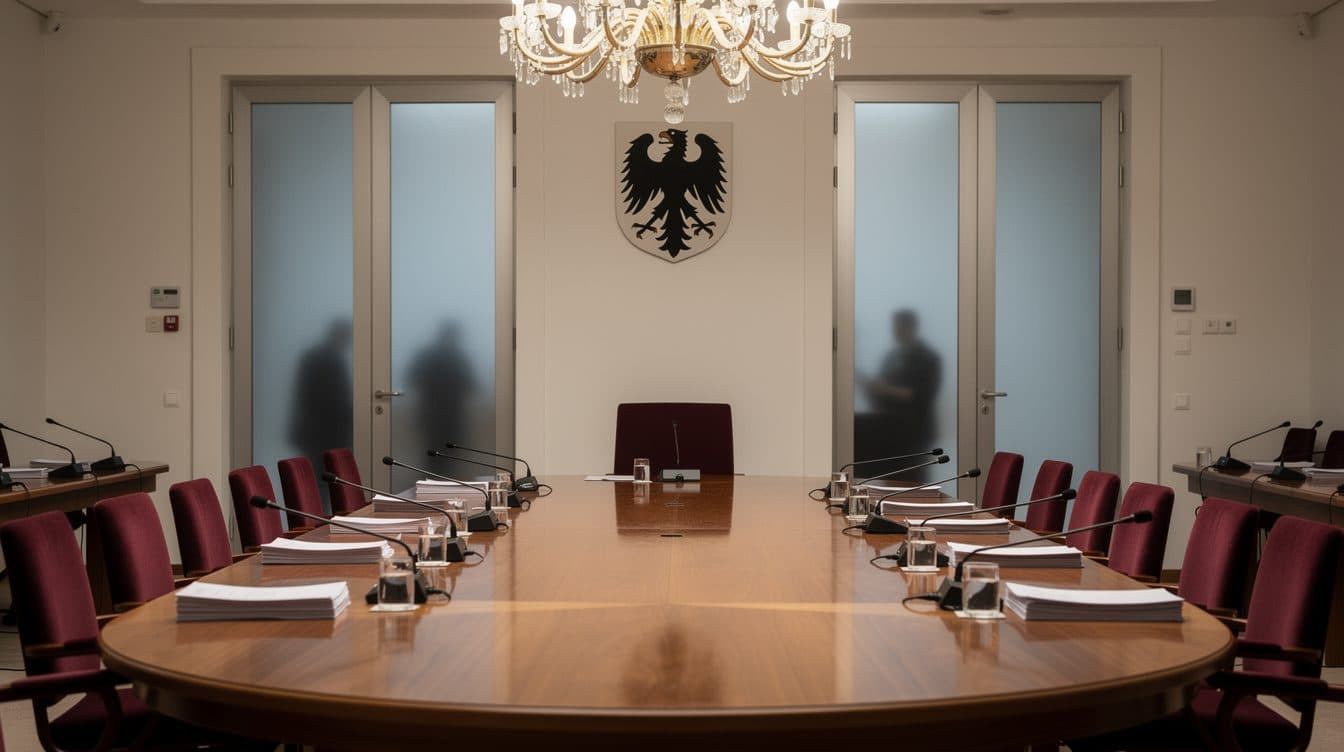
AI-generated image (flux-2/pro-text-to-image via Kie.ai)
Summary
The Presidential Conference of the National Council did not agree on mandatory security checks for parliamentary staff on Wednesday. At the same time, the body reaffirmed that the term "remigration" in its current usage is anti-democratic and unconstitutional.
Vienna, June 3, 2026
In the Presidential Conference of the Austrian National Council on Wednesday, no parliamentary group supported mandatory security checks for parliamentary staff, while at the same time, the continued use of the term "remigration" by the FPÖ was criticized as anti-democratic and unconstitutional.
The Presidential Conference of the Austrian National Council convened on Wednesday to discuss two controversial points: possible security checks for parliamentary staff and the repeated use of the term "remigration" by FPÖ members of parliament. At the end of the session, no parliamentary group advocated for mandatory checks. The body consists of the three Presidents of the National Council and the parliamentary group leaders of all parliamentary factions and serves as an advisory body for compliance with the rules of procedure.
The impetus for the debate on security checks came from State Secretary Jörg Leichtfried, who had proposed screening employees who have access to sensitive committees. The background is a report from the domestic constitutional protection agency, according to which four FPÖ parliamentary staff members have ties to the Identitarian movement. The Third President of the National Council, Doris Bures (SPÖ), stated after the presidential conference that the Freedom Party bears responsibility for ensuring that no enemies of the constitution are active in parliament.
Trigger for the Debate: Constitutional Protection Report
The Deputy Green Parliamentary Group Leader, Sigrid Maurer, clarified after the meeting that the issue of checks exclusively concerned the FPÖ parliamentary group. The Second President of the National Council, Peter Haubner (ÖVP), in turn, pointed to the clubs' self-responsibility for their personnel and saw no fundamental need to change existing procedures. Thus, the initiative to introduce general security checks for parliamentary staff remained without a majority.
A second focus of the meeting was the handling of the term "remigration." Doris Bures announced that she would continue to issue calls to order for the use of this term in the future. Bures pointed out that parliamentary work is being disrupted by the use of the term "remigration," which is anti-democratic and unconstitutional, stating verbatim in a statement: "Parliamentary work is being disrupted by the use of the term 'remigration,' which is anti-democratic and unconstitutional."
Calls to Order and Parliamentary Rules of Procedure
Peter Haubner (ÖVP) agreed with Bures' position in terms of content and therefore follows the same procedure as the Third President. Both had already issued calls to order against FPÖ members of parliament about two weeks prior. Bures also reiterated that she would continue to issue calls to order for the use of the term "remigration." Sigrid Maurer stated that she had no doubt about what the Freedom Party meant by the term – the goal was the deportation of people.
Among others, Bures had issued a call to order against FPÖ leader Herbert Kickl after he had called for "a systemic change, that of Fortress Austria – and remigration" in a debate on the EU Asylum Pact. Walter Rosenkranz (FPÖ), First President of the National Council, also had a regulatory responsibility in his capacity but saw no reason for a sanction. Rosenkranz pointed out that the term "remigration" in migration research refers to the return of emigrants to their homeland.
The presidency reaffirmed that the term, in its current usage, is classified as anti-democratic and unconstitutional. Bures expressed the hope that National Council President Walter Rosenkranz would join the common approach. Bures emphasized that in the Second Republic, it had always worked well when the presidency acted uniformly. However, during the session, Rosenkranz appeared rather reserved; a statement from his spokesperson was not available by the editorial deadline.
Substantive Meaning of the Term
The FPÖ announced on Wednesday that it would continue to discuss the issue of the term "remigration" internally within the parliamentary group. The SPÖ and the Greens simultaneously called for a clear distancing and clarification of the term from the Freedom Party. Sigrid Maurer said that the FPÖ meant deportation by the term; Bures described its use as anti-democratic and unconstitutional.
Regarding the concrete meaning of the term, the FPÖ's use in its election program is based on the concept of the far-right Identitarian movement. This implies the systematic deportation of non-white people from Europe, including those who have already become naturalized citizens. The book "Remigration: A Proposal" by Identitarian activist Martin Sellner explicitly describes the deportation of already naturalized individuals. The Christchurch attacker had donated to Martin Sellner and was in contact with him.
The term was further politically charged by an interview of FPÖ General Secretaries Michael Schnedlitz and Christian Hafenecker on the conspiracy platform broadcaster Auf1 with Editor-in-Chief Stefan Magnet, which appeared about a week before the report. Auf1 is described as a platform for conspiracy narratives. In a question, Magnet used the term "replacement migration." Schnedlitz described "remigration" there as "nothing other than the official program of the USA" and referred to US immigration authorities who act "brutally, violently, and largely without legal basis" against people regardless of their residency status.
Reactions from the FPÖ and Opposition Parties
Furthermore, Schnedlitz stated that "remigration" is "practically another word for deportation" and included voluntary returnees. He also criticized that there had been "even a call to order" in a plenary session. He also accused the constitutional protection agency of attempting to influence parliament, politicians, and parties in connection with the word "remigration."
On the issue of security checks, Bures stated that the FPÖ should use a different term in the future; if "repatriation" is meant, it should be said as such. The discussion in the Presidential Conference was inconclusive, so the Austrian Parliament continues to conduct no security checks for its employees. The FPÖ parliamentary group stated that it would discuss the terminology issue again within the group.
Since its success in the last National Council elections, the FPÖ has addressed the term "remigration" in almost all sessions of the National Council. The fact that the Presidential Conference now clearly classifies the term in its current usage as anti-democratic and unconstitutional marks an escalation of the conflict between the parliamentary groups – although, of course, no sanctioning mechanisms against the group as such were decided. The session on Wednesday is therefore likely to be just one stage in an ongoing dispute over language, security, and political responsibility in the Austrian Parliament.
The report was written by Irene Brickner and Colette M. Schmidt and published on June 3, 2026.
Questions & Answers
Who proposed security checks for parliamentary staff?
State Secretary Jörg Leichtfried had proposed screening employees with access to sensitive committees after the constitutional protection agency identified connections to the Identitarian movement in four FPÖ employees.
Why does the presidency classify the term "remigration" as unconstitutional?
The presidency argues that the FPÖ's use of the term follows the concept of the Identitarian movement, which implies the systematic deportation of non-white people from Europe, including already naturalized individuals.
What position does National Council President Walter Rosenkranz hold?
The FPÖ politician Rosenkranz saw no reason for a call to order and pointed out that the term in migration research refers to the return of emigrants to their homeland.
Presidential Conference: No security checks for | allfacts360