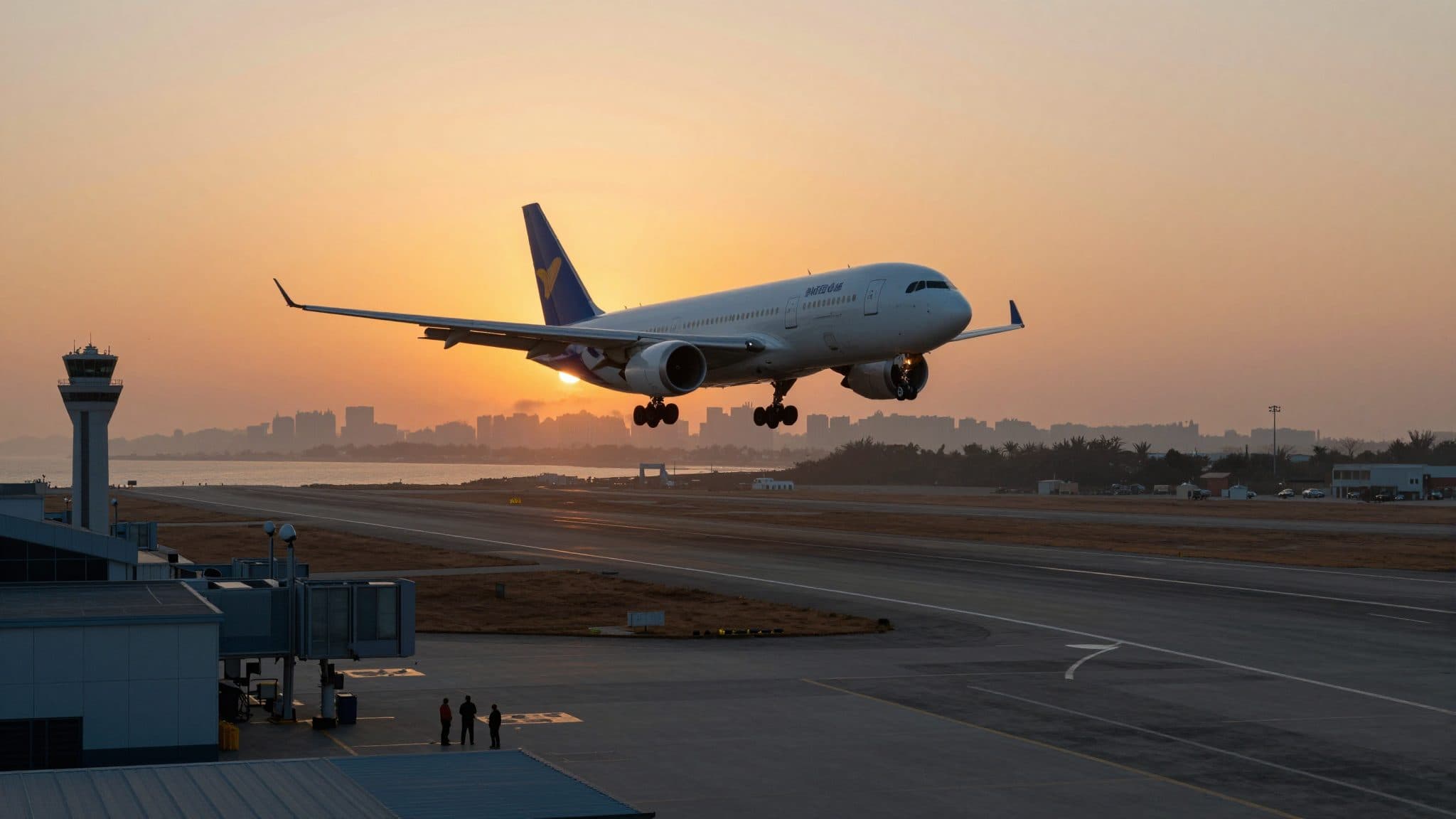
Qantas Airbus A350 completes record nonstop flight from Melbourne to Toulouse in 24 hours
Melbourne/Toulouse, 28 July 2026
AI-generated image (z-image via Kie.ai)
Summary
A specially modified Airbus A350 flown by Qantas landed in Toulouse on Tuesday after 24 hours and 24 minutes in the air, completing a nonstop test flight of more than 23,000 kilometers from Melbourne. The flight is part of Qantas' long-planned Project Sunrise, which aims to launch nonstop service between Sydney and London from October 2027.
Melbourne/Toulouse, 28 July 2026
A specially modified Airbus A350-1000ULR operated by Australian airline Qantas landed in Toulouse on Tuesday after 24 hours and 24 minutes of nonstop flight from Melbourne, covering more than 23,000 kilometers and setting a new duration record for a commercial aircraft demonstration flight.
Background of the record attempt
The aircraft, designed for ultra-long-haul operations, departed Melbourne and touched down at the Airbus factory site in southwestern France after spending a full day in the air. Qantas and Airbus announced the landing through the Reuters news agency and dpa-AFX, with the dispatch datelined Melbourne and Toulouse. According to the verified figures, the plane covered approximately 23,075 kilometers without a single intermediate stop.
The flight surpassed the previous demonstration-flight duration record of 22 hours and 42 minutes, set in 2005 by a Boeing 777-200LR flying between Hong Kong and London. By completing the Melbourne–Toulouse leg in 24 hours and 24 minutes, the A350-1000ULR exceeded that benchmark by nearly two hours. Airbus described the journey as crossing two oceans and three continents and experiencing two sunrises and two sunsets on a single flight.
Airbus statement on the flight
In a statement, Airbus said: "Für die Crew hieß das: vom Winter in den Sommer zu fliegen, zwei Ozeane und drei Kontinente zu überqueren – und auf einem einzigen Flug gleich zwei Sonnenaufgänge und zwei Sonnenuntergänge zu erleben" — describing the experience for the crew as flying from winter into summer, crossing two oceans and three continents, and witnessing two sunrises and two sunsets on a single journey.
Online tracking and public interest
The flight was tracked live by more than 3.6 million people online, according to the flight-tracking service Flightradar24. The service stated this made the test one of the most-watched flights of all time, adding that only the flight carrying Queen Elizabeth II's coffin in 2022 had drawn a larger audience on the platform. The unusual level of public attention underscored how rare direct, very long-distance commercial flights remain in modern aviation.
The aircraft used for the test was an A350-1000ULR, a variant of Airbus's widebody fitted with an additional fuel tank that holds roughly 20,000 liters of extra kerosene. The aircraft offers seating for 238 passengers and is intended to enable scheduled nonstop services of between 19 and 21 hours, depending on weather conditions. To counteract fatigue on these ultra-long-haul flights, pilots will work in four-hour shifts.
Project Sunrise and the modified A350
The test flight is part of Qantas' long-planned "Project Sunrise," an initiative aimed at introducing nonstop connections between Australia and major cities in Europe and North America. The airline has ordered twelve of the modified A350-1000ULR aircraft to support the routes. The first of those aircraft is scheduled to be delivered in April 2027.
Qantas confirmed that it expects to begin daily nonstop service between Sydney and London from October 2027, with nonstop flights to New York planned to follow later. The two routes are widely regarded as the cornerstone of Project Sunrise, and the Toulouse landing is considered one of the final major tests ahead of certification and entry into service.
Airbus has been testing the aircraft since June 2026 in a two-month campaign. A week earlier, the same Airbus had flown from Toulouse via the Indian Ocean to Melbourne in just over 19 hours, completing the outbound leg of what was effectively a round-the-world demonstration. The Tuesday return leg took roughly five hours longer than the outbound flight, partly because of prevailing winds and routing constraints.
Industry analysts say the route's eventual commercial viability will depend on a combination of regulatory approval, crew scheduling rules, and passenger demand for long-haul nonstop services. The modified A350-1000ULR is designed to reduce the number of stops required for transcontinental travel, but it does not eliminate the operational complexity that comes with flights approaching a full day in duration.
Records and market reaction
Qantas and Airbus have not yet confirmed whether the Melbourne–Toulouse flight will be entered into the Guinness Book of Records. The flight's status as the longest nonstop flight ever flown by a commercial aircraft, based on the verified duration of 24 hours and 24 minutes and the distance of approximately 23,075 kilometers, is nonetheless expected to be referenced in subsequent aviation records and certification submissions.
On financial markets, Qantas' share price on the Sydney Stock Exchange was largely unchanged in the morning after the landing, trading 0.10 percent higher at 10.40 Australian dollars. The muted reaction suggests investors are treating the test flight as a milestone along the Project Sunrise timeline rather than a market-moving event.
Next steps toward entry into service
Analysts had previously issued a series of recommendations for Qantas Airways ahead of the flight, including a "buy" rating from Nomura on 24 August 2012, a "buy" from Citigroup Corp. on 5 July 2011, a target of 1.95 euros from Focus Money on 25 February 2010, and a "buy" from Citigroup Corp. on 4 February 2009. None of those recommendations have been formally updated in connection with the Project Sunrise test flight.
The aircraft that landed in Toulouse carried a crew rather than paying passengers, in keeping with the test-flight nature of the operation. Airbus said the campaign running since June 2026 has focused on endurance, fuel management, and crew-rest protocols. The additional fuel tank that enables the extended range is integrated into the aircraft's existing center tank structure and does not require a redesigned fuselage, Airbus has confirmed.
For the moment, Airbus and Qantas are treating the landing as a public demonstration of the maturity of the ultra-long-haul program. With delivery of the first production aircraft scheduled for April 2027 and commercial service planned to begin in October 2027, the Melbourne–Toulouse flight marks one of the final pre-delivery milestones for an aircraft type that both companies hope will redefine nonstop commercial aviation between Australia and the rest of the world.
Questions & Answers
What record did the Qantas Airbus A350 set on the Melbourne to Toulouse flight?
According to Airbus and Qantas, the aircraft completed a nonstop test flight of 24 hours and 24 minutes covering approximately 23,075 kilometers, surpassing the previous demonstration-flight record of 22 hours and 42 minutes set by a Boeing 777-200LR between Hong Kong and London in 2005.
Why is the aircraft called the A350-1000ULR and what is special about it?
The ULR designation stands for "ultra long range." The aircraft is a modified A350-1000 fitted with an additional fuel tank holding roughly 20,000 liters of extra kerosene, giving it the range to operate nonstop routes of 19 to 21 hours with seating for 238 passengers.
When will Qantas begin scheduled nonstop service using the A350-1000ULR?
Qantas plans to offer daily nonstop flights between Sydney and London starting in October 2027, with nonstop service to New York planned later. The first of twelve ordered aircraft is scheduled to be delivered in April 2027.
Qantas A350 sets nonstop record: Melbourne to Toulouse in | allfacts360