Research: Climate change is causing Europe's soils to dry out with increasing frequency
Zurich, 24 July 2026
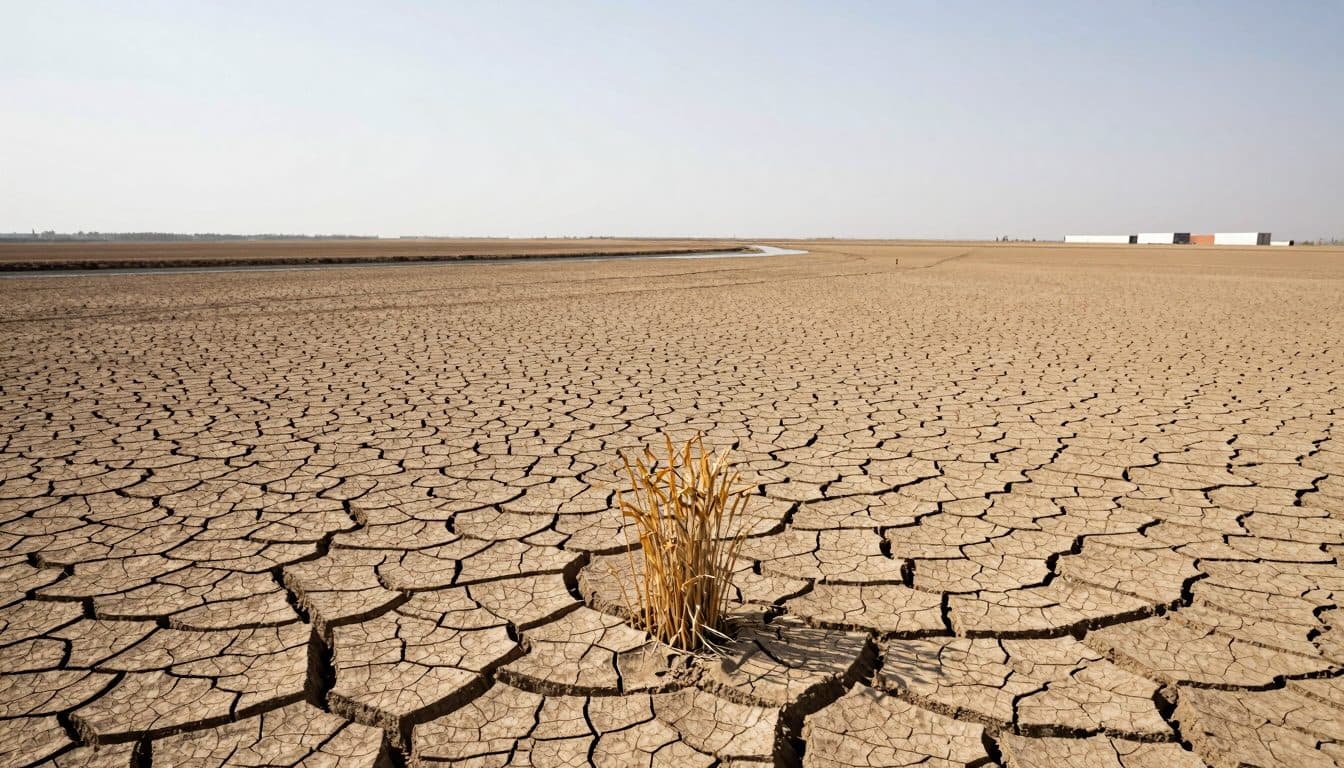
AI-generated image (z-image via Kie.ai)
Summary
An international study by the World Weather Attribution initiative shows that agricultural soil droughts in Western Europe have become roughly five times more likely due to climate change. Even at a warming of 1.4 degrees Celsius, such conditions occur regularly — with serious consequences for harvests, water levels, and food prices.
Zurich, 24 July 2026
A study by the World Weather Attribution initiative, with the participation of researchers from ETH Zurich and Imperial College London, demonstrates that persistent heat is increasingly drying out soils in Europe and that agricultural droughts in Western Europe are today roughly five times more likely than before industrialization.
Research team and methodology
The World Weather Attribution (WWA) initiative, together with scientists from twelve European countries, analyzed trends in precipitation, soil moisture, and potential evapotranspiration. Potential evapotranspiration — PET for short — describes how much water the atmosphere can evaporate under given conditions. The result: Europe is experiencing a "combined crisis triggered by persistent precipitation deficits and extreme heat, the impacts of which are already being felt clearly," as the WWA stated — and this "even though summer has only just begun."
Climate researcher Mariam Zachariah from Imperial College London, a member of the World Weather Attribution initiative, said according to the available reports: "Am alarmierendsten ist, dass diese Bedingungen bereits bei einer Erwärmung von 1,4 Grad Celsius auftreten." Dominik Schumacher from the Institute for Atmospheric and Climate Science at ETH Zurich added: "Trotz höherer Winterniederschläge in weiten Teilen Europas beobachten wir inzwischen bereits im Frühjahr (...) eine verstärkte Tendenz zu ungewöhnlicher Austrocknung der Böden."
According to the researchers, rising temperatures are the central cause: "Das haben wir selbst verursacht: Mit steigenden Temperaturen nimmt der 'Durst' der Atmosphäre rasch zu und entzieht Flüssen, Seen, Stauseen und Böden Feuchtigkeit." The consequence is a vicious cycle: hot air dries out the soil, and dry soil in turn heats the air further. "Wenn die Luft immer heißer wird, trocknet sie den Boden aus. Heiße Luft macht trockene Böden und trockene Böden machen es noch heißer," Schumacher further explained. "Und genau das hat also auch den Weg für diese extreme Hitzewelle Ende Juni geebnet."
Causes: Heat rather than missing rain
The study also shows that the problem is not solely a lack of rainfall. "Dasselbe Niederschlagsdefizit, das früher vielleicht noch keine Dürre ausgelöst hätte, führt heute zu einer Dürre," Zachariah is quoted as saying — simply due to higher evaporation, because the atmosphere has become thirstier. "Der Klimawandel hat offenbar auch die Schwellenwerte für Dürren verschoben, da die Atmosphäre nun 'durstiger' ist," the researcher added.
The statistical analysis found that agricultural soil droughts in Western Europe are today roughly five times more likely than in a preindustrial reference period. In Eastern Europe, the factor is even higher: such droughts have become around eleven times more likely there. "In der westlichen Region treten die Bedingungen wie von April bis Juni unter den derzeitigen klimatischen Bedingungen schätzungsweise ungefähr alle fünf Jahre auf," the study states.
Statistical findings: five- to elevenfold increased risk
The immediate consequences for agriculture are substantial. In France, the lowest maize harvest in 50 years is expected, according to the reports. In Romania, more than one million hectares of maize cultivation area have been lost. Farmers in Hungary are also struggling with the dry soils, and parts of Poland are reportedly facing the highest level of forest fire danger.
Beyond agriculture, the impacts are also visible in goods transport and water levels. Low water levels of rivers such as the Elbe and the Rhine are impairing shipping. "Historische Ernteverluste (...) könnten zusammen mit den anhaltenden globalen Konflikten die Lebensmittelpreise erhöhen und Haushalte mit geringem Einkommen überproportional treffen," the study further states. In conjunction with current global conflicts, this could "zu einem Anstieg der Lebensmittelpreise führen und einkommensschwache Haushalte unverhältnismäßig stark treffen," the WWA concludes.
Consequences for agriculture and consumers
The initiative emphasizes that the study clearly demonstrates the connection between human-made climate change and the current drought. "Das haben wir selbst verursacht," the WWA stated in a position paper. The central message: without rapid and decisive emission reductions, Europe is heading "auf eine Zukunft zu, in der diese glühend heißen, trockenen Sommer immer wieder auftreten," as Zachariah added.
The researchers view the coming decades with concern. "Sollten die globalen Emissionen die Temperaturen wie prognostiziert auf 2,8 Grad Celsius ansteigen lassen, könnten diese intensiven Verdunstungsbedingungen doppelt so wahrscheinlich werden und Dürren wie diese zu einem regelmäßigen Ereignis machen," the analysis states. The European State of the Climate Report also shows that Europe has been warming significantly faster than the global average since 1980.
The study was published under the title "Increasingly hot Europe faces more severe droughts and growing challenges for water and land management." The WWA, founded in 2014 by climatologists Geert Jan van Oldenborgh and Friederike Otto, includes among its members Imperial College London, the Koninklijk Nederlands Meteorologisch Instituut, ETH Zurich, and the Laboratoire des sciences du climat et de l'environnement.
Outlook under rising emissions
In Germany, the question of water management is being discussed in parallel. "Wir haben eben die Situation, dass wir in den meisten Regionen in Deutschland und auch von den meisten Industriebetrieben, die Wasserrechte haben, nicht genau wissen, wie viel Wasser sie zu welchem Zeitpunkt entnehmen," Andreas Marx said in this regard. The researchers point to tangible consequences and call for better monitoring systems.
The study distinguishes between two regions: Western Europe and Eastern Europe. Both show a clear increase in soil droughts, although the factors differ in magnitude. While in Western Europe the probability has roughly quintupled, in Eastern Europe it has roughly increased elevenfold. The researchers attribute this, among other things, to the different baseline climatic conditions.
Water management in Germany
Zachariah emphasizes that the heatwave at the end of June would hardly have been possible in this intensity without the preceding soil drying. The combination of dry soils and hot air pushed temperatures even higher. "Es ist ein bisschen wie bei einem Schwamm," Schumacher explained regarding the upper soil layer, "Es spielt keine so große Rolle, ob es im Winter mehr regnet, wenn ein Teil dieses Wassers nicht gespeichert wird."
Already now, in summer 2026, the continent is showing the consequences. "Von einem 'ganz normalen Sommer' kann längst keine Rede mehr sein," one of the reports states. Even though Germany is supplied with sufficient drinking water during sustained temperatures of 30 to 40 degrees, experts warn of growing challenges for water and land management. Some cities have already called for water savings.
For the coming years, the researchers expect a further intensification if the global emissions trajectory is not fundamentally changed. The probability of intense evaporation conditions could double if global warming reaches 2.8 degrees Celsius. According to the WWA, droughts like the current one would then become a regular occurrence.
Significance for adaptation and policy
The authors of the study emphasize that their analysis not only documents the current situation but also provides guidance for adaptation. A better understanding of potential evapotranspiration and soil moisture dynamics can help improve early warning systems and adapt agricultural planning. However, the central challenge remains the reduction of greenhouse gas emissions.
The WWA makes clear: "Manchmal gibt's es eben auch die Nachrichten, die alle hören wollen." The study provides empirical evidence that climate change has durably shifted the threshold for droughts in Europe. The coming years will show whether international politics translates the scientific findings into concrete measures.
Questions & Answers
Who published the study on European soil drought?
The study was published by the World Weather Attribution (WWA) initiative together with scientists from twelve European countries, with the participation of Imperial College London and ETH Zurich.
How much more likely have soil droughts in Europe become?
According to the study, agricultural soil droughts in Western Europe are roughly five times and in Eastern Europe around eleven times more likely than before industrialization.
What concrete consequences does the current drought have?
In France, the lowest maize harvest in 50 years is expected; in Romania, more than one million hectares of maize cultivation area have been lost; and low water levels of rivers such as the Elbe and Rhine are impairing goods transport.
Climate change: Soil drought in Europe five times more | allfacts360