Research Project PSI: For the First Time, a Robust Figure for All Parking Spaces in Austria Has Been Surveyed
Graz, July 22, 2026
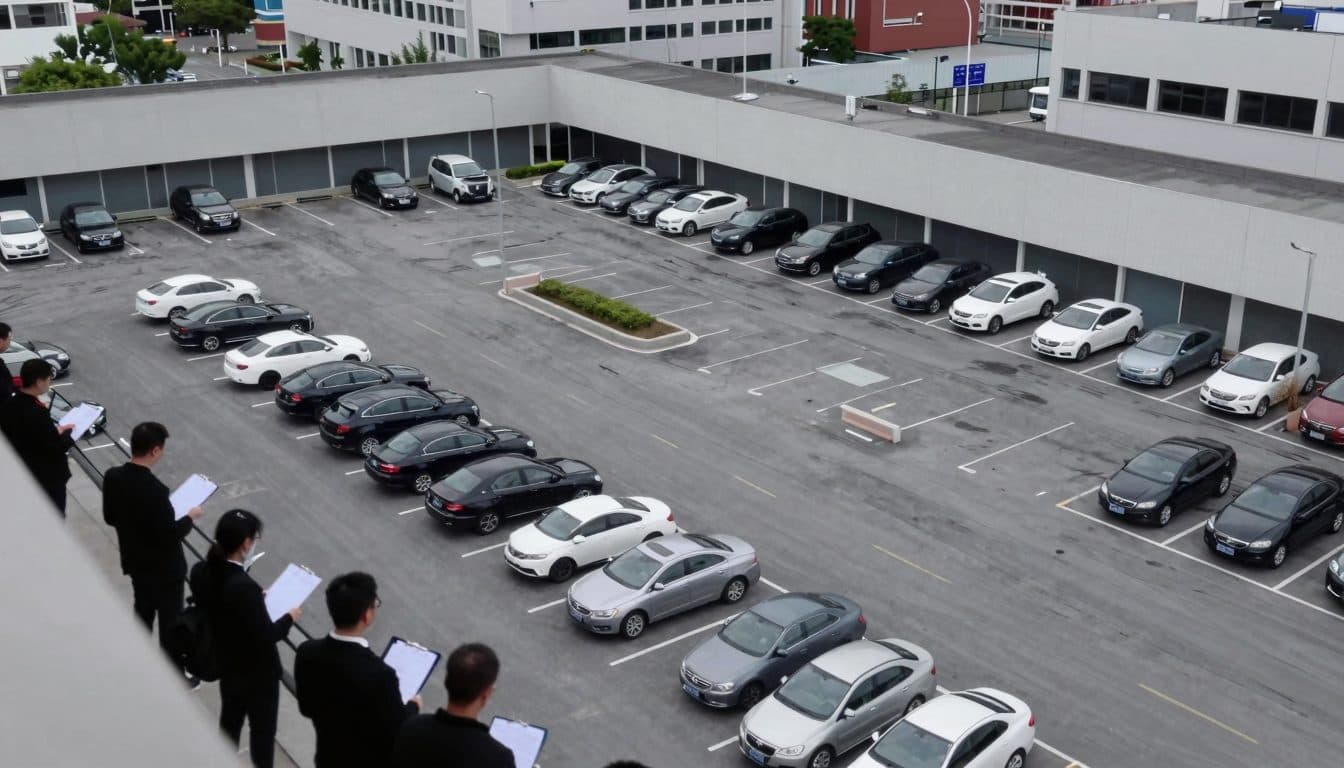
AI-generated image (z-image via Kie.ai)
Summary
A research team at TU Graz has, for the first time, comprehensively recorded all parking spaces in Austria as part of the "Parking Space Insight" project. According to their findings, there are 13.6 million parking spots, which together cover an area nearly as large as Lake Neusiedl.
Graz, July 22, 2026
A team from TU Graz has, for the first time, comprehensively surveyed the number of all car parking spaces in Austria as part of the "Parking Space Insight" (PSI) project, arriving at 13.6 million designated parking areas.
The Key Figures at a Glance
The result of the calculations shows that there are 13.6 million designated parking spaces for cars nationwide. Of these, 78 percent are surface-level parking areas away from public roadways, ten percent are located at the edge of public roads, and twelve percent of the parking spots are in parking garages and underground car parks. Specifically, according to the research team's figures, these include 10.5 million so-called off-street surface parking areas, which are not listed separately in the statistics but were recorded spatially.
Parked vehicles occupy a total of 31,700 hectares. This converted area of 317 square kilometers is comparable in size to Lake Neusiedl and corresponds to roughly two and a half times the area of the city of Graz. The surfaces are generally sealed. Sealed areas in Austria as a whole cover approximately 3,000 square kilometers, which is roughly equivalent to the combined area of Vorarlberg and Vienna.
Naturally, surface-level parking lots require the most space: 29,000 hectares, accounting for 91 percent of the total area. Parking garages and underground car parks are far more efficient, requiring only 2.4 percent of the available space but providing 12 percent of the supply. These parking structures are efficient in terms of land use, as they account for less than 2.5 percent of the area of all parking spots.
Data from 50 Digital Layers
The figures are based on a new model for "parked traffic," into which large volumes of data have been incorporated—over 50 digital data layers sourced from, among others, the OpenStreetMap platform, digital landscape models, and mobile network data. "In parking space management, estimates or incomplete data sets have often been used up to now," reflects Michael Cik from the Institute of Road and Transportation Science at TU Graz. "With this, we are creating for the first time a uniform and robust data basis across Austria that enables an objective analysis of the parking space supply," assures Cik.
"Man hatte keine Ahnung und keine Zahlen, mit denen man rechnen konnte," sagt Verkehrsforscher Michael Cik von der TU Graz. "Aber die Gretchenfrage ist: Wie kann man das machen? Es ist eine große Herausforderung, das für ein ganzes Land zu machen," sagt Cik. Konzentriert hat man sich auf Pkw, "auch wenn es mal sein kann, dass sich ein kleiner Lkw auf einen Parkplatz an der Straße stellt," sagt der Experte. Andererseits stelle sich die Frage, was in die Parkplatzschätzung einbezogen wird: "Ein Asphaltplatz vor einem Einfamilienhaus hat vielleicht Raum für acht Autos, die dort aber normalerweise nicht stehen," sagt der Experte.
International Comparison of Cities
In international comparison with the major cities of Barcelona and Paris, the Austrian figures are relatively high. The Catalan metropolis has a parking space density of 0.48, while in the French capital it is only 0.35 spaces per resident. Vienna comes in at 0.67, and Graz even at 0.74 spaces per person. "Paris is a prime example of the fact that the number of parking spaces has been drastically reduced from the political side in recent years," emphasizes Cik.
In Vienna, this has changed over the past 70 years: where one could once easily zip past St. Stephen's Cathedral by car, the Kärntner Straße has been reserved for pedestrians since the mid-1970s. Since 2015, 60,000 parking spaces have been closed off, for instance in favor of bicycle lanes. Nevertheless, Michael Cik is convinced: "Das Auto-Liebkind der Österreicherinnen und Österreicher sorgte früh für einen relativ hohen Motorisierungsgrad." This has still had a major influence in the capital.
Parking Space as a Policy Lever
According to Statistik Austria, the car stock in 2025 amounts to 5.3 million, or 573 cars per 1,000 residents. The roughly 9.2 million people would fit within the entire area of Vienna Airport, which covers about ten square kilometers. "Our intention is to reflect the status quo for 2026 and to observe how things look in the coming years," says Cik. "We are actually lucky that Austria isn't that big—a monitoring system for all of Germany would be wished for by everyone researching mobility there, but they consider it very unrealistic." (Julia Sica, 22.7.2026)
Many cities and municipalities do have mobility plans extending to 2040 or 2050 aimed at shifting a certain percentage of car traffic to ecological alternatives, says Cik. "Das ländliche Gebiet ist deutlich komplexer," explains Cik, who conducts research at TU Graz's Institute of Road and Transportation Science. "Am Ende des Tages sind Parkplätze der mit Abstand größte Hebel, um den motorisierten Individualverkehr zu steuern – neben den Parkkosten." When there are too few spots or they are too expensive, motivation increases to switch to bicycles, public transportation, and the like.
"Uns geht es darum, Datengrundlagen zu schaffen für die Frage, wie man diesen Riesenhebel einsetzen möchte." The "Parking Space Insight" project compiles robust data on domestic parking space for the first time. The team named their project "Parking Space Insight," short: PSI.
Questions & Answers
Who is Michael Cik and what did he research?
Michael Cik is a transportation researcher at the Institute of Road and Transportation Science at TU Graz. Together with his team, he comprehensively surveyed the parking situation in Austria for the first time as part of the "Parking Space Insight" project.
How many parking spaces are there in Austria?
According to the analysis, there are approximately 13.6 million car parking spaces in Austria, occupying a total area of around 31,700 hectares or 317 square kilometers—nearly the size of Lake Neusiedl.
How do Vienna and Graz compare internationally?
Vienna has 0.67 parking spaces per resident, and Graz even has 0.74. Both are thus significantly above Barcelona (0.48) and Paris (0.35).
Parking Spaces in Austria: 13.6 Million Parking Spots | allfacts360