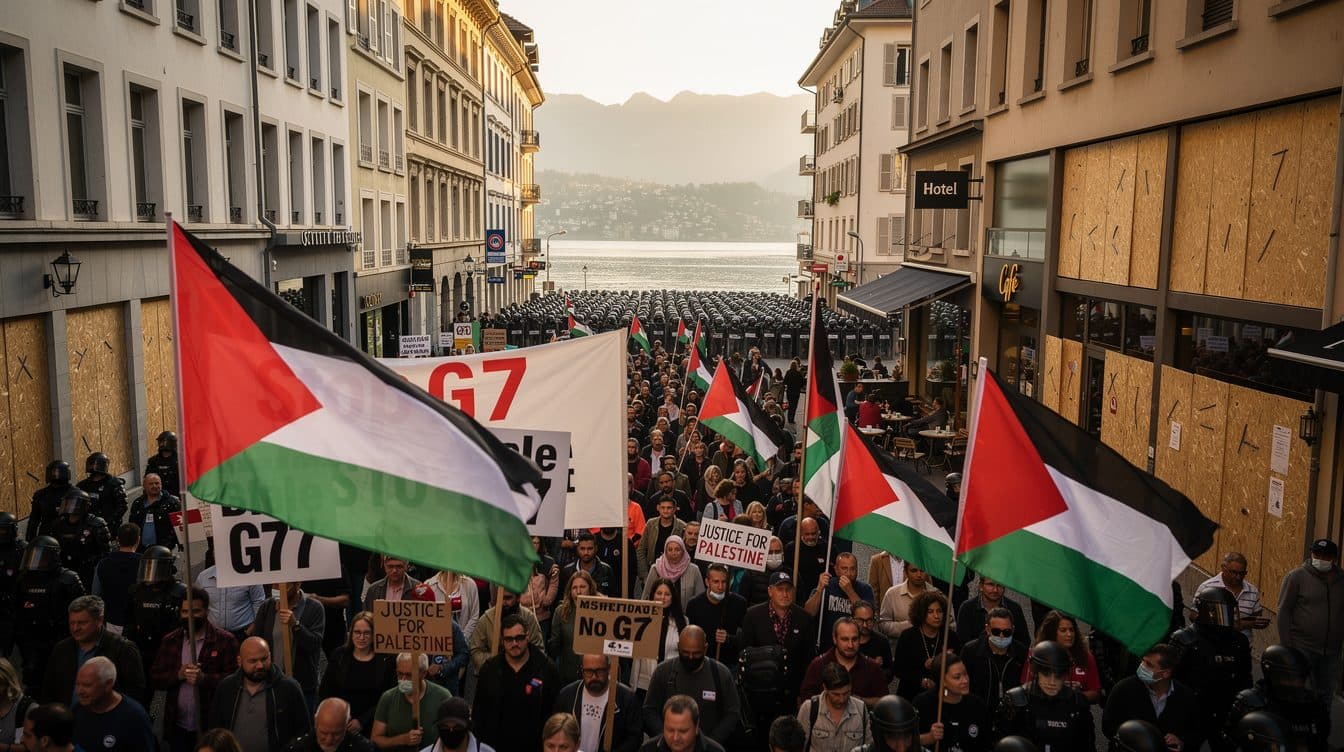
Riots in Geneva on the eve of the G7 summit in Évian
Geneva, 14 June 2026
AI-generated image (flux-2/pro-text-to-image via Kie.ai)
Summary
On the eve of the G7 summit in the French town of Évian, serious riots broke out in Geneva. After an initially peaceful demonstration under the motto "No G7," stones and fireworks were thrown at police, who responded with tear gas; cars burned, and banks and shops were damaged.
Geneva, 14 June 2026
Thousands of people demonstrated in Geneva on Sunday under the motto "No G7" against the G7 summit in nearby Évian; the initially peaceful rally escalated in the late afternoon into violent clashes between demonstrators and police.
The protest march had been organized by an alliance of around 60 organizations under the motto "No G7." According to the news agency Keystone-SDA, several thousand people gathered in the afternoon in a park on Lake Geneva, including environmental activists, feminists, activists for the rights of Palestinians, Kurds, as well as a so-called "revolutionary bloc." At the head of the march, according to reports, a banner was carried reading "Antifascist, anti-imperialist answer – No G7."
A broad alliance with a clear message
The organizers campaigned for their cause with sharp criticism of the seven leading industrial nations. The call from the No G7 coalition states that there "great powers make decisions in favor of the most privileged minority in the world and to the detriment of more than 90 percent of the population." The G7 is an "illegitimate and outdated institution, a private club that no longer corresponds to today's world." Demonstrations were held, among other things, against US military bases in Europe, for higher minimum wages, free contraceptives, unrestricted freedom of movement for workers worldwide, and the removal of gender designations from identity documents.
Security forces on high alert
The security authorities had been preparing for a large deployment for days. The Geneva police brought in reinforcements from all over Switzerland. As the Geneva government announced, several thousand police officers had been checking cars and the identities of passers-by in the city for two days. At the Swiss border with France, around 30 border crossings were closed and only seven kept open. Switzerland is home to the nearest airport to Évian; the delegations are expected to arrive there on Monday. In Geneva itself, hundreds of shop owners and hoteliers barricaded their shop windows with plywood panels – including luxury stores, banks, hotels, and supermarkets. The newspaper "Le Temps" showed images of unprotected façades that were damaged or sprayed with graffiti.
Figures on the number of participants initially diverged. AFP reporters counted around 15,000 demonstrators about an hour after the start. Alexandre Brahier, spokesperson for the Geneva police, spoke of an estimated 7,000 participants. The organizers reported "tens of thousands of participants" in the late afternoon. According to police figures, around 20,000 people took part in the initially largely peaceful demonstration. Police had previously expected up to 50,000 demonstrators and stationed around 7,000 security forces on the Swiss side of Lake Geneva.
Memories of the trauma of 2003
The Geneva police were particularly nervous in light of the experiences of 2003. Monica Bonfanti, cantonal police chief of Geneva, described the incidents at the time as a "trauma for the Geneva police." At the G8 summit in 2003 in Évian, which at that time still included Russia, serious riots, looting, and a seriously injured man had occurred in Geneva. The damage was estimated at around six million Swiss francs. According to the Geneva government, this memory led the authorities once again to take massive precautions.
Initially, the protest march proceeded peacefully. In the afternoon, the march moved through the city along the approved route, with police initially keeping in the background. In the park and along the route, however, police confiscated numerous items that appeared to be intended for clashes with police: knives, gas cartridges, telescopic batons, boules, and fireworks, as well as protective masks, balaclavas, spare clothing, and reinforced tarpaulins. The police announced on Facebook that they had seized several items apparently intended for confrontations.
Turning point in the late afternoon
In the late afternoon, the mood shifted. According to Swiss public broadcaster RTS, Black Bloc groups reversed the direction of the march and moved toward the district that houses the European headquarters of the United Nations. Police estimate the number of so-called Black Bloc activists – who "frequently seek out riots" – at around 6,000. In the area of the train station and in the Nations district, demonstrators and police engaged in clashes. According to AFP and Keystone-SDA reports, demonstrators threw bottles, stones, pieces of concrete, and fireworks at the security forces; police responded with tear gas.
There was property damage to several buildings. Among those affected were banks, a moped shop, the building of the International Telecommunication Union (ITU), and offices of the consulting firm PricewaterhouseCoopers. At a Banque du Leman, wooden barriers were torn down and windows smashed. On Avenue de France, furniture was thrown onto the railway tracks. Near the bus station, a Tesla car caught fire; several other cars were set on fire according to the news agency AP. Firefighters arrived, and police cordoned off the area extensively.
Property damage to banks, ITU, and PwC
Police attempted to dissolve the march using loudspeaker announcements. They declared the demonstration no longer authorized and urged participants to leave the area calmly. The situation in the city remained tense in the evening. According to the facts, the dissolution of the protest march continued. Brahier did not yet wish to comment on the number of arrests; the police wanted to wait for the overall picture first. The peaceful majority of demonstrators reportedly returned to the starting point in Mon-Repos Park.
The demonstration was directed not only against the G7 as an institution, but especially against individual heads of state and government. Numerous placards were directed at US President Donald Trump. A spokesperson for the No G7 coalition stated: "We are very afraid of the politics and the political measures of Mr. Trump and also the other heads of state and government of the G7, because they fight, wage wars everywhere." Banners and chants also called for an "answer to fascism, imperialism, and capitalism." Some signs read "Antisemitic never; anti-Zionist always."
Criticism of Trump's policies and the summit agenda
Critics also faulted the thematic focus of the summit. According to news agencies, the agenda of the heads of state and government from Great Britain, France, Italy, Germany, Canada, Japan, and the USA centers above all on economic and armaments issues, including the division of military tasks in Europe and the securing of the eastern external borders. From the perspective of the protest movement, internationally significant issues such as the fight against the consequences of climate change and solidarity with developing countries were missing.
Dispute over the location of the demonstration
The question of the demonstration's location also caused friction between the countries involved in the run-up. The Geneva government criticized that France had not been willing to tolerate demonstrations at the actual summit location. The rally was therefore registered in the Swiss border city. Geneva, some 50 kilometers from the French town of Évian-les-Bains, is described in reports as a kind of "enclave on French soil," since the lake separates the city from the venue. On Monday, the heads of state and government of the G7 countries are to arrive in Geneva; the meeting in Évian runs from Monday to Wednesday.
The situation in Geneva remained unclear even after the official end of the event. The conditions stipulated that the rally had to end by 10:30 p.m. While the peaceful majority of participants dispersed in the evening toward Mon-Repos Park, clashes continued in individual parts of the city. Reporters observed bathers and swimmers on the shore of Lake Geneva under blue skies, while smoke from burning vehicles hung in the air and a sailboat with the inscription "No G7" glided past on the water.
Overall, the events made clear the anger of part of civil society at the policies of the leading industrial nations – and at the same time the security authorities' fear of a repetition of the violence of 2003. The day's toll: property damage in the millions, injuries, dozens of seized projectiles, and incalculable damage to the host city's image. The actual G7 summit in Évian begins on Monday – under the impression of these images from the neighboring city.
The Swiss authorities announced they would review the operation. Police spokesperson Brahier pointed to ongoing investigations and announced that concrete figures on arrests and injuries would only be released after the evaluation was complete. In the meantime, preparations for receiving the delegations at Geneva airport continued; the security measures are to be maintained until the end of the summit, according to police.
For the coming days, observers in both countries expect further protest actions. The No G7 coalition had already announced that it intended to continue its mobilization beyond Sunday. At the same time, the Geneva police appealed for the cooperation of residents and urged the public to report any suspicious observations. The authorities stressed that freedom of expression would be guaranteed, but that violent riots would be consistently suppressed.
Questions & Answers
Why was the demonstration registered in Geneva and not in Évian?
The Geneva government criticizes that France did not want to tolerate demonstrations at the actual summit location in Évian. The alliance therefore registered the rally in Geneva, some 50 kilometers away.
Who called the "No G7" rally?
The No G7 coalition, an alliance of around 60 organizations from environmental protection, feminist groups, Palestine solidarity, Kurdish associations, and a so-called "revolutionary bloc."
How did the security forces respond to the riots?
The Geneva police used tear gas, declared the march no longer authorized via