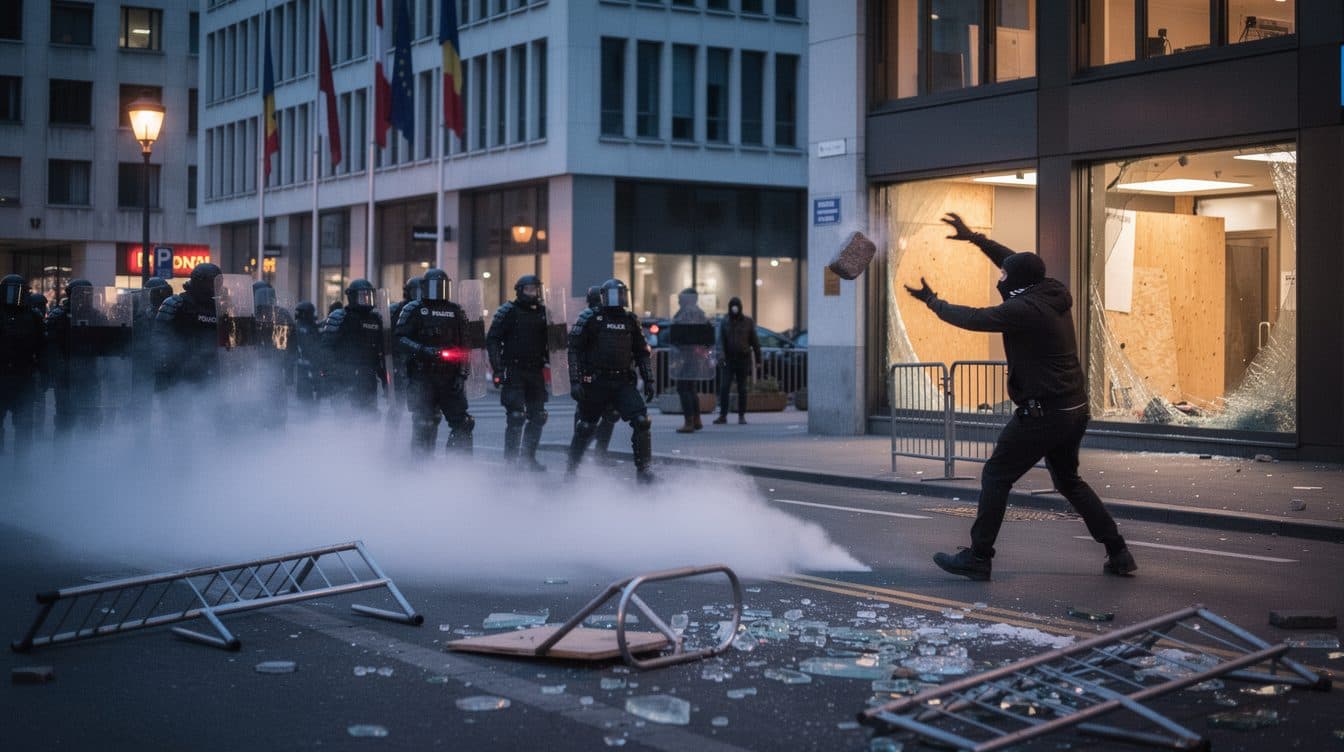
Protest against G7 summit in Geneva escalates: Masked rioters throw paving stones, police deploy tear gas
Geneva, 14 June 2026
AI-generated image (flux-2/pro-text-to-image via Kie.ai)
Summary
In Geneva, a protest against the G7 summit in Évian escalated increasingly on Sunday. Masked individuals threw paving stones, set a car on fire, and smashed windows, while police deployed tear gas and water cannons.
Geneva, 14 June 2026
A protest by several thousand people against the G7 summit in the French town of Évian, initially peaceful, escalated in Geneva on Sunday when masked rioters tore up paving stones, smashed windows, and set a car on fire.
Summit in Évian, protest in Geneva
The G7 meeting of heads of state and government from Germany, France, Great Britain, Italy, Canada, Japan, and the USA begins this Monday in Évian on the French side of Lake Geneva. Since France did not want to tolerate any demonstrations on the occasion, the protest shifted to the Swiss side, as the Geneva government criticized. Geneva lies around 50 kilometers from the summit location; the city is like an enclave on French territory.
The demonstration was called by the «No-G7» coalition, an alliance of around 60 organizations. Police spoke of at least 20,000 participants, the organizers of tens of thousands. The «No-G7» coalition of 60 organizations protested, according to a manifesto, against US military bases in Europe, for higher minimum wages, free contraceptives, borderless freedom of movement for workers from around the world, and the removal of gender information from all identity documents. That was an «illegitimate and outdated institution, a private club that no longer corresponds to today's world.» There, «great powers make decisions in favor of the most privileged minority of the world and to the disadvantage of more than 90 percent of the population.»
Broad alliance and clear messages
At the head of the march, a banner was carried with the inscription «Antifascist, anti-imperialist response – No G7». Behind it, various blocs lined up, including feminist, pro-Palestinian, revolutionary, Kurdish, and trade union groups, and numerous participants carried Palestinian flags. Numerous banners were directed against the G7 summit and called for a «response to fascism, imperialism, and capitalism».
The protest march initially proceeded peacefully along the approved route in the afternoon. The situation first escalated in the area of the train station, where demonstrators threw objects at the security forces, as reporters from the news agency Keystone-SDA observed. A bloc of several hundred black-clad followers disrupted the long peaceful atmosphere of the demonstrators.
Violence on the margins of the demonstration
The masked individuals tore paving stones from the ground and plywood paneling from shop windows, set a car and garbage containers on fire, and smashed numerous windows, both of shops and at bus stops, advertising boards, and the entrances of UN organizations. Targets of property damage included banks and other buildings, including those of the International Telecommunication Union (ITU) and the consulting firm PwC. On the Avenue de France, furniture was thrown onto the railway tracks, later demonstrators set a Tesla on fire and smashed the windows of a UN office.
In the neighborhood around the UN headquarters, demonstrators pelted police with paving stones and fireworks. The security forces responded with tear gas and water cannons, deploying tear gas multiple times over the course of the evening. Around 7 p.m., police dispersed the demonstration.
Massive police presence and border controls
The Geneva police had prepared extensively for possible riots. The Swiss closed around 30 border crossings down to seven and carried out identity checks in the city as early as Friday. Several thousand police officers have been checking cars and identities of passersby throughout the city for two days; a total of around 7,000 security forces were deployed on the Swiss side. Police reported on Facebook that they had seized objects that were apparently intended for clashes with police.
According to its own statements, the Geneva police had seized numerous dangerous objects in the run-up that could have been used as potential weapons. The finds were made along the route and in the area of Mon Repos park. The confiscated objects included knives, gas cartridges, telescopic batons, boules, and fireworks. In addition, protective masks, balaclavas, spare clothing, and reinforced tarpaulins were seized.
Away from the approved marching route, police cordoned off the main bridge over the Rhône to the main shopping streets with a large presence, and elsewhere the United Nations headquarters. In downtown Geneva, luxury stores and banks, as well as hotels and supermarkets, had barricaded their facades and shop windows with plywood panels days before the demonstration.
Trauma of 2003 as background
The background to the extensive security precautions is memories of the year 2003, when hooligans caused damage running into the millions during a demonstration. At that time, only a few dozen officers were deployed and were completely overwhelmed by the violence. The events of 2003 are a trauma for the Geneva police, said the canton's police chief, Monica Bonfanti.
Questions & Answers
Why did the protest against the G7 summit take place in Geneva and not in Évian?
France did not want to tolerate any demonstrations on the occasion, which is why the organizers registered the demonstration under the motto «No G7» in Geneva, around 50 kilometers away, as the Geneva government criticized.
Who called for the demonstration and how many people came?
The demonstration was called by the «No-G7» coalition, an alliance of around 60 organizations. Police spoke of at least 20,000 participants, the organizers of tens of thousands.
How did the security authorities respond to potential riots?
Switzerland closed around 30 border crossings down to seven, carried out identity checks in the city as early as Friday, and, according to its own statements, deployed around 7,000 security forces who seized, among other things, knives, gas cartridges, telescopic batons, and fireworks.