Risk of Further Escalation in the Iran War Grows – Deaths, Wave of Attacks and Collapse of Negotiations
Washington/Tehran, 19 July 2026
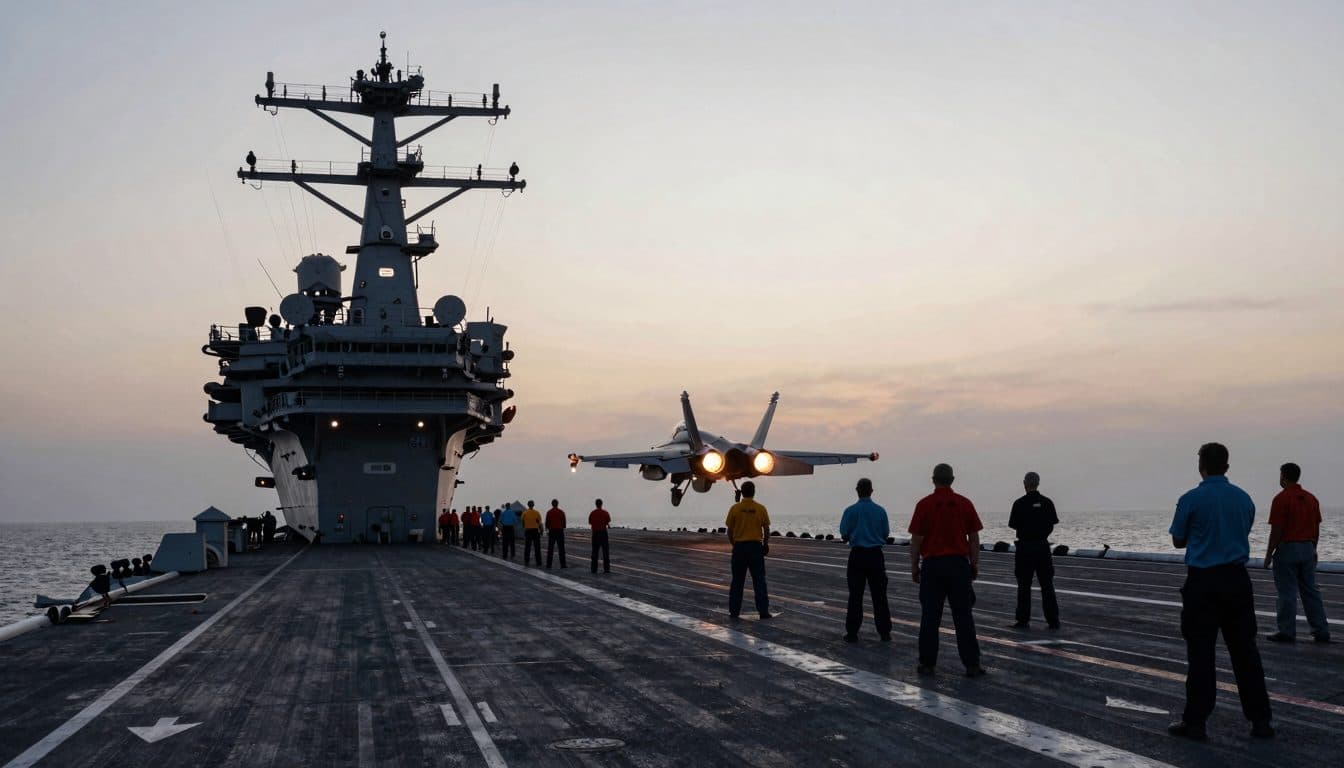
AI-generated image (z-image via Kie.ai)
Summary
In the war between the United States and Iran that has been ongoing since February, a further escalation threatens following a new wave of US attacks and the death of two American soldiers in Jordan. Tehran is suspending the framework agreement concluded in June, Revolutionary Leader Mojtaba Khamenei is vowing retaliation, and the Gulf states are also raising the alarm.
Washington/Tehran, 19 July 2026
In the eighth consecutive night of strikes on Iranian targets, the United States has expanded its air raids against Iran following the death of two US soldiers in Jordan, while Tehran has declared the framework agreement concluded with Washington in June to be terminated, and Revolutionary Leader Mojtaba Khamenei has announced retaliation.
Wave of Attacks and Retaliation
The situation in the war against Iran, which has been waged jointly by the United States and Israel since 28 February, escalated again overnight into Sunday. The regional command CENTCOM announced on Saturday (local time) that US forces had attacked Iranian positions for the eighth time in a row. Military coastal surveillance and air defence installations as well as missile and drone storage sites had been "successfully" hit. Washington was thereby responding to an Iranian attack in Jordan, in which two US soldiers were killed on Friday – the first deaths reported by the US military from Iranian fire since the early days of the conflict nearly five months ago.
The officially known number of US soldiers fallen in the war against Iran thus rises to 16. One further soldier is missing, according to the Pentagon. Iran's Health Ministry has reported at least 50 dead and more than 500 injured in the country since the renewed escalation wave just over a week ago. The Iranian government usually publishes only civilian casualty figures and releases no data on its own military losses.
US President Donald Trump expressed condolences over the killed soldiers, according to the broadcaster NewsNation. "Das ist eine sehr traurige Sache," he said. At the same time he reiterated that Iran must not have nuclear weapons, and added with regard to Iran's suspension of the framework agreement that he did not care "völlig egal". "Wir sehen das ungern," Trump said about the deaths.
Khamenei Announces Retaliation
According to CENTCOM, the strikes also served to "schnell zu bestrafen" the Iranian Revolutionary Guards for a deadly attack on American soldiers in Jordan. A further objective was to further weaken Iran's ability to "die kommerzielle Schifffahrt in der Straße von Hormus zu bedrohen" – one of the world's most important shipping lanes for trade in oil, gas and fertilisers.
In parallel with the eighth wave of attacks, Iran is itself stepping up the pressure. Iran's supreme leader, Ayatollah Mojtaba Khamenei, who has never before appeared in public, had the following communicated in a statement: „Da der amerikanische Feind nun auf Kriegstreiberei, die Übernahme noch schwererer Kosten und eine noch größere Schande aus ist, soll er wissen, dass das geliebte iranische Volk und die Widerstandsfront unvergessliche Lektionen für ihn bereithalten." Khamenei took over the office after the death of his father in US-Israeli attacks.
Earlier, Iranian Deputy Foreign Minister Kazem Gharibabadi had stated, according to the Fars news agency, that his country had suspended the framework agreement concluded with the United States in mid-June and no longer felt bound by it. "Leider haben die Amerikaner mit ihren aggressiven Maßnahmen gegen ihre Verpflichtungen aus der Absichtserklärung von Islamabad verstoßen," Gharibabadi was quoted as saying. The agreement had provided for negotiating a final deal to end the war and reopening the Strait of Hormuz within 60 days. This negotiating roadmap has thus become meaningless for the time being.
Framework Agreement Suspended
The Iranian retaliatory strike in Jordan apparently marked a new level of intensity. According to US officials quoted by the "Wall Street Journal," Iran has in the meantime adjusted to American defence systems and is firing missiles that travel at extremely high speed and can manoeuvre during their descent. The Tasnim news agency reported that at least six missiles struck outlying areas of Qeshm Island in the Persian Gulf in the early morning (local time). US officials also expressed concern to the "Wall Street Journal" that Iran might be receiving assistance with target identification from China or Russia.
Warnings are also coming from the region. The Foreign Ministry of the United Arab Emirates called on the platform X for an "sofortigen Stopp der Eskalation" and the utmost restraint, "um gefährliche Auswirkungen und ein Abgleiten der Region in ein neues Ausmaß an Gewalt und Instabilität zu verhindern". The Emirates at the same time called for an immediate end to hostilities and a swift return to the negotiating table.
Warnings from the Region
The pressure on Trump is likely to grow with the new losses. The war is already unpopular in the United States, and domestic opposition is mounting. Observers see the president under domestic political pressure while the military escalation continues. Trump himself said, according to NewsNation from a TV interview with the Iranian minister, that the latter was "mit der Verteidigung des Landes beschäftigt" – an indication of the ongoing war mobilisation in Tehran.
International mediators, meanwhile, are hardly appearing at all. According to experts, the dialogue between Washington and Tehran has been largely frozen for months and is being conducted primarily through military strikes. The Israeli Iran expert Danny Citrinowicz wrote on the online platform X that, given the practically non-existent trust between Washington and Tehran, the increasingly exhausted mediators and a dialogue conducted primarily through military strikes, "ist das Risiko einer weiteren Eskalation mittlerweile größer als die Aussichten auf eine Deeskalation". It is becoming ever clearer, he said, "dass die Ereignisse allmählich außer Kontrolle geraten".
Risk of a Spillover
Unless something substantial changes soon, the conflict is heading towards a "weitaus gefährlichere Phase" that could become ever harder to contain for both sides, Citrinowicz warned further. Under these circumstances, it will be extremely difficult to keep "die Eskalationsspirale unter Kontrolle". The conflict also threatens to widen, drawing the Gulf states allied with Washington even more directly into it.
Observers also point to the mood within the Iranian Revolutionary Guards. Citrinowicz wrote that Tehran's display of power during the mourning ceremonies for the killed head of state Ali Khamenei had apparently strengthened the conviction of important Guard commanders that they needed to intensify the response to US attacks. From the experts' perspective, this increases the risk of a further escalation of retaliatory strikes.
The background to the conflict is a cycle of escalation that has been ongoing again since the beginning of July. A ceasefire that had been in place since the beginning of April was declared ended by Trump himself. Since then, the US military has been conducting attacks on Iranian territory almost daily. Washington's strategy is, according to its own statements, aimed at systematically weakening Iran's military capabilities – in particular the drone and missile programmes of the Revolutionary Guards – and at keeping the sea routes in the Persian Gulf open.
Background of the Conflict
With the eighth consecutive night of attacks and Tehran's suspension of the framework agreement, the already fragile negotiating channel is now interrupted for the time being. Should there be no diplomatic movement in the coming days, analysts warn of a spread of the war to other regional actors – with possible consequences also for global energy supplies via the Strait of Hormuz.
Questions & Answers
Who is Mojtaba Khamenei and why is his statement significant?
According to the article, Mojtaba Khamenei is Iran's supreme leader, who took over the office after the death of his father in US-Israeli attacks and has never before appeared in public. His statement announcing "unvergesslicher Lektionen" for the United States marks a clear escalation threat from Tehran.
Why has Iran suspended the framework agreement with the United States?
Iranian Deputy Foreign Minister Kazem Gharibabadi stated, according to Fars, that the United States had violated its commitments under the Islamabad memorandum of understanding with its attacks. The agreement concluded in mid-June provided for a final peace deal within 60 days and the reopening of the Strait of Hormuz.
What role does the Strait of Hormuz play in the conflict?
The Strait of Hormuz is one of the world's most important shipping lanes for trade in oil, gas and fertilisers. According to CENTCOM, the US air strikes are aimed in part at weakening Iran's ability to "die kommerzielle Schifffahrt in der Straße von Hormus zu bedrohen".
Iran War: Escalation, US Strikes and Khamenei's Threat | allfacts360