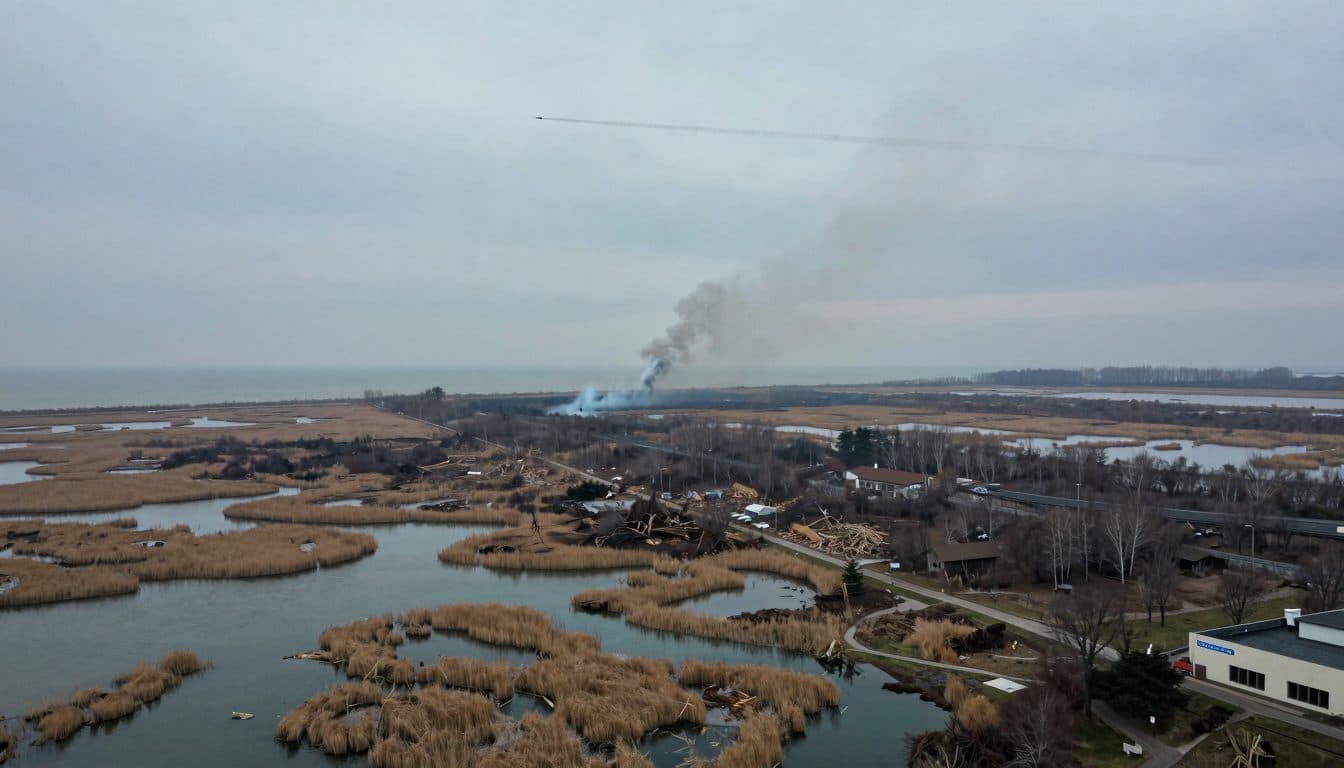
Romanian F-16 intercepts Russian drone over the Black Sea
Bucharest, July 26, 2026
AI-generated image (z-image via Kie.ai)
Summary
The Romanian Air Force used an F-16 fighter jet on Sunday to once again intercept a Russian drone over the Black Sea. The shootdowns of unmanned aircraft in Romanian airspace are continuing after Friday and Saturday.
Bucharest, July 26, 2026
A Romanian F-16 fighter jet intercepted a Russian drone over the Black Sea on Sunday, according to Bucharest.
Shootdown on Sunday over the Black Sea
The drone was intercepted over the Black Sea on Sunday by a Romanian F-16 fighter jet, the government announced. The aircraft had violated Romanian airspace at 10:13 a.m. local time (9:13 a.m. CEST), according to the Ministry of Defense. According to Interim Defense Minister Radu Miruta, the pilot reportedly responded within five minutes of the drone entering airspace. The action came just one day after two previous shootdowns.
With the latest intercept, the Romanian Air Force is continuing its new shootdown practice. After the pilot of a Romanian F-16 fighter jet eliminated such an aircraft in the east of the country with a missile on Friday, further drone shootdowns occurred on Saturday and Sunday morning after the drones had entered Romanian territory. It was the first time since the start of Russia's war of aggression against Ukraine that the Romanian army had shot down a drone in its own country's airspace. Romania shares a border of roughly 600 kilometers with Ukraine, which has been attacked by Russia.
Shootdowns on Friday and Saturday
The drone shot down on Friday was brought down near the village of Padina, about 100 kilometers from the capital, Bucharest. President Dan stated that, according to an investigation, the drone shot down on Friday was a model of the Iranian-developed Shahed type "used by the Russian Federation in its war of aggression against Ukraine." On Saturday, the army shot down another drone in the Danube Delta near the border with Ukraine. Investigations into the drones shot down on Saturday and Sunday are ongoing.
Since the start of Russia's war of aggression against Ukraine in 2022, drones from both sides in the conflict have repeatedly entered the airspace of Romania and other NATO states. Over the course of the war, which has now lasted nearly four and a half years, drones have repeatedly penetrated Romanian airspace. Some crashed, but none were shot down until Friday. At the end of May, an explosive-laden drone crashed into a residential building in Romania near Galati on the border with Ukraine. According to Bucharest, it was a Russian drone.
Diplomatic reaction from Bucharest
Both Russia and Ukraine deploy large numbers of drones in the war. Romanian airspace is also part of NATO and EU territory. President Dan described the Russian violations of airspace as "It is impermissible and unbearable that the Russian Federation continues to violate Romanian airspace, which is simultaneously NATO and EU airspace. Such actions are unacceptable and we treat them, together with our allies, with seriousness." The wording of the statement underscores the seriousness that Bucharest attaches to the situation.
Interim Defense Minister Miruta stated that "these provocations should promptly come to an end," and that Romania would know how to defend both its sovereignty and its airspace. Foreign Minister Oana Toiu wrote on platform X that she had summoned the Russian ambassador "due to repeated violations." President Dan also announced: "Romania's diplomatic protest toward the Russian Federation will be based on these investigations." In doing so, Bucharest is intensifying diplomatic pressure on Moscow in parallel with military measures.
Legal basis and security policy
The legal basis for the shootdowns is a law passed by the Romanian parliament in 2025 that allows the Romanian military to shoot down unmanned drones. Until then, the armed forces had only been authorized to identify and track aircraft. The amendment to the law was considered necessary following several drone incidents in recent years in order to be able to respond to repeated violations of airspace. Romania is thus one of the first eastern NATO states to have put an explicit shootdown provision for drones into force.
The drone flights are taking place against the backdrop of a severe domestic political crisis in Romania, after a coalition of pro-European parties collapsed. In the most recent parliamentary elections, pro-Russian parties received around 40 percent of the vote and could only be kept from power through a cross-bloc show of unity. The Social Democrats are now, however, seeking a government tolerated by the pro-Russian camp. As a result, the country's foreign and security policy is being put to the domestic political test, while the airspace violations continue.
Domestic political situation in Romania
Observers see the incidents as a deliberate provocation designed to test Romania's capacity to act. The air force's swift response and the simultaneous diplomatic escalation by the Foreign Ministry are regarded in Bucharest as evidence of a coordinated answer. At the same time, concern is growing among the Romanian public that the drone incidents could further intensify the societal debate about how to deal with Russia at a delicate domestic political moment. President Dan stressed that every violation of airspace is a violation of alliance territory and will be answered together with partners.
The Romanian government has meanwhile announced that it will review the incidents jointly with its NATO allies. Alongside the technical identification of the downed drones, investigations are underway to determine the origin, flight path, and mission of the aircraft. According to President Dan, the diplomatic protest is to be built on the results of these investigations. As a result, the question of a formal complaint to international bodies or further sanctions steps could gain significance in the coming days.
NATO partners and EU states were informed of the incidents, according to Bucharest. The Alliance is monitoring the situation on its eastern flank with heightened attention, as comparable incidents had been recorded in Poland and the Baltic states in recent years. Discussions about the legal basis for shootdowns also took place there. Romania could now take on a pioneering role within the Alliance with its practice, should other members pursue similar regulations.
NATO context and outlook
In Romania, meanwhile, the debate over the modernization of air defense is growing. The country's F-16 fleet has been in service for years, but is considered stretched to its technical and personnel limits. Politicians from various camps are calling for investment in modern radar systems and a wider selection of intercept weapons in order to be able to respond to the growing number of drone incidents. The incidents of recent days are likely to further reinforce these demands.
Overall, the three shootdowns within just a few days illustrate a new phase in Romania's handling of the Russian drone threat. For the first time, the country is actively intervening in its airspace; previously, aircraft were merely tracked or documented. With the summoning of the Russian ambassador, the ongoing investigations, and the reference to the applicable shootdown law, Bucharest is pursuing a combined military-diplomatic response to the repeated violations of its territory.
The coming days will show whether the diplomatic steps will lead to de-escalation or whether the incidents will continue. President Dan made clear that Romania, together with its allies, would respond "with seriousness" to any further violation. At the same time, it remains unclear how domestic political forces, particularly pro-Russian currents, will react to the shootdowns and the diplomatic protest. The security situation on NATO's eastern flank thus remains tense.
Questions & Answers
Who intercepted the drone over the Black Sea?
According to the Romanian government, the drone was intercepted on Sunday by a Romanian Air Force F-16 fighter jet over the Black Sea, five minutes after it entered airspace.
Which drone was shot down on Friday?
President Dan stated that the drone shot down on Friday near the village of Padina was a model of the Iranian-developed Shahed type used by the Russian Federation in its war of aggression against Ukraine.
How is Romania responding diplomatically to the incidents?
Foreign Minister Oana Toiu summoned the Russian ambassador, President Dan announced a diplomatic protest to be based on the ongoing investigations, and pointed to the seriousness of the situation together with allies.
Romania: F-16 intercepts Russian drone over the Black Sea | allfacts360