Salzburg Festival: Ulrich Rasche stages Goethe's "Faust I" as a dark soul ride on Perner Island
Hallein, 26 July 2026
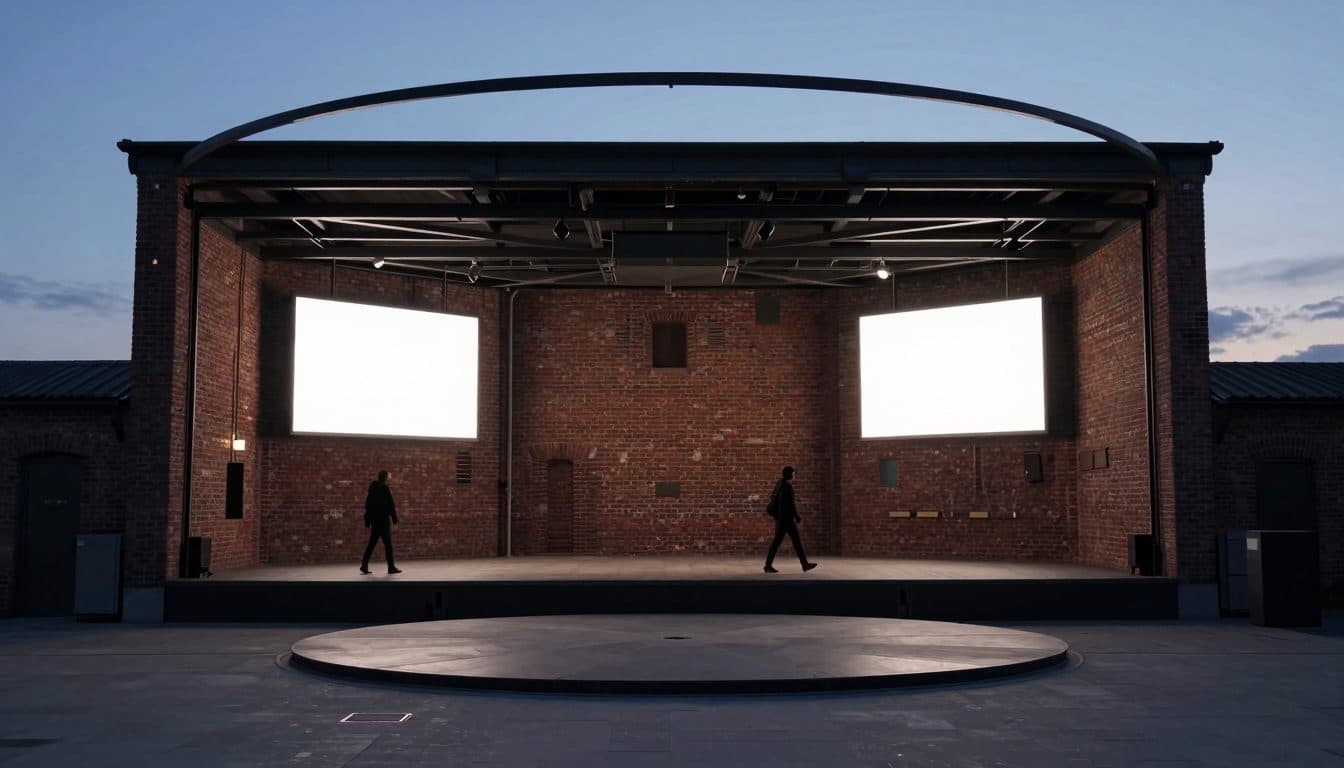
AI-generated image (z-image via Kie.ai)
Summary
At the Salzburg Festival, director Ulrich Rasche brought Goethe's "Faust I" to Perner Island in Hallein as a radically abridged, dark staging. The premiere, featuring Steven Scharf as Faust and Valery Tscheplanowa as Mephistopheles, was received with great applause.
Hallein, 26 July 2026
With a radically abridged, dark new version of Goethe's "Faust I," director Ulrich Rasche premiered the first production of the Salzburg Festival on Perner Island in Hallein, which was received with great applause.
Cut version without prologue
The staging, which premiered on Saturday evening on Perner Island in Hallein, lasts around three and a half hours. In his cut version, Rasche dispenses not only with the "Prologue in Heaven" but also with the "Prelude on the Stage" and the "Dedication." What remains is a concentrated piece about a deeply despairing human being who struggles with himself and his repressed parts.
„Da steh' ich nun, ich armer Tor, und bin so klug als wie zuvor." The almost logical pact with the devil Mephistopheles is meant to provide relief in the form of pleasure and passion. Right at the beginning, Rasche poses the central question of the evening: „Habe nun, ach! …" The famous opening monologue falls, and it immediately becomes clear that this Faust no longer wants to go on living.
Steven Scharf as a frail Faust
Steven Scharf plays this Faust as a tall, frail-looking man who fights his way across the gently rotating turntable with small steps. Dutifully, Faust records what he has indeed studied „mit heißem Bemühen." At the same time, he murmurs just enough Goethean blank verse to still pass as an educated bourgeois. „Es möchte kein Hund so länger leben!" He has therefore taken to magic in order to recognize what holds the world together at its core, takes a sip from a phial – and imagines Mephistopheles.
The theater machinist Rasche, after Aeschylus' "The Persians," Lessing's "Nathan the Wise," and Donizetti's opera "Maria Stuarda," has once again constructed a sophisticated, dystopian stage machine. On the turntable there are two disks, from which a circular construction hangs beneath the ceiling. In parallel, two capital screens lower themselves, which one could call "light boxes."
Multiple souls, five performers
„Es wohnen, ach, ganz schön viele Seelen in dieser Brust": If in Goethe's original drama there are two, in his dark new staging the German director undertakes a multiple soul-examination of a desperate and constantly doubting person – with a radically abridged text version, a reduced cast of only five performers, and the sophisticated stage apparatus.
Valery Tscheplanowa, the Nathan from 2023, now plays the quite roguish Mephisto. At first she appears to Faust as a spirit, but from the moment she laughs out loud, she determines and dominates this "Faust" staging as Mephistopheles with every glance and every tiniest movement. Together with two further "Men in Black" – Mephisto and two companions – she encounters Margarete and later her brother Valentin. All figures are dressed in Mephistopheles' costume, which underscores the multiple casting of the souls.
Anna Drexler plays Margarete, who in the play is called "Gretchen." In this staging, however, she appears only late and repeatedly takes on the role of the observer. To Mephisto's "Sie ist gerichtet," she herself replies "Ist gerettet." The staging of "Faust I" at the Salzburg Festival was received with great applause.
The "interior" as a corridor
Rasche had announced in advance that he wanted to show the "interior" of Faust. He achieves this through the construction of the turntables and the hanging screens, which form a corridor. "In diesem Tunnel wird Faust ganz auf sich zurückgeworfen und mit Anteilen seiner selbst konfrontiert, die er zuvor verdrängt hat," Rasche explained beforehand at the festival's terrace talk.
„Durchaus studiert …" To the continuous, mostly very illustrative, urgent soundtrack by Alfred Brooks, the tall Steven Scharf fights his way with the small steps of a frail old man across the gently rotating turntable. This Faust with a desperate facial expression is almost paradigmatically disillusioned and embittered.
The machine theater setting is strongly reminiscent of the dramatic poem "Nathan the Wise" by Lessing, which Rasche had performed on Perner Island in 2023: back then there were three metal disks that could rotate independently of one another faster or slower or even change direction. For "Faust I," Rasche went a step further: there are indeed only two disks, but from a circular construction beneath the ceiling two capital screens hang down in parallel.
The verses of the world-famous tragedy by Johann Wolfgang von Goethe (1749–1832) are often delivered deliberately. This deliberation supports Rasche's staging, in which every gesture and every spoken word gains weight. The director deliberately slows the rhythm of the evening in order to make the inner tornness of the title figure visible.
Deliberate verses, physical concentration
The staging begins immensely strong – with the classic monologue of Faust. „Habe nun, ach!" – thus falls the famous first sentence, which sums up the entire despair of the protagonist. Rasche stages this moment as physical concentration: Scharf stands motionless on the stage while the turntable slowly sets itself in motion and the light boxes change their colors.
Faust's drug trip: Rasche grinds away with the colors. If one is not, like Peter Stein once was, inspired by the idea of wanting to bring the entire "Faust" by Johann Wolfgang Goethe to the stage, then one can get straight to the dog's core. Rasche chooses this path and concentrates on the inner intoxication and the hallucinatory experience of his protagonist.
Between insight and exhaustion
Video walls create a corridor trap through which Faust cannot escape. „Die permanente Steigerung ersetzt die Fähigkeit zur Bindung," says Rasche. This thesis runs through the entire evening: every gesture, every step on the turntable intensifies itself until the figures are caught in a whirl of movement and language.
„Die Frage ist: Wie kann der Körper eine möglichst intensive Verbindung zur Sprache herstellen?" Scharf said in an interview with the Süddeutsche Zeitung. This question is answered by the staging over three and a half hours with a choreography of rotation, language, and silence.
This "Faust" revolves around itself, and this search for meaning turns out to be a rodeo ride between hallucinogenic megalomania and subtle self-contempt, between constant longing and irreparable destruction, between gaining insight and total exhaustion. Rasche succeeds in translating Goethe's text into a physical experience that casts a spell over the audience.
At the Münchner Residenztheater, the play celebrates [Note: The subsequent text is cut off in the source material.] It is considered likely that the production will be taken over after Salzburg into other houses. Ulrich Rasche, who is regarded as a theater machinist, has once again confirmed his reputation as a renewer of machine theater with this staging.
Questions & Answers
Who directed the new "Faust I" staging at the Salzburg Festival?
Director Ulrich Rasche is responsible for the radically abridged, dark new version of Goethe's "Faust I," which premiered on Saturday on Perner Island in Hallein.
Which performers are on stage?
Steven Scharf plays the frail Faust, Valery Tscheplanowa the roguish Mephistopheles, Anna Drexler plays Margarete ("Gretchen"), and Johannes Nussbaum as well as Max Rothbart play further figures.
What distinguishes this staging from earlier "Faust" adaptations?
Rasche dispenses with the "Prologue in Heaven," the "Prelude on the Stage," and the "Dedication," limits the cast to five participants, and stages the play as a soul-examination of a despairing figure with two rotating disks and two hanging light boxes.
Faust I Salzburg: Rasche's dark staging on Perner Island | allfacts360