School Barometer 2026: Student Behavior Burdens Teachers More Than Two Years Ago
Stuttgart, 23 June 2026
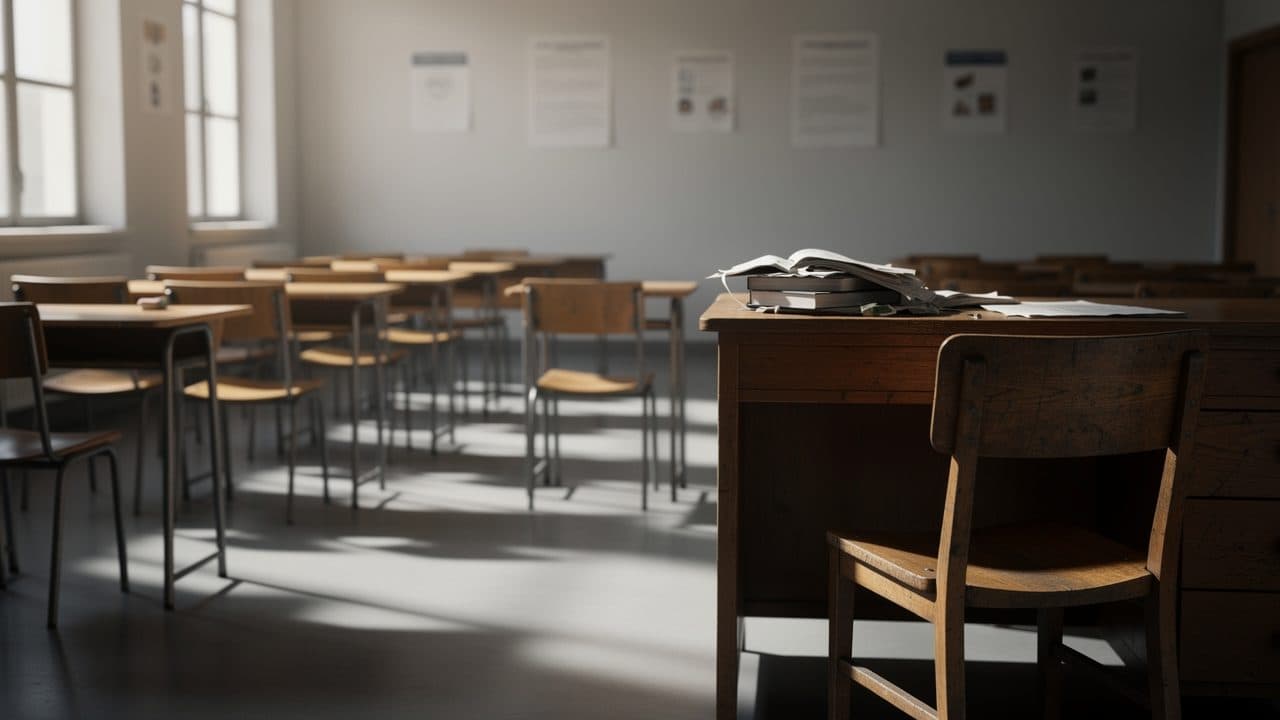
AI-generated image (flux-2/pro-text-to-image via Kie.ai)
Summary
The School Barometer 2026 by the Robert Bosch Stiftung shows: 46 percent of teachers perceive the behavior of their students as the greatest professional burden – eleven percentage points more than in 2024. At the same time, 83 percent say they are satisfied with their profession and demand more multiprofessional support.
Stuttgart, 23 June 2026
The German School Barometer 2026 by the Robert Bosch Stiftung shows that 46 percent of the surveyed teachers regard dealing with the behavior of their students as the greatest professional burden.
The Robert Bosch Stiftung has been conducting representative surveys on the situation of schools in Germany on a regular basis with the German School Barometer since 2019. For the current edition, a total of 1,547 teachers at general and vocational schools were surveyed by the opinion research institute Forsa between 11 November and 2 December 2025. The results have a margin of error of three percentage points.
According to this, 46 percent of respondents cite student behavior as the greatest professional burden. Two years ago, only around one in three surveyed teachers (35 percent) had felt this way. In second place among the burdens mentioned, at 34 percent, is the heterogeneity of classes – meaning large differences in performance between students. 27 percent see high workloads and lack of time as a problem.
Examples of burdensome behavior cited in the survey include lack of motivation and willingness to learn, psychological problems, aggressiveness, or concentration problems. Teachers at Haupt-, Real-, or Gesamtschulen as well as at vocational schools particularly frequently perceive the behavior of their students as burdensome, while colleagues at primary schools or Gymnasien report this significantly less often.
What burdens teachers most
47 percent say they need training in dealing with psychologically burdened students. As many as 82 percent would like to have more knowledge about how they can promote competencies such as empathy, teamwork, independence, or critical thinking among students. Experts from the field also cite the influence of social media as a cause.
Education expert Katharina Thoren from the Robert Bosch Stiftung says: "Das große Interesse an Fortbildungen ist eine echte Chance, die wir nutzen sollten, um Lehrkräfte beim Umgang mit schwierigen Unterrichtssituationen gezielt zu stärken. Aber das reicht nicht aus." Schools urgently need multiprofessional teams, such as social workers, school psychologists, or IT specialists. The goal is "damit Lehrkräfte sich wieder voll auf das konzentrieren können, was ihre eigentliche Aufgabe ist: guten Unterricht."
A School Barometer by the foundation in which students were surveyed had only in March shown an increase in psychological burdens among young people. According to Thoren, the teachers' observations also align with the feelings of the students. This can affect the behavior of the students. She also pointed out that wars and crises worldwide could play a role.
Desire for training and demand for teams
Despite the burdens, the vast majority of respondents enjoy their work. 83 percent are satisfied with their jobs. However, according to the foundation, 28 percent would leave the profession if an alternative were available. More than a third of teachers feel left alone, according to the foundation.
The proportion of teachers who work with AI several times a week has more than doubled to 25 percent. The foundation names student behavior, political statements, and dealing with artificial intelligence as the three biggest challenges for teachers in Germany. 48 percent wish that their schools would do more in the area of democracy education.
Differences between school types and states
In a comparison between states, teachers in Bavaria and Baden-Württemberg are significantly more satisfied with their jobs than those in the north, east, and in North Rhine-Westphalia. In NRW, satisfaction on a scale from 1 (low) to 4 (high) is 2.9; the burnout value is the highest nationwide according to the School Barometer. A survey by the Philologenverband NRW from 2025 found that 37 percent of surveyed teachers work more than 50 hours per week, 12 percent even more than 60 hours.
According to GEW (Gewerkschaft Erziehung und Wissenschaft), a key stress factor is that teachers do not have enough time to prepare their lessons according to their own pedagogical standards. According to the Rheinische Post, a total of 650 teachers in NRW left the profession in 2025 – 283 civil servants and 367 employees. Almost 7,800 positions were unfilled according to the report.
Contrary to a ruling by the European Court of Justice from 2019, the actual working hours of teachers continue to be not recorded. The weekly working hours including preparation and follow-up are set by the NRW Ministry of Education; the state civil servant law provides for a compulsory teaching load of 41 hours per week for civil servant teachers. Teachers at Gesamtschulen and Gymnasien in NRW must teach 25.5 hours per week.
Relief offerings at schools
At the Europaschule Langerwehe in the Düren district, principal Regina Westermann has, in her own words, created retreat spaces, "sodass sich die Lehrerinnen aus dem Lehrraum zurückziehen können, zum Beispiel in einen Ruheraum, in dem nicht gesprochen werden darf". There is also a school garden. The school also sends out a newsletter every two weeks to pass on information in a bundled way: "So gibt es keinen digitalen Overkill – da nicht jede Info immer direkt mit jedem geteilt wird." Westermann observes growing organizational and educational tasks that come on top of teaching for teachers. They have continuous social interaction throughout the day with different learning groups of 20 to 30 students each – "das zieht viel Kraft und Energie".
For teachers at public schools in NRW, there is a free psychosocial counseling hotline at 0800-0007715, available daily and around the clock; the counseling is confidential and anonymous.
27 percent of teachers believe they are not allowed to express their own political opinions in class.
(dpa)
Questions & Answers
Who is Katharina Thoren?
Katharina Thoren is an education expert at the Robert Bosch Stiftung and is quoted multiple times as an expert in the School Barometer 2026.
What are the greatest burdens for teachers according to the School Barometer 2026?
Dealing with student behavior (46 percent), followed by heterogeneity in the classroom (34 percent), and high workload (27 percent).
How many teachers were surveyed for the School Barometer 2026?
For the current edition, the opinion research institute Forsa surveyed a total of 1,547 teachers at general and vocational schools between 11 November and 2 December 2025.
School Barometer 2026: Teachers Complain About Student | allfacts360