Second heat wave of the year rolls across Germany – DWD warns of high thermal stress
Offenbach, 18 June 2026
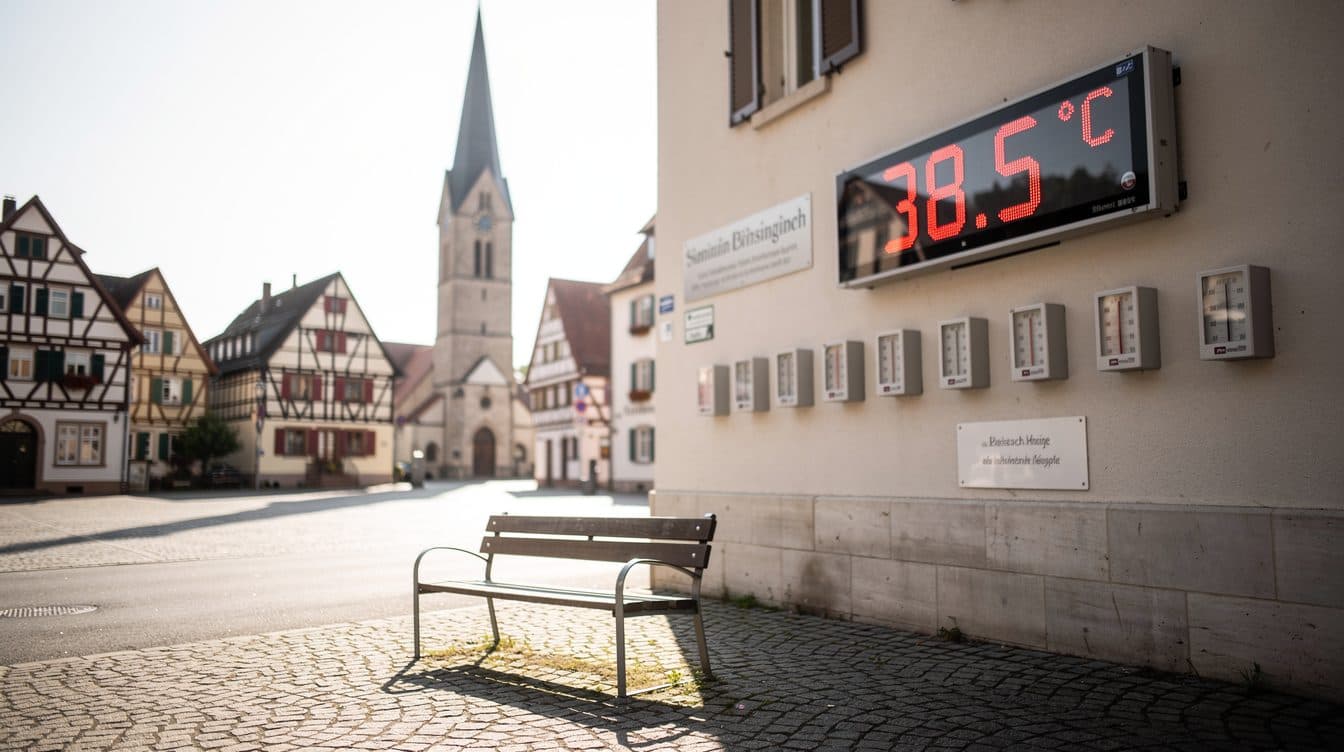
AI-generated image (flux-2/pro-text-to-image via Kie.ai)
Summary
The German Weather Service is warning of the second heat wave of the year, with temperatures near 40 degrees in the south of Germany. In Müllheim in southern Baden, 32.7 degrees were already recorded on Wednesday – the provisional daily maximum.
Offenbach, 18 June 2026
The German Weather Service (DWD) issued an official heat warning for several federal states on Wednesday evening, as the second heat wave of the year begins on Thursday, with temperatures reaching close to 40 degrees in the south of Germany.
Responsible for the extreme heat is the high-pressure system "Gorgias," which, according to the DWD, is directing warm to hot air masses from the southwest into Germany. Already on Wednesday, temperatures climbed above the 30-degree mark in many places in the south of the country, the weather service reported. In Müllheim in southern Baden, the thermometer rose to 32.7 degrees, reaching the highest value of the day in Germany. It was similarly hot in the Baden town of Rheinfelden and in Konstanz at 32 degrees. According to the DWD, the temperatures measured are provisional values.
Warning for several federal states
Already on Wednesday evening, the experts issued a heat warning for Baden-Württemberg, Rhineland-Palatinate, and parts of North Rhine-Westphalia, Hesse, and Bavaria. The official warning applies to these regions from Thursday 11.00 a.m. to 7.00 p.m. The DWD also publishes forecasts for the coming days. You can see in which regions warnings are currently in effect on the service's warning map.
For Thursday, the meteorologists predict the start of a heat phase with high thermal stress. Almost everywhere the 30-degree mark will be exceeded, and in the south the thermometer is even heading toward 40. Only on the North Sea coast will temperatures remain somewhat more moderate. In many regions, the German Weather Service expects more than 30 degrees and sultry hot weather over the coming days. From Friday, the experts also expect thunderstorms: „ab Freitag gibt's Blitz und Donner".
Peak on Thursday and Friday
Summer has therefore not only arrived, but – as the weather service puts it – "with power": „Der Sommer komme mit Macht, so der Wetterdienst." Under a radiant blue sky and perfect outdoor pool weather, temperatures have climbed above the 30-degree mark in many places, particularly in the south of Germany. The highest temperature measured so far this year in Germany was 33.4 degrees in Waghäusel-Kirrlach (Baden-Württemberg) on 26 May.
The German Weather Service describes a heat wave as a multi-day period of unusually high thermal stress. However, there is no universally valid definition of a heat wave. In the DWD's internal warning system, the service warns of days with high thermal stress based on the perceived temperature and a simulation model for calculating indoor heat stress. On the warning map, the service indicates varying levels of stress depending on the level.
How the DWD classifies the warnings
For the lowest level, "Strong heat stress" (light purple), the DWD recommends avoiding the heat, drinking sufficient fluids, and cooling both your body and your home and keeping them cool. At level 2, "Extreme heat stress" (dark purple), the same recommendations apply as at level 1. In addition, particular attention should be paid to at-risk groups such as older people and those with pre-existing conditions. Heat waves pose a major risk to health, particularly for old and sick people. They put a strain on health, especially for older or pre-ill people.
Alexandra Schneider, head of the Environmental Risks research group at the Helmholtz Center Munich, puts the situation in scientific perspective: „Insgesamt gehört Hitze heute neben den Luftschadstoffen bereits zu den wichtigsten umweltbedingten Gesundheitsrisiken in Deutschland und weltweit", sagt Alexandra Schneider, Leiterin der Forschungsgruppe Umweltrisiken am Helmholtz-Zentrum München. The issue is thus gaining societal significance beyond individual heat waves.
Heat as a health risk
The fact that the number of such extreme days is increasing is evidenced by long-term DWD statistics. Until 1990, an average of four to five hot days per year was normal in Germany. 2018 holds the record with over 20 days. Since 2010, due to climate change, there have already been an average of eleven days – more than twice as many, as can be seen in the trend line. The south and east of the country are particularly affected, with Brandenburg and Berlin leading the way, although there are also particularly many hot days along the Rhine.
More hot days due to climate change
The German Weather Service therefore uses its heat warning system to warn of days with high thermal stress. This includes data on the perceived temperature as well as model calculations for indoor heat stress. A "hot day" within the meaning of this statistics is defined as a day on which the temperature rises to at least 30 degrees. These are days on which the temperature rises to at least 30 degrees.
For comparison: Germany's all-time temperature record was measured on 25 July 2019 in Tönisvorst and Duisburg-Baerl: the thermometer read 41.2 degrees. The highest value ever recorded in the month of June was also measured in 2019: on 30 June, the weather experts registered 39.6 degrees in Bernburg in Saxony-Anhalt. The DWD forecasts for the coming days suggest that values could rise toward these historic marks.
Previous temperature records in Germany
With the second heat wave of the year, the debate about dealing with heat in cities, care facilities, and schools is also intensifying. Authorities recommend keeping rooms as dark as possible during the day, ventilating intensively at night, and moving physical exertion to the cooler morning and evening hours.
The DWD particularly advises older people, the chronically ill, pregnant women, and families with infants to take the heat periods seriously and to regularly spend time in cooler places. Sports and heavy physical work should also be shifted to the early morning hours or late evening. In the event of symptoms such as dizziness, cramps, or circulatory problems, medical practitioners advise seeking medical help.
How long the current heat wave will last cannot yet be definitively stated according to the DWD. However, the coming days will be "consistently hot," it was said from Offenbach. Only with the thunderstorms expected for Friday could there be a slight regional cooling. Until then, the situation remains tense.
In view of the rising number of hot days, experts such as Alexandra Schneider from the Helmholtz Center Munich are calling for better population protection. This includes, in the long term, more green spaces in cities, heat-resistant building design, and a reliable early warning system. The second heat wave of the year is arriving in Germany – it once again makes clear that heat is no longer an isolated weather event, but a recurring risk.
Questions & Answers
Where was the highest temperature measured in Germany on Wednesday?
The provisional highest value of the day was recorded by the German Weather Service in Müllheim in southern Baden at 32.7 degrees. In Rheinfelden (Baden) and in Konstanz, 32 degrees were recorded in each.
Which regions does the DWD's official heat warning apply to?
According to the facts, the DWD's official heat warning applies to Baden-Württemberg, Rhineland-Palatinate, as well as parts of North Rhine-Westphalia, Hesse, and Bavaria, from Thursday 11.00 a.m. to 7.00 p.m.
What recommendations does the DWD give in case of extreme heat stress?
At level 2 ("Extreme heat stress"), the DWD advises avoiding the heat, drinking sufficient fluids, cooling the home, and paying particular attention to older and pre-ill people.
Heat wave Germany: DWD warns of 40 degrees in the south | allfacts360