SpaceX enters the New York Stock Exchange and propels Elon Musk to the rank of first trillionaire
6/11/2026
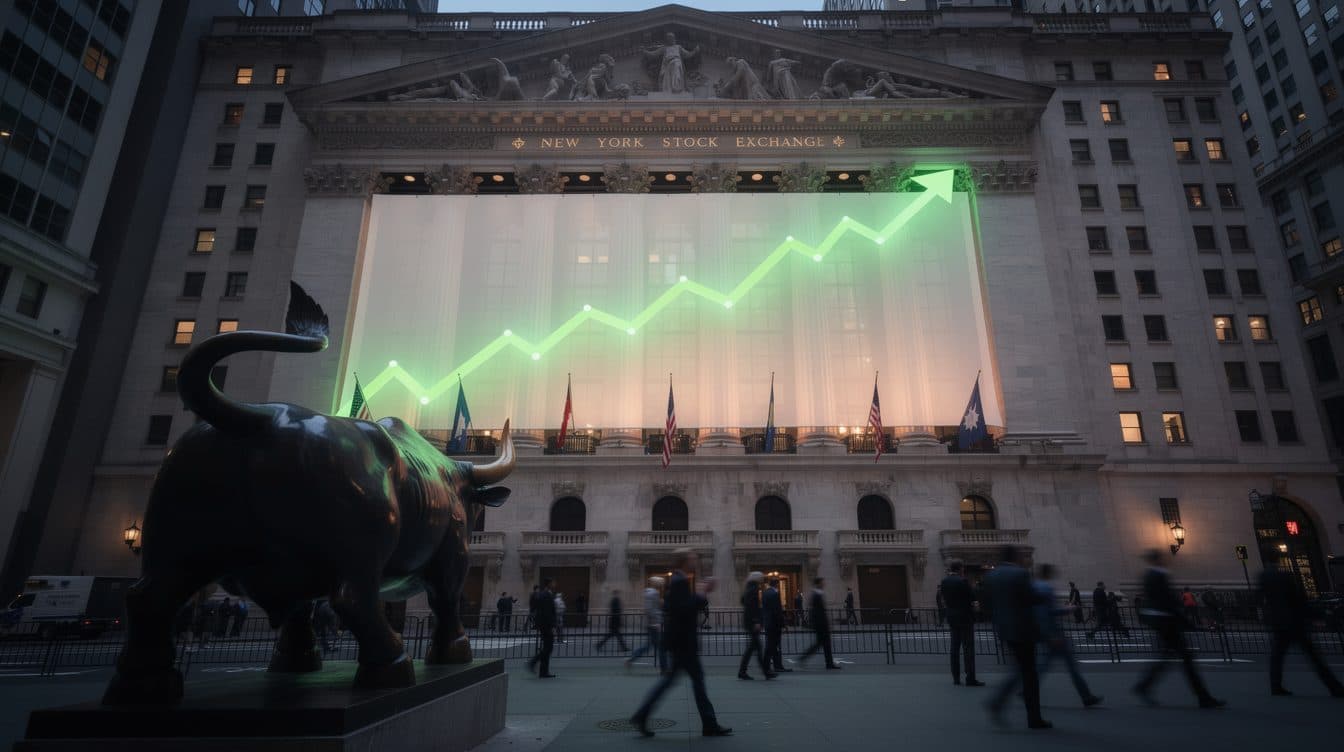
AI-generated image (flux-2/pro-text-to-image via Kie.ai)
Summary
SpaceX made its debut on the New York Nasdaq on Friday, raising some 75 billion dollars in the largest initial public offering in history. The operation propels Elon Musk beyond the symbolic threshold of a trillion dollars in personal fortune.
Elon Musk's space company SpaceX completed its initial public offering on the Nasdaq in New York on Friday, June 12, 2026, raising approximately 75 billion dollars through the sale of roughly 555.6 million shares at a unit price of 135 dollars, becoming the most highly valued company at its debut in the history of financial markets.
An IPO that breaks all records
The operation, which constitutes the largest initial public offering ever carried out, far surpasses the previous record set in 2019 by the Saudi oil giant Aramco, which had raised about 29 billion dollars. The issue price of 135 dollars had been set in advance by SpaceX itself, without going through the traditional indicative range, which constitutes a notable exception in the practice of financial markets. "Anders als bei vielen anderen Börsengängen legte SpaceX den Ausgabepreis von 135 Dollar vorab selbst fest. Üblicherweise nennen Unternehmen zunächst eine Spanne – und ermitteln den Preis dann basierend auf dem Interesse der Investoren", it is recalled in the German financial press.
At the opening, the stock jumped by nearly 30% to reach 174 dollars, before pulling back slightly. According to market data, the share then traded during the session around 161 dollars, lifting SpaceX's market capitalization well beyond two trillion dollars. The offering was oversubscribed multiple times, with total investor demand exceeding 250 billion dollars for a targeted offer of 75 billion. In New York, about a hundred people had gathered in Times Square to follow the event, some dressed as astronauts.
Elon Musk becomes the first trillionaire in history
With a targeted valuation of approximately 1.77 to 1.8 trillion dollars at its debut, SpaceX immediately ranks among the most highly valued American companies, behind Nvidia, Apple, Alphabet, Microsoft and Amazon, but ahead of Meta. The group far surpasses the market valuation of the electric vehicle manufacturer Tesla, also led by Musk. SpaceX thus became the seventh most highly valued listed company in the United States on its first day of trading.
Elon Musk, founder and CEO of SpaceX, holds approximately 40% of the company's capital and retains full control thanks to multiple voting shares. "Musk wird mit einem Stimmrechtsanteil von mehr als 80 Prozent auch nach dem Börsengang die volle Kontrolle über SpaceX behalten", can be read in the specialized press. According to some estimates, his stake in SpaceX now exceeds 800 billion dollars at current prices. Combined with his stake in Tesla, his total fortune exceeds the symbolic threshold of one trillion dollars, making him the first human being to reach this level of wealth, mainly on paper. Forbes estimates his assets at some 1.1 trillion dollars.
An extraordinary financial structure and valuation
The amount raised, although a record, represents only about 4% of the company's total capital, which corresponds to an extremely small free float compared to market standards. The offering nevertheless reserved an unusually large share for individual investors: about one-fifth of the 555.6 million shares put on sale were intended for them, compared to a usual share of 5 to 7%. According to Bloomberg, these individual investors placed orders representing more than 100 billion dollars, far more than the offer reserved for them. Hundreds of thousands of individual investors took part in the operation, and the New York Times calculated that approximately 4,400 SpaceX employees could become millionaires thanks to this IPO.
This IPO presents remarkable financial characteristics that raise questions. SpaceX reports annual revenue of approximately 18.7 billion dollars, but recorded a net loss of approximately 4.9 billion dollars last year, and a deficit of 4.28 billion dollars in the first quarter of the current fiscal year, largely due to massive investments in its artificial intelligence division and in the Starship program. The implied price-to-sales ratio exceeds 94, compared to about 18 for Nvidia, 10 for Apple and about 7 for the Nasdaq 100 as a whole. Morningstar analysts calculated a valuation of 780 billion dollars, less than half of the targeted market valuation.
The SpaceX group consists of three divisions with very different profiles: the traditional space business, Starlink satellite internet, and artificial intelligence. Starlink is by far the main economic engine, having generated approximately 11 billion dollars in revenue last year, or about 60% of consolidated revenues, and an operating profit of 4.4 billion dollars. The service has more than 10 million customers in 164 countries and operates more than 9,600 satellites in orbit. Launched as a secondary SpaceX project, Starlink is now described as the fastest-growing telecommunications operator in the world.
Three divisions, a business model under construction
The recent integration of xAI, the artificial intelligence company founded by Musk in 2023, further expands the scope of the listed group. This division now encompasses the Grok chatbot, the social network X (formerly Twitter, bought by Musk in 2022 and renamed since) and data center infrastructure. The IPO prospectus notably mentions the potential market for satellite connectivity, valued at 1.6 trillion dollars for all providers, and the overall artificial intelligence market, including infrastructure, which SpaceX estimates at more than 26 trillion dollars.
The Starship program, in which SpaceX has invested more than 15 billion dollars in total, should eventually make it possible to transport satellites and carry out commercial flights. The company plans to use Starship to put into orbit next-generation Starlink satellites enabling direct connection between smartphones and the space network. The long-term stated objective remains the colonization of Mars, a project described as "Wahnvorstellung" (delusion) by some experts, but defended by Musk who, at his stock market debut, recalled having initially assigned SpaceX only a 10% chance of success at its founding.
Experts divided between enthusiasm and skepticism
Comments from analysts and financial experts oscillate between enthusiasm and caution in the face of this extraordinary operation. Stephan Kemper, chief strategist at BNP Paribas Wealth Management, described the valuation as "sehr ambitioniert" (very ambitious) and warned that current shareholders could sell a significant portion of their shares in the next six months, exerting lasting pressure on the price. Economist Georg von Wallwitz, of the firm Eyb & Wallwitz, estimated that the current "Goldgräberstimmung" (gold rush) recalled the bursting of the dotcom bubble of the late 1990s. New York finance professor Aswath Damodaran criticized the 26,000 billion dollar estimate of the AI market, declaring on CNBC that upon reading this figure, he thought Musk's Grok chatbot had written the prospectus, "weil wir wissen, dass KI zu Halluzinationen neigt".
The Interessenverband für Anleger (IVA), the Austrian investor protection association, warned potential buyers. Its spokesperson Florian Beckermann declared: "Gerade unerfahrene Anleger laufen hier Gefahr, nahe eines Markthochs einzusteigen und anschließend erhebliche Verluste zu erleiden" and warned that "Medienhype, Prominentenstatus und die Faszination für die Raumfahrt könnten zu einer Überbewertung der Aktie und in Folge zu einer Bruchlandung im Depot führen". The IVA recalled that the space sector remains a "Hochrisikogeschäft" (high-risk activity) dependent on technology, regulation, accidents, geopolitics and the evolution of government contracts. It also stressed that since the prospectus is not approved in Austria, Austrian investors had to use brokers from third countries, which can lead to additional costs.
A strategic player at the heart of geopolitical rivalries
The strategic importance of SpaceX for the United States reinforces the geopolitical sensitivity of the company. Since the end of the space shuttle program, SpaceX has become practically indispensable to NASA and the Department of Defense. In the United States, the company now represents 94% of the mass put into orbit, and was responsible for more than half of rocket launches in the world in 2025. SpaceX also provides military communications to the United States and its allies, making it a central player in the technological and space competition with China.
The question of the legal framework surrounding private space activities arises with new acuity. The 1967 Outer Space Treaty, which stipulates that space must be used "zum Wohle … der gesamten Menschheit" (for the benefit of all humanity) and that it cannot be subject to national appropriation, contains no enforcement mechanism. The United States partly filled this void through the 2020 Artemis Accords, which provide that the exploitation of resources does not constitute an "appropriation". The 1967 treaty nevertheless remains the reference framework, but its effective implementation in a context of increasing privatization of space remains uncertain.
Expected consequences on global markets and finance
The technical and economic conditions of the IPO were adapted accordingly. The index providers Nasdaq and FTSE Russell modified their rules in the short term to allow the rapid inclusion of SpaceX shares in their main indices, while MSCI invoked in May rules introduced in 2007 for large IPOs. S&P Dow Jones however maintained its rule requiring twelve months of trading before a stock can join the S&P 500. In addition, SpaceX offered its existing shareholders the possibility of selling their shares well before the expiration of the usual one-year lock-up period, which could trigger a wave of sales from the end of August. The proceeds of the IPO, which will be paid
SpaceX IPO record: Musk first trillionaire | allfacts360