SpaceX scrubs Starship test flight at the last second; payload question resurfaces
Starbase, Texas, 17 July 2026
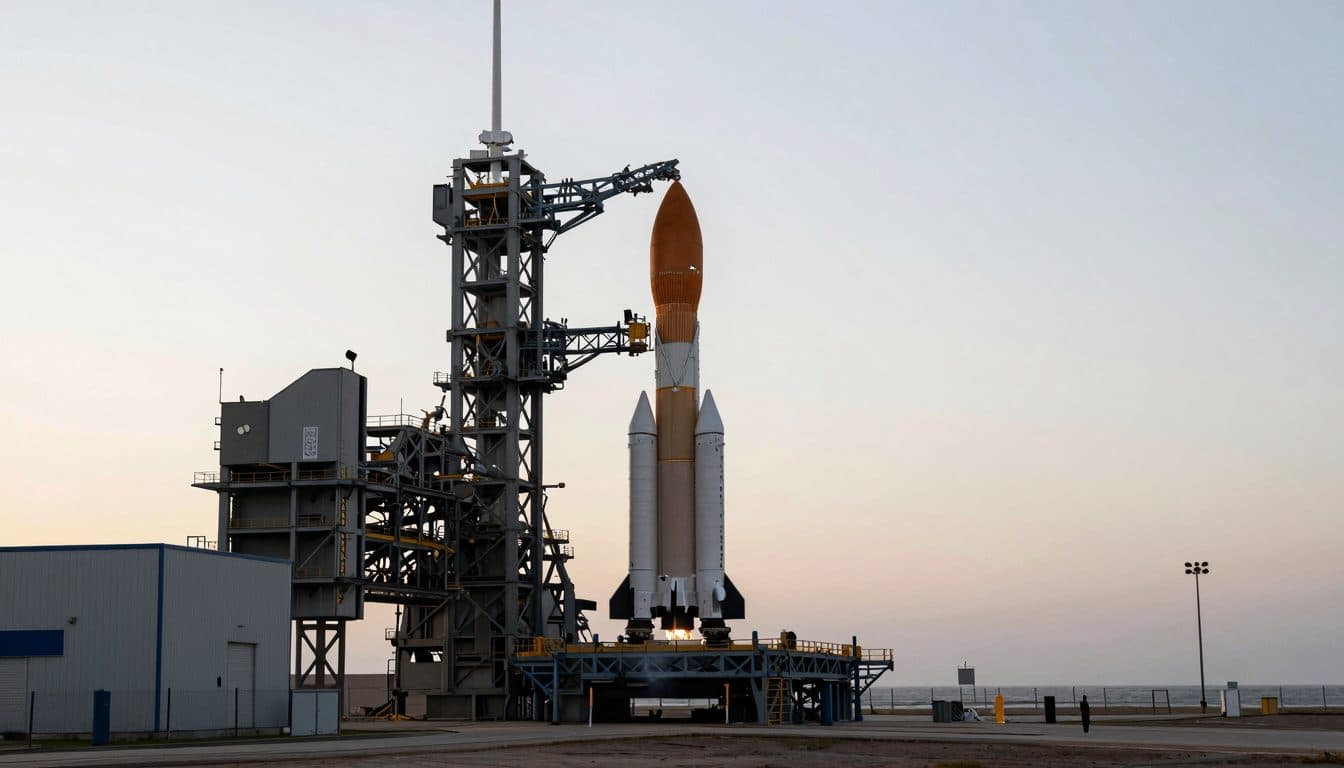
AI-generated image (z-image via Kie.ai)
Summary
SpaceX aborted a Starship test flight at the last second on Thursday after several of the booster's 33 engines failed to ignite, according to Elon Musk. The scrub is the first Starship test since SpaceX's listing and revives doubts about the vehicle's promised 100-tonne payload capacity, demonstrated at only 37.5 tonnes in its latest flight.
Starbase, Texas, 17 July 2026
SpaceX aborted a Starship test flight at the last second on 17 July 2026 after several of the Super Heavy booster's 33 engines failed to ignite, postponing the 13th integrated test of the largest rocket system ever built.
What happened on the pad
The countdown was halted automatically when a subset of the engines did not come up to pressure, Elon Musk, wrote on his social network X. "Einige der Triebwerke haben nicht gezündet, was einen automatischen Abbruch des Starts ausgelöst hat", he said, adding that two engines would need to be swapped before another attempt. "Der nächste Startversuch wird hoffentlich in ein paar Tagen stattfinden."
It was the first time the "Version 3" variant of the vehicle had rolled to a launch pad, and the first Starship test conducted since SpaceX began trading publicly. Two raptor-engine issues, Musk said, made a same-day recycle impossible. The company is now targeting the next attempt "early next week."
The Starship stack stands about 124 metres tall, made up of the roughly 70-metre Super Heavy booster and a near 50-metre upper stage also called Starship. It is the tallest and most powerful rocket system ever constructed and is central to SpaceX's plans to reach the Moon and, eventually, Mars. NASA intends to use a derivative of the vehicle to land astronauts on the lunar surface as part of its Artemis program.
Flight profile and what was supposed to happen
The flight was intended to repeat a sub-orbital trajectory over the Gulf of Mexico, with a booster splashdown and a controlled upper-stage re-entry into the Indian Ocean. Between those two milestones, SpaceX had planned to release a batch of third-generation Starlink satellites, the first deployment of the upgraded internet relay nodes from Starship. That task will now be pushed to the next mission.
The 12 previous Starship test flights have produced a steady drumbeat of explosions, partial successes and incremental recoveries. The very first, in April 2023, lifted off from Starbase in Texas and remained intact for only a few minutes before the vehicle was lost. Subsequent flights pushed the booster catch technique, refined the upper-stage re-entry profile and demonstrated in-space engine relights, but each test also exposed new failure modes that SpaceX has had to work through.
The 100-tonne promise and the 37.5-tonne reality
Against that record, investors are weighing the gap between marketing claims and demonstrated performance. According to SpaceX's 2022 prospectus, the vehicle was designed to deliver 100 tonnes of payload to low Earth orbit and as much as 150 tonnes in the lower orbits used for Starlink deployments. A tanker variant was even projected to transfer 200 tonnes of propellant in orbit. The numbers for the smaller Falcon 1 and Falcon 9 rockets are well documented, but SpaceX has not published comparable mass, thrust or specific-impulse figures for the current Starship design beyond early concept presentations from 2016, when the rocket was still called BFR, or Big Falcon Rocket.
A SpaceX technical document published with the most recent flight has, for the first time, put a real number on what the vehicle has actually carried. The Version 3 upper stage flew with a 37.5-tonne test payload, a figure that sharply undercuts the 100-tonne promise and has sharpened analyst scrutiny of the rocket's economics. Version 3 was not expected to reach orbit and showed no significant performance reserves, a reminder that the headline figure remains aspirational rather than achieved.
Stock reaction and analyst views
The scrub is feeding directly into SpaceX's market story. On Thursday the company's share price closed below its $135 IPO offer price for the first time, then slid further after hours to roughly $126, a decline of more than 3 percent on the day. In market-capitalisation terms SpaceX, briefly the fifth-most-valuable listed company in the world, has dropped to eighth place and now sits only narrowly above Saudi oil producer Saudi Aramco.
Analyst sentiment around the stock has been split. Deutsche Bank, UBS and JPMorgan all carry Buy or Overweight ratings, while Bernstein rates the shares Outperform. Other commentators have warned of a possible bubble in robotics and space equities, a debate the scrub is unlikely to cool. ARK Invest, meanwhile, increased exposure to the stock this week, a counterweight to the more cautious voices on Wall Street.
What the next attempt means for NASA and Mars
Beyond finance, the timeline for NASA's Artemis lunar program remains exposed. The agency has contracted a Starship-derived lander to carry astronauts from lunar orbit down to the surface and back. Every Starship test flight is, in effect, also a step — or a stumble — on that road. The next attempt will be closely watched not only for engine performance but for the pace at which SpaceX can convert its flight cadence into the reliability a crewed lander demands.
For now, the immediate question is procedural: which engines failed, why, and whether the issue is a quality-control problem limited to two units or a systemic concern across the Raptor production line. SpaceX's pattern has been to publish post-flight summaries within days of each attempt, and the next test window will hinge on what those reviews show. Until then, Version 3's credentials as a step toward 100-tonne payloads remain unproven, and the stock's wobble suggests investors are taking note.
The wider context is that SpaceX is no longer a private company whose test failures can be absorbed in silence. With public-market scrutiny now part of every flight, the gap between the 100-tonne number in the 2022 prospectus and the 37.5-tonne number on the latest manifest is exactly the kind of detail short sellers, regulators and retail investors will continue to compare. The next attempt, "hopefully in a few days," will be read as much for what it carries as for how high it flies.
Questions & Answers
Why was the Starship test flight on 17 July 2026 aborted?
According to Elon Musk, several of the Super Heavy booster's 33 engines failed to ignite, triggering an automatic abort. Two engines will need to be replaced before another attempt can be made.
How much payload has Starship actually carried compared with the 100-tonne target?
SpaceX's 2022 prospectus described a 100-tonne payload to low Earth orbit, but a technical document released with the latest flight shows the Version 3 upper stage was loaded with only 37.5 tonnes of test payload.
What happens to SpaceX's stock and NASA plans after the scrub?
The shares closed below their $135 IPO price for the first time and slid to about $126 after hours, while NASA's plan to use a Starship-derived lander for Artemis Moon missions remains tied to the vehicle's test cadence.
SpaceX Starship test scrubbed; payload gap in focus | allfacts360